

The dwindling importance of unions

by Russ Roberts on September 12, 2007

in Work

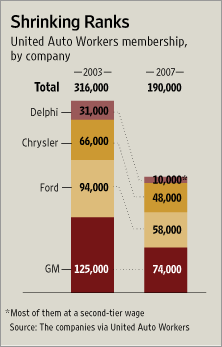
Here’s the stat of the week (from this WSJ article on the auto industry): UAW membership is only 190,000 workers. That’s a typical number of net jobs created for the economy. The chart shows the change since 2003. It’s a dramatic decrease. But the really interesting number is 1979. In 1979 there were 1.5 MILLION UAW members. What an economic transformation, driven by productivity and Japanese competition.

P1ai965a_uaw_20070910191837

Comments    Share Share    Print Print    Email Email

  • Tom

    I wonder if that 190k pops right back up to 1.5 mil when you add back the retirees still on benefits?

  • And that is why unions are diminishing outside of the public sector. In many ways, unions are the victims of their own earlier success. They were able to get businesses to behave in ways that were ultimately counterproductive. The businesses eventually suffered, which in turn caused union membership to suffer.

  • Eric

    I have no problems with unions as long as the following hold true:


    - They are completely voluntary organizations


    - Unions do not have the coercive power of government behind them (meaning that an employer can simply choose to fire unionized members)


    Of course, unions probably wouldn't exist under these conditions (except in the public sector, where incentives differ dramatically).

  • MH

    The same union tried to organize NYU grad students. Being in NYC, they actually managed to get the votes, but the union promised not to interfere with the actual management of the school (assigning students, etc.), a promised they failed to live up to. Their interference destroyed the trust between our ultra-liberal administration to the point that the administration successfully litigated to get the union kicked off campus. The UAW promptly went after the part-time professors. Again, this is NYC, so they won that vote, too. They're like roaches. Hopefully, the teachers, despite their knee-jerk liberalism, will soon be wondering what their dues are really going for, and we can get rid of this parasite, too.

  • What I find most striking is that the UAW has pushed really hard to expand its membership in any way that it can. For example, they tried to convince me that I was oppressed as a graduate student at Cornell (where tuition was covered, health care was virtually free, I received a healthy stipend, and got to live in Ithaca), but their unionization push ultimately failed.


    I am all in favor of workers organizing if they so choose to, but from living through that union drive it was clear that this was not the case. There were very very few students at Cornell who would have even imagined that they should organize. And even after months of propoganda from the UAW organizers, the vote still went down miserably. This tells me the UAW is not really interested in representing workers who wish to organize, but rather (and not surprisingly) that they are merely interested in securing the comfort of their leadership people and their organizers at the expense of everybody else.


    Russ, clearly what these data are telling us is that American corporations are becoming more powerful and more successful at exploiting workers, no?

  • Jim

    I guess I know why the UAW pushed to get the Atlantic City casino workers into the union.


    http://money.cnn.com/2007/09/11/news/uaw_casinos.fortune/?postversion=2007091205

  • Flash Gordon

    This is a welcome circumstance. Unfortunately, the government workers unions may be taking up the slack. At least the industrial unions had some members that didn't vote for Democrats. The government unions are solid Democrat, probably to the last man and woman because they see bigger government to be in their interest.

blog comments powered by Disqus

Previous post:

Next post:
