

Last week’s EconTalk episode was with Robert Shiller. He argues that the run-up in housing prices beginning in 1997 was irrational exuberance, a bubble, bound to pop, caused by social contagion:
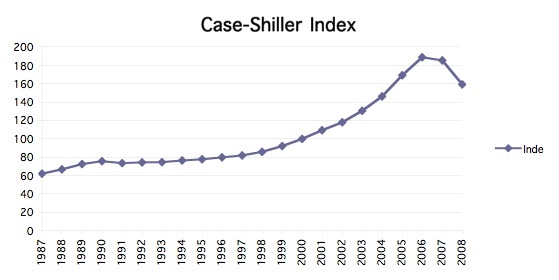
I wish I’d asked him about all the stuff I’ve since learned about–the incredible increase in government intervention, during both the Clinton and Bush administrations to increase home ownership among low-income buyers and raise the overall rate of home ownership.
As this post points out, it may have begun in earnest in 1997 with Andrew Cuomo, at the time the head of HUD, encouraging the GSEs to become more active in the subprime market. Is that causation or just correlation for the graph? I am looking forward to reading and learning more this week.



Podcast RSS Feed
Full EconTalk Text


{ 8 comments }
Assuming that there's an exact correlation between the stock market and housing bubbles, if Cuomo's "encouragement" began in April 1997, there might be something there.
More likely though is that it's coincidental. Properly visualized, with Shiller's housing price index plotted against rents, we see that a linear relationship defines order in housing market. A bubble is evident when housing prices begin following an exponential trajectory while the growth rate of rents remains linear. In 1997, the linear slope changed from a less steep level to a steeper value, coinciding with the bubble developing in the stock market.
You would expect that if earnings in the stock market were being cashed in and converted into housing.
The bubble in the housing market didn't begin until the 2000s, as housing prices began following exponential growth while rents continued growing at linear rates.
Russ, wouldn't this be a good time to learn more about the work which led Hayek come up with all of the great "Hayekian" insights into the functioning of the economy you bring up time and again on your podcast — i.e. Hayek's work on systematic misallocations of goods and resources caused by false price signals in the market for credit, money, and time consuming production goods?
Hayek discovered the whole insight into the "price signaling" function of prices by looking at the monetary and credit causes of the trade cycle embodied through the time structure of the capital goods using production economy.
A good part of what drove Hayek to see this "price signaling" function was the necessary ABSENCE by assumption of this function within the macroeconomic constructions of Keynes and the "Keynesians". (Hayek also saw the same thing in the constructions of the socialist economists, and in the constructions of many of the "economics as mathematics" modelers.)
If you don't get Hayek's micro/agent-based macroeconomics you really don't get the core of Hayek's insight into "price signals" and the coordinating operations of the economy.
Hayek's work explains how interest rates set below the nature rate distorts allocation of money and resources in the economy across the time structure of production and consumption, creating a temporary "boom" and leading to an inevitable financial bust.
I might in particular recommend the very well written articles and books by Roger Garrison, of Auburn University, many of which are available on his web site.
I forgot to say the obvious:
From the perspective of Hayek's economics, the cheap money policies of Greenspan and the Fed were an ultimate cause of the current boom and financial bust cycle — fueling the housing bubble and the subprime lending disaster.
Russ,
Shiller, and most economists ignore one major change that directly impacted housing. The taxation of gains on single family homes was dramatically reduced (effectively eliminated) beginning in 1997. Prior to 1997, a homeowner had to invest at least his proceeds into a new home for the sale to be tax exempt. Beginning in 1997, every homeowner who qualified for residency (2 years out of 5) could exempt $250k of gains ($500k if married filing jointly). This change eliminated taxation of gains on housing for nearly all homeowners.
You know very well, if you tax something less, its value will rise.
Those who cry "bubble" are the ones who simply cannot explain what seems like irrational behavior on the part of investors. In this case, the rapid rise in housing was rational and predictable.
So now explain the rapid fall.
With the economy growing nicely, virtually full employment, and housing in a long upward move, life seemed too good to be true in 2004. The Keynesians at the Fed looked at this impressive growth and decided they had to do something. In their worldview growth = inflation. So despite stable gold and low inflation, the Fed began a massive rate hike campaign in order to curb growth. They raised the FFR from 1% to 5.25% between June 2004 and June 2006. While the Fed Funds Rate has little impact on mortgage rates, it does directly impact HELOCS and credit card debt, two key sources of financing for entrepreneurs and small business owners. The Fed didn't just slow growth, they crushed it because their interest rate mechanism is outdated. With growth slowing, the economy was demanding less dollars, but the Fed did not slow the supply. Folks think a higher FFR reduces liquidity but there is not direct link. So gold and then other commodities and then most consumer prices began to rise rapidly. The inflation then starts to eat at the original source of the housing boom. Inflation directly reduces the after-tax return on investment because there is no index for inflation with capital gains (housing or investment). So with higher costs, slowing growth, and lower real returns, the party came to an end.
Thank you Federal Reserve.
John McCain just said this past weekend that he would appoint Andrew Cuomo as head of the SEC because he was so impressed with him.
I've been trying to understand how much of the blame for this financial debacle should be laid at the feet of the Fed. It turns out that, ” The Federal Reserve ceased publishing M3 statistics in March 2006" (http://en.wikipedia.org/wiki/Money_supply) which has been criticized by Ron Paul ("M3 is the best description of how quickly the Fed is creating new money and credit. Common sense tells us that a government central bank creating new money out of thin air depreciates the value of each dollar in circulation.",ibid).
Here is an amazing figure when coupled with the above fact:
http://en.wikipedia.org/wiki/Image:Components_of_the_United_States_money_supply2.svg
Notice the rapid rate of the growth of M3 since 1995. It certainly raises a red flag to a non-expert like myself when I learned that the Fed will no longer publish M3.