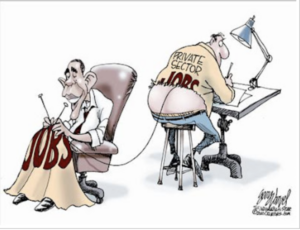
Crowding out

by Russ Roberts on February 22, 2010

in Stimulus

Cartoon by Gary Varvel. (HT: The New Seditionists)

View Comments    Share Share    Print Print    Email Email

  • Juan
    C'mon Russ, be serious. You can't possibly post that cartoon and beleive the idea behind it. After it has been so thoroughly discredited. Since the 1920s!!

    Brad DeLong, once again, explains why its wrong. http://delong.typepad.com/sdj/2010/02/yep-chica...
    please tell me what exactly is the mistake in wicksell's, fisher's, and friedman's theory
    here is menzie chinn's analysis of crowding out. http://www.econbrowser.com/archives/2010/02/in_.... it does not find any.
    as to the argument that spending crowds out future jobs, the counterargument is that they are uncertain. you can´t be sure that they will in fact be created. you don´t know for sure what will happen. keynes´argument, based on GE Moore's ethics (and his own theory of probability) was that it is unacceptabe to trade the certainty of improvement in the present or immediate future for better times in a hypothetical future.

    after all the explanations and analysis, you can´t still seriously be sticking to your argument. crowding out is just not there.
    ...........even schwarzenegger conceded.....
  • Russ, that is about the funniest cartoon I have seen in a month. Thanks.

    Terry
  • greego
    Here's a real-world example of the perils of federal-level fiscal stimulation from my home country.

    The Australian government decided to heavily subsidise roof insulation as an economic stimulant, and to appease the greenies. Win-win! Except that shonky dealers have come in to claim the subsidy (who'd've thunk it?), at least 1000 houses are electrified due to the wrong material being used, nearly 100 houses have caught fire and 4 people have died. The minister primarily responsible is ex-Midnight Oil singer Peter Garrett, if anyone remembers that band from the 80s.

    And now the industry is in disarray as the subsidy is unwound through political pressure:

    http://www.smh.com.au/national/hundreds-of-insu...

    Fiscal stimulus FTW!
  • mordy
    Its 1/2 right.....where are the Republicans and Sen. Brown with their new Jobs (killer) bill!!!

    http://autonomyandpolitics.blogspot.com/
  • muirgeo
    Evidence???? Any? Even a single shread?


    I didn't think so but it sounds real good.
  • lee_kelly
    You should have said: "even a single thread."

    Oh, and use less question marks. And cartoons like this don't sound good.
  • muirgeo
    Yeah sure thanks.... Evidence?
  • lee_kelly
    Evidence of what? That you should use less question marks?
  • haywoodJ
    i didnt read all the responses, but it seems to me that to be totally accurate, obamas knit would be completely loose making almost see through and 4 times the size and the font of the word jobs would be like .5 pt?
  • Juan
    bravo lee_kelly!! you arethoughtful and wise.

    "But wouldn't it be more accurate to have a small pile of fabric sitting in the corner than private industry is currently not employing? Perhaps Obama should be knitting his shirt by taking from a little material from the private sector and a lot from the unused pile. In that case, it may be better to have a shoddy piece of clothing that uses some of the unemployed resources than simply leaving them in a pile in the corner."

    certainly wiser than many other commentators here who apparently have their heads comfortably inside an austrian hole
  • lee_kelly
    Juan,

    I thank you for the compliment, though please understand that I am, to some extent, playing devils advocate. My positions on various economic, social, and political issues have much more in common with the Austrian commenters here than almost anyone else. Moreover, no matter how thoughtful and wise I seem to you in the preceding posts, on the journey to my current views I also spent some time in that "Austrian hole." Honest, wise, and thoughtful people can hold opposing views on all manner of topics, especially economics and politics.
  • lee_kelly
    Another though just occured to me that is pertinent to this discussion while posting on the Coordination Problem blog. I'll just copy-paste it here:

    Though it occurs to me now that high unemployment may be preferable to a government jobs program that directs resources toward destructive ends--like particular ongoing wars. In many ways, the U.S. Military is being run as the worst kind of jobs program; not only does it not direct resources to the highest value, but we would all probably be better off if its resources were left in warehouses to gather cobwebs.
  • Ryan Vann
    Excellent symbolism being used in this cartoon. Anyway, Lee Kelly and Daniel both brought up useful criticisms of the crowding out argument, although I think there may be some confusion clouds that need to be burned off.

    To begin, I know Daniel was being a bit flippant, but it is important to destinguish a positive sum view of trade vs a zero or negative sum of government intervention. Trade is thought to be positive sum because the two participants in the trade receive surplus value. We know this almost tautologically because nobody would freely trade for something if they did not value it more than what they gave up (sure there could be some indfferent exchanges).

    Government intervention is often said to be zero or negative sum because it takes money in the form of taxes from an individual and returns dubious services as a result. Because exchange is not freely entered into, it is hard to determine what the net result is. I personally don't like this explanation, because it seems to assume a hard currency system, whereby the only way for the government to acquire money is to tax.

    Since we operate under a fiat currency, I think we need to look more at real inputs, and whether the government sector is consuming enough real goods and capital to displace market productivity. Looking at Gov Spend/GDP ratio and growth rates, it is kind of hard to come to a conclusion because both have been relatively stable, and haven't moved much (I don't have access to SPSS or anything like that right now, and can't run a quick regression to get an idea). This of course has changed recently, and it will be interesting to see if G/GDP ratios will be maintained at current levels, and what the impact will be on GDP growth.

    I'm very sympathetic to Lee's arguments about under utilization of labor and capital under a recession, and wouldn't argue that the government can make a difference in the short term.
  • danielkuehn
    Haha - no actually I wasn't being flippant at all. If I honestly believed that fiscal stimulus was zero-sum - if I had a zero-sum perspective on economic questions in general - how could I justify advocating fiscal stimulus the way I do?

    Your regression will suffer from massive endogeneity problems. If fiscal stimulus is considered to be justified precisely when growth rates are in the tubes, simply regressing one on the other is obviously going to make stimulus look bad. But you're confusing correlation and causation. It's not to say it can't be done - but proper identification of these models is very hard. Even if we did have a reputable way to satisfy concerns about endogeneity, the conditions for a strong fiscal stimulus are relatively rare (thankfully).
  • Ryan Vann
    Daniel, you are the one who is confused.

    If fiscal stimulus is most potent precisely in times of down trending growth rates, the second derivative (aka rate of change of the rates of change) would be more acute when doing a regression. The net positive or negative argument is irrelevant.
  • danielkuehn
    No, just think about what a scatter plot would look like - growth rates would be low when G/GDP would be high. When growth rates are high, G/GDP would be lower. It's implicit simply with constant government spending - the relationship will grow even stronger with procyclical spending. You need to identify an appropriate counterfactual of what growth would look like without government spending - which means removing the endogeneity inherent in pro-cyclical fiscal policy.

    I'd also note that it's not just about spending. It's about deficit spending. Same endogeneity concern applies to that, though.
  • Ryan Vann
    No, you still don't seem to get what I'm saying here, which is basically use a VAR approach to the regression. Is this perfect, no, but if the assertion that G is most potent when GDP is in decline, a VAR regression would certainly pick this up.
  • danielkuehn
    It's been a while since I've actually run a VAR, but it's news to me if the exogeneity assumptions aren't still a concern for these models. Why do you think Barro has been making such a fuss about his defense-spending models? He needs exogenous government spending - that's why.

    Look, if it were as easy as regressing government spending on GDP growth, do you really think there would be so much disagreement? Unless I'm still misunderstanding something, in which case I'm happy to hear what that is.
  • Ryan Vann
    Still don't see what the problem is, you can specify exogeneity restrictions in a VAR. Point is the trend is less likely to bias coefficients if you use var or even a double exponential smoothing model. You can always fall back on quibbles about exogeneity, but it doesn't mean we shouldn't run some regressions (there is a dearth of regressions of fiscal stimulus in my opinion).
  • lee_kelly
    The government crowds out private sector jobs all of the time, but given the economy's short rate of expenditure and income, surely the crowding out effect is going to be more reduced now than it would normally, right? This cartoon, while accurately describing the consequence of government's ordinary endevours, seems to be less appropriate at this particular time than ever.
  • lee_kelly
    To avoid misunderstanding, let me add that I do not support the U.S. Government's recent fiscal stimulus or jobs bill proposals. My point is merely that the crowding out effect of government spending will surely be less at the present time than with an equivalent amount of spending during ordinary times.
  • greego
    You could also hold the view that a time of 'recalculation' (to use Kling's term) then it's even more important for the government to not compete for scarce credit and resources or to start unsustainable programmes that create uncertainty and further recalculation at a later date when they are modified or scrapped.
  • lee_kelly
    I do hold the view that we are in a time of recalculation. However, the recalculation will be unnecessarily prolonged--and complicated with political upheaval--while problems with the money supply exist. In any case, the recalculation is about the redeployment of resources fo alternative uses, and being a pile of fabric in the corner is not an alternative use--it is a non-use. In the ideal, a fiscal stimulus could deploy these resources to some use (even if it not its best use), and then unwind in good time to allow private industry to do its recalculating. Of course, the unrealistic nature of this ideal is one of the reasons why I do not support a fiscal stimulus, but my point that the crowding out effect would seem to be lessened at present still stands.
  • theorlonater
    Bingo.
  • lee_kelly
    I said that being a pile of fabric in the corner is a non-use. Of course, this is ignoring the reality of politics, where the unemployed resources may be very useful to particular political interests. We shouldn't forget that in our analyses of "the" economy.
  • Methinks1776
    When the government continues to extend unemployment benefits (paid for by employers and decreasing the amount available to pay new employees), why would people look for a job?
  • lee_kelly
    While unemployment benefits do lessen, and for some people compensate entirely, the cost of being unemployed, there are still significant benefits to being employed that most people have an incentive to pursue. It is a problem, but do you eliminate government distributed unemployment benefits completely? If that is a possible long term goal, it is one that could only be humanely achieved by incremental steps.
  • Methinks1776
    Lee, over the past year or so, congress has dramatically extended unemployment benefits. Who do you suppose pays for it? Labour. Businesses shed employees when they're struggling - the last thing they can afford is an increase in unemployment insurance premiums and the last thing more generous unemployment benefits do is encourage hiring. As you know, there is no free lunch.

    The benefits (and pain) may be government distributed, but it is paid for by the very people supposedly receiving the the "benefits". I won't even bother bringing up examples of how unemployment is abused and how more generous unemployment benefits lead to more incentive for fraud. But even if you argue that eliminating unemployment is a long term goal, what reasonable argument can you put forth in favour of INCREASING said benefits at a time when government's stated goal is to increase employment?
  • lee_kelly
    Methinks,

    I don't like the government distributing unemployment benefits; it would be infinitely preferable for private charities to perform that service. I would like to see government distributed unemployment benefit abolished entirely, though in the case that private charity fails to fill the gap, perhaps a reasonable case can be made for some very basic role for government. In any case, I am not sure what you expect me to disagree with--with regard to the proper role of government, we are in almost complete agreement.
  • Methinks1776
    Lee, I don't even think it's an issue of charity. Employers pay into the unemployment insurance pool for every employee. If the employer's ex-employees claim unemployment, the employer's premium increases. One of the common frauds is employees who were not laid off but fired for cause (even theft) who are able to collect unemployment despite expensive appeals by the former employer. This costs labour. If the employer were not forced to pay into this diseased system, labour would receive the difference and employees would have more to save for a "rainy day" - a concept that has virtually disappeared in America. I don't think we necessarily disagree. To me, you seem to be conflating unemployment and other welfare. I think there's a stronger case for government involvement in redistributing some wealth to the indigent (which, of course, never stops with the indigent...but, that's another story).
  • snargles
    let's keep in mind that resources are scarce and they are represented in the form of money. money doesn't hold value per se, but the perception of what it's purchasing power is makes it a desireable commodity. allowing government to purchase resources (supposedly unused, but what's that a metaphor or something? recalculation? unused pile? what?) to expand it's budget will most necessarily drive private competition away, especially the laws and demands they will place on companies that they are trying to directly compete with (toyota, anyone?). Furthermore, since government is printing it's own money to buy these 'unused resources' it really doesn't have a justifiable claim to them other than fraud or counterfeit if you prefer. So if you think the captain of the economy should have a gangster mentality, and even more ridiculously you think that the economy should have a captain, then I suppose you can see comments 1-15 above in order to find the right balderdash to describe where you're coming from. As for me, I'll take my studies of Hayek a little bit more seriously. thanks <3 snargles
  • Methinks1776
    Are you sure you meant to respond to me? I'm not in favour of any government meddling in the economy (or much of anything else, for that matter) at all.
  • snargles
    No, not you, not anyone in particular, just those in this thread that expose themselves as economic illiterates by espousing false wisdom through proclaiming meaining in general aggregate measures, the epistemological error of course in trying to measure growth of an entire economy and show proof that it's zero sum, negative sum, positive sum. It's fallacy, it's government intervention; it's a broken window. A growth in GDP or any aggregate measure neither proves or disproves whether an economic policy measure is beneficial. In general, measures that enhance economic freedom will over time lead to prosperity, not in GDP mind you, but for the individuals that benefit from them.
  • danielkuehn
    The point, though, is that credit and resources aren't scarce. That's the crux of the stimulus argument. If it were, of course everyone would be in agreement that it's a bad idea (at least on macroeconomic merits... you could still advocate some of this stuff as legitimate public goods - just not on a hundred billion dollar scale).
  • theorlonater
    Everything is scarce, prices reflect the relative level of scarcity not some arbitrary definition of scarcity when it reaches a certain percentage.
  • lee_kelly
    Prices ordinarily reflect the relative level of scarcity. However, if money itself becomes scarcer (either because less is supplied or more is demanded), then, holding all else equal, the price of money denominated as every other good must increase. But relative price adjustments take time, and until then money prices will be sending the signal that all other goods, including labour, are more scarce than is actually the case. In other words, prices ration, but when there is an excess demand for money, all the spending has dried up before the goods have finished been allocated, i.e. there is a surplus. In terms of the "Great Recalculation," as Kling calls it, some resources aren't being included in the recalculation, because there is noise in the price signal.
  • txslr
    I have read your comment several times and I’m not quite getting it. Clearly as money becomes dear the price of all goods in money terms must rise. That’s plain old MV=PQ where V is the inverse of money demand. When you say that relative prices take time to adjust, however, are you talking about the relative prices of different goods or the price of money relative to all goods? I figure you are talking about the overall price level (P in the equation above), which messes with contractual relationships in a big way, amounting to a transfer of wealth (in real terms) from debtors to creditors. However, “… when there is an excess demand for money, all the spending has dried up before the goods have finished been allocated, i.e. there is a surplus” sounds like money illusion. To take an admittedly simple-minded example (the type I am best at) if the Federal Reserve announced that on June 1 they were going to force redemption of every dollar for two “New Dollars”, this would make debtors very happy and creditors crazy, but on June 2 the real goods markets would still clear, wouldn’t they? They may not clear at the same before-conversion-equivalent-price because the old debtors are on a buying spree and the old creditors are insolvent, but they will clear and there will be no surplus. What am I missing?

    And while I’m asking silly questions, how does one determine that there is an “excess” demand for money? In today’s world, for example, millions of homeowners have had their savings dramatically cut, and they are responding by increasing their cash savings. Makes sense to me – in fact, I’m doing it. Life cycle theory of savings and all that. Having the government borrow and spend on my behalf seems like little more than an attempt to undo my decision to increase my cash savings by forcing me to bear a higher future tax burden (or suffer the burdens of future inflation). Being a rational expectations kind of guy I’m responding to this by saving even more AND by planning for an early retirement so that I can avoid the coming tax bills. So what is “excess” about my demand for money?

    Thanks.
  • lee_kelly
    Hi txslr,

    An excess demand for money is when the supply of money decreases relative to the demand for money. Equivalently, an excess demand for money is when the demand for money increases relative to the supply of money.

    When an individual increases his demand for money, he can raise his income or reduce expenditures until the former exceeds the latter and his heightened demand for money is satisified. But what if everyone increases their demand for money? While it is possible for an individual to increase his money balance, for the economy as a whole, expenditures must be equal income, i.e. every dollar that one receives as income is someone elses expenditure. In other words, it is impossible for everyone to increase their money balances at the same time, so some portion of their demand for money must go unsatisfied.

    If you can get your head around the consequences of this, then you're halfway to understanding what I am going on about.
  • txslr
    Thanks, Lee.

    I'm pretty sure I'm following the monetary side of this. If Velocity falls (i.e. demand rises) and Money stays constant either Prices must fall or the Quantity of Goods and Services Produced must fall, or some combination of both. I understand how this creates a challenge for monetary policy, and that it was exactly this type of velocity shift that caused Paul Volcker's Fed to overshoot by targeting a constant growth in monetary aggregates (even leaving aside the changing definition of money).

    My puzzlement runs more to the fiscal side. Looking at it from a Modigliani Lifecycle Theory of Savings perspective, suppose there is a sudden shock to asset values that causes individuals to lower their estimate of future endowments dramatically. This increases their marginal propensity to save, decreases velocity and (by definition) increases money demand. In this case, what value is there in expansionary fiscal policy? Money demand in this case isn't "excess" in any way I can see - it is a perfectly rational and correct response to changing endowments. If the government responds by borrowing money and spending it, it is once again lowering expected endowments (future expected taxes), which will cause them to save more, prompting the government to borrow and spend more, ad infinitum.

    In the current case we have the added problems of massive misallocation of resources through the asset price-driven boom that preceded the crash and the concomitant massive costs of reallocation of resources away from residential construction, etc., but the story still seems to explain what is going on, and why fiscal policy is helpless to address it.
  • lee_kelly
    txslr,

    An excess demand for money is when the supply of money decreases relative to the demand for money, so that it is impossible, given the supply of money, for everyone to increase their money balances. When everyone begins to reduce expenditures, they also reduce income for the whole economy. Total spending declines and, at prevailing prices, commitments, and expectations, goods and services are too expensive. A surplus of resources (including labour) then develops, creating what we call a recession.

    In principle, the government can help alleviate this problem by convincing people to exchange some of their extra money balances for government bonds. If the increase in the demand for money was instigated by turmoil in the private financial market, then a safe and liquid government bond may be one of the few things that people will spend their money on. When the government sells the bond, it can begin spending the money until prevailing prices, commitments, and expectations no longer make goods and services too expensive. Although government bond holders will need to repaid at some point, by putting to use otherwise unemployed resources and more quickly bringing an end to the recession, taxpayers will nonetheless be better in the long run.

    Of course, there are many dangers and costs associated with a fiscal stimulus, but this is how, in principle, it may work. Given the reality of the federal government, in my opinion, attempting a fiscal stimulus seems like a terrible idea.
  • theorlonater
    And so do you think monetary pumping and fiscal stimulus measures are needed in order to bring the price level back into one which is easier to have the "Recalculation?" What aggregates are you trying to use for the ideal amount of returning to a correct level of price stability? How slow do you think the relative change in the price adjustment would be? Besides, if there is deflation that doesn't mean there can't be adjustment going with other factors that determine profitability in the Recalculation period. Historically it's the case that other factors not being adjustable that delay recovery not deflation of previously created money during the boom period. And that demand for money might be used for savings which helps build the capital stock so we can begin recovery.
  • danielkuehn
    Prices *usually* reflect relative scarcity. But then again, if things were *usual* I wouldn't be advocating fiscal stimulus.
  • lee_kelly
    Although I appreciate the theoretical case for a fiscal stimulus, it is the least best way to address an excess demand for money. In fact, I consider fiscal stimuli to be completely detrimental unless particular conditions are satisfied; one such situation which you should bear in mind is the presence of a central bank independently pursuing its own policy. As Scott Sumner keeps pointing out, the Fed has not "run out of ammunition," but instead is pursuing particular macroeconomic targets. The problem, in short, is that any increase in nominal expenditure created by the fiscal stimlus will be offset by less aggressive monetary policy. Thus, the central bank will replenish the stock of unused fabric as the government finds a use for it.
  • greego
    "The point, though, is that credit and resources aren't scarce."

    I don't mean relatively more or less scarce compared to other times - I just mean scarce, as they always are. There are probably more idle resources now than during the boom; both theory and evidence seem to indicate that. However I don't see how central planning can improve this situation overall compared to a market-based recalculation just because of these imbalances.
  • lee_kelly
    Hi greego,

    The recalculation requires that price signals be operating well. But what if there is noise in the price network that is preventing the calculation from accouting for particular resources? That is, I believe, the problem that monetary disequilibrium is adding to the recalculation, and it could be argued that a temporary fiscal stimulus may help clear up some of that noise and, thus, enable the recalculation to continue more smoothly. I am not saying that I believe this to be true for our particular circumstance, but I do believe there is a theoretical case to be made. (And sometimes I like to argue against myself).
  • greego
    Yes, there are monetary imbalances caused by a centralised, regulated banking system that add noise to pricing signals. And by definition, fiscal stimulus is just more noise.
  • lee_kelly
    The fiscal stimulus may create unsustainable distortions in the pattern of spending, and unwinding them may be troublesome. However, these kind of demand-driven price changes are not what I had in mind with the term "noise." But certainly, you rightly identify one of the costs of fiscal stimulus that makes it, in my opinion, a very poor means by which to address an excess demand for money.
  • lee_kelly
    Not quite. Resources (and credit, which is just a way to gain access to resources) are scarce. The crux of the argument for a stimulus (whether monetary or fiscal) is that there is a surplus of resources at prevailing prices, contracts, expectations, etc., and that waiting for all those to adjust would create significant economic and political suffering, i.e. a recession or even depression.
  • danielkuehn
    Certainly - sorry, I didn't intend my two sentences to be an exhaustive theory. Your italicized emphasis is especially important. And I think it's more than just that the adjustment would cause suffering. That's relatively vague term. When the market is operating normally, prices may fall for the market to adjust. That could be construed as "suffering" for some parties, but it doesn't mean stimulus is justified. What's key for stimulus is that adjustment would occur through the mechanism of a further adjustment in output, because price adjustment isn't possible. That can have a "rigid prices" flavor to it, or it can have a liquidity trap flavor to it depending on who's making the case. But the point is that it's more than just suffering.
  • lee_kelly
    What is true for a particular individual, company, or industry, may not be true for the ecoomy as a whole. Bill Woolsey made a great post about this on his Monetary Freedom blog yesterday, and I think it is very important for understanding macroeconomics. (Notice how I wrote that as though I actually understand macreconomics? Don't believe it). In any case, the difference between a recession for a particular individual, company, or industry, and a recessions for the economy as a whole, is that in the former case spending is redirected and resources are redeployed while in the latter case they are neglected. This is because expenditures must equal income for the entire economy--everyone can't reduce expenditures and increase income at the same time. Therefore, an economy-wide downturn is fundamentally different to a sectoral downturn.
  • danielkuehn
    I just started following Woolsey's blog - it's very good.
  • stevenhorwitz
    To be totally accurate, Obama's knitting would have to be smaller than the t-shirt it's replacing, made out of the wrong material, and knitted in the wrong proportions.
  • LAD
    ... and it would be a gift for Obama's union friends.
  • lee_kelly
    But wouldn't it be more accurate to have a small pile of fabric sitting in the corner than private industry is currently not employing? Perhaps Obama should be knitting his shirt by taking from a little material from the private sector and a lot from the unused pile. In that case, it may be better to have a shoddy piece of clothing that uses some of the unemployed resources than simply leaving them in a pile in the corner.

    Or at least, that is how it is supposed to work in principle. The question is whether the government will allow its shoddy clothing to be disassembled and returned to private industry in the future. If not, then it is probably not worth the risk of letting Obama get his grubby hands on it.

    In any case, the unused pile of fabric in the corner is only there, because the government monopolises the money supply and then has created monetary disequilibrium--an excess supply of money during the boom and an excess demand after the bust.
  • Methinks1776
    Lee, somebody in the private sector must create wealth to be taxed away to pay some government employee. This obviously provides little incentive to create wealth and the creation of wealth is what creates real jobs.

    Your "unused pile" analogy is, at best, a stretch. It is unused precisely because wealth cannot be created with this unused material right now. Thus, employing the "unused" pile puts more of a drag on wealth creators. How is this helpful? Not only does it not accomplish the goal of economic growth but it also actually retards growth.

    It's not just the availability of credit. Many businesses are frozen in place because they are so uncertain about what new regulations will do to their business in the future.
  • lee_kelly
    Hi Methinks,

    The government need not tax, in the short run, anyone to pay a public employee, and neither does government spending necessarily divert resources from private use. In an economy with an excess demand for money, i.e. a shortage of money relative to prevailing prices, contracts, expectations, etc., a surplus of labour and goods develops. In other words, resources become unemployed. If government spending redeploys these otherwise idle resources, then it is not extracting anything from the private sector. Although it may be true that the private sector once created those resources, they are presently being neglected, i.e. left to depreciate.

    Please understand that I do not advocate government spending in this circumstance. The first best way to resolve an excess demand for money is an appropriate increase in the supply of money; private industry would not neglect resources as described above when in monetary equilibrium. In other words, if the Federal Reserve did its job right, then fiscal stimulus would be entirely detrimental. However, given that we have a monopoliser of the money supply that is not directly concerned with pursuing monetary equilibirium, it is possible that a fiscal stimulus is a lesser evil than allowing the excess demand for money to persist.
  • Methinks1776
    Lee,

    When people make investment decisions, they don't limit their forecasts to the short run. Each employee of the government creates a liability - one that the private sector will have to pay for. Why do you think private decision makers ignore this fact?

    A further drag is the expectations of further regulation which discourages the private sector from redeploying now idle resources. And then there's the overt government take-over of private industries. You don't really think that the government will make GM profitable, do you? Or that it won't use Fannie and Freddie to further distort the mortgage market? They will do nothing more than drive innovative, competitive, wealth creating companies out of business. Yet these Frankensteins can all be used to soak up the excess capacity.

    The government is incapable of making decisions that are NOT politicaland political decisions in the economy eventually distort the economy to the point that it no longer functions at all.

    For these reasons, I don't think that fiscal stimulus is the lesser of the two evils. It is at least as evil and it's more dangerous because it feeds people's dreams that perhaps the government might be working for them.

    BTW, if I understand you correctly, you're basically making a case for The Fed's QE and you're saying that the Fed hasn't printed enough money? Please correct me if I misunderstand. What makes you think this is a liquidity crisis?
  • lee_kelly
    Hi Methinks,

    I am in agreement with you: I do not think a fiscal stimulus is the lesser evil. I merely said that it is possible for a fiscal stimulus to be preferable to allowing an excess demand for money to persist. However, at the very least, an uncorrupt, competent, and fiscally responsible government would be necessary. Each of your objections are sound given the actual governmental institutions of the United States, and that is one reason that I do not support the fiscal stimuli. Part of the intent behind my previous comments was to make as strong an argument as possible for a position I disagree with--I sometimes like to call it the iron man fallacy.

    To answer your other question, I believe the Federal Reserve's monetary policy has been too tight since the bust, because nominal expenditure nose dived in 08-09 from its previous trajectory. However, the Federal Reserve has acted inappropriately with regard to the kind of assets it has purchased; it has no place attempting to prop up particular sectors--fiscal policy should be left to government.
  • Methinks1776
    I differ with you with regard to monetary policy. It's a credit crises, partially caused by an overly loose monetary policy in the beginning of the decade, not a liquidity problem. Loose monetary policy now exacerbates the problem, IMO. I can't disagree with you regarding asset purchase.
  • lee_kelly
    I also agree with you that loose money caused the crisis, but that doesn't mean tight money can't be the problem now. Though I keep writing that our current problem is an excess demand for money, before the bust our problem was an excess supply of money. In other words, loose monetary policy aggravated the boom and tight monetary policy intensified the bust--whether monetary policy is loose or tight depends on relative changes in the supply and demand for money.

    The Austrian Theory of the Business Cycle is a story of what happens when there is too much money relative to demand (plus some injection effects, because it matters where and how the money enters the economy). An imbalance between the supply and demand for money can be resolved either by decreasing supply or increasing demand, but when the bust finally hit money demand increased too much. What followed was a Hayekian "secondary recession" which should can be corrected by increasing the money supply. Bear in mind that in a free market for banking and money, private issuers of money would increase their supplies in response to increased demands, so advocating this kind of monetary policy is nothing but advocating that central banks emulate what free banking would do automatically.
  • true_liberal
    When a government job is created, it is partially or wholly protected from competition, and has thus less productivity incentive than a private sector job. This is a major thrust of the cartoon.
  • Methinks1776
    soon people will pretend to work and we will pretend to pay them.
  • indianajim
    Not "totally accurate" Steve; I would substitute "at all accurate."
  • vidyohs
    And inside out.
  • danielkuehn
    I thought Cafe Hayek was opposed to a zero-sum perspective on the economy :)
  • true_liberal
    It's worse than zero-sum. A government-created job is - in general - less competitive, less productive than a private sector job. I like stevenhorowitz' comment - "To be totally accurate, Obama's knitting would have to be smaller than the t-shirt it's replacing, made out of the wrong material, and knitted in the wrong proportions."

    Just ask the guy who has left government and gone to work in the private sector!

    To be sure, errors occur in the private sector too - but competition either causes corrections, or eliminations... Not so in government!
  • Kevin
    Thanks. Can we have another rant on how Don is turning his blog into simplistic argumentation against strawmen now? Or is the real substantive difference found in the emoticons?
  • BV
    If parties A and B agree upon a transaction that is mutually beneficial, then the term zero sum does not apply.

    If party A steals the wallet of party B, then the term zero sum DOES apply.

    While I cannot speak for the writers of this blog, my best guess is that they oppose zero-sum "economics."
blog comments powered by Disqus

Previous post:

Next post: