

He [Trump] then criticized his Administration’s immigration raid on a Hyundai-LG Energy Solution battery plant in Georgia when hundreds of South Korean nationals were detained. “They had like 500 or 600 people, early stages to make batteries and to teach people how to do it,” he said. Immigration agents “wanted them to get out of the country. You’re going to need” them.
He’s right. Nearly half of the Fortune 500 companies, including Nvidia, Google and Tesla, were founded by immigrants or their children. A quarter of billion-dollar U.S. startups were founded by an immigrant who arrived as an international student. These are often the people who remain in the U.S. after graduation on H-1B visas. Mr. Trump seems to recognize it is self-destructive to train these students and then send them back to India or China instead of building firms here.
***
As for Mr. Vance, he replied to an immigration question at a Turning Point USA event last month this way: “My honest view is that, right now, America, thanks in part to the Biden border invasion, but also thanks in part to a lot of bad immigration policy, right now, we have let in too many immigrants.” He also said legal immigrants “are undercutting the wages of American workers.”On wages, Mr. Vance is repeating the lump of labor fallacy that American and foreign workers compete for a limited number of jobs. Studies have generally found that immigration raises average wages and employment of native-born workers, in part because their work is complementary. Economists from the University of California, Davis, last year calculated that immigrants increased wages for less educated native workers by 1.7% to 2.6% between 2000 and 2019.
…..
Think of the Irish in the 19th century, Italians in the early 20th, or multiple Asian ethnicities today. The children of these immigrants learn English, attend American schools and most of the time absorb U.S. values. They certainly work hard. More than a quarter of Hispanics are marrying non-Hispanics.
The worst damage to our “common community” owes to the identity politics pressed by the political left, which includes hostility to America’s founding principles. That worldview preaches racial grievance and ethnic division, a la the New York Times 1619 project. The best response to that isn’t an identity politics of the right. It’s a reaffirmation of American principles that unites the country, as well as promoting economic growth and mobility to assure everyone has opportunity.
There are high-paying jobs that do not require a college degree. As of 2024, aircraft and avionics equipment mechanics and technicians have a median salary of $79,140 per year. Electrical power-line installers and repairers have a median salary of $92,560 per year. Elevator and escalator technicians have a median salary of $106,580 per year.
(Median salary means half the people in the group make more than that number, and half make less than that. Salary levels are influenced by the company, by experience, by location, by skill level, and in some cases, how well the employee can negotiate a higher salary. I know that after this is posted, someone on social media will say the above numbers are a lie because they know an elevator technician who makes much less than $106,000 per year. This also happens whenever I mention the national average price for a gallon of gas.)
Commercial pilots need a high school diploma, FAA certifications, and flight training, which can cost $55,000 to $100,000. But that investment in yourself can pay off; in 2024, the median salary of a commercial pilot was $198,100 per year.
If you can get an associate’s degree, you can work in some jobs in medicine and health care — MRI technologists, sonographers, dental hygienists, nuclear medicine technologists, and radiation therapists have median salaries ranging from $88,180 to $101,990 in 2024.
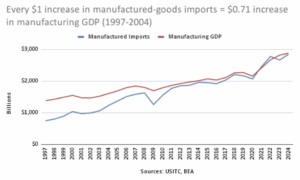
Bryan Riley tweets these data that reveal that a significant portion of U.S. imports of manufactured goods are inputs used by manufacturers in America or otherwise complement U.S. manufacturing activities: (HT Scott Lincicome)
Ted Zachariadis’s letter in today’s Wall Street Journal is spot-on:
After last week’s elections, Jim LeMunyon writes that Republicans need to wake up and smell the coffee (Letters, Nov. 10). Good idea, but with the effect tariffs are having on the price of java, they might not be able to afford it.
Will Marshall explains that “reindustrialization is just central planning, MAGA-style.” (HT Arnold Kling) A slice:
Trump believes free trade agreements and globalization eviscerated U.S. manufacturing, studding the landscape with shuttered factories — “tombstones” as he put it in his bleak 2017 inaugural address.
In fact, U.S. manufacturing output has grown substantially since 1980. What has declined is factory employment and manufacturing’s share of GDP. That tracks the trend of deindustrialization and rising demand for services in all advanced countries, regardless of trade policies.
Nonetheless, the president is ripping up trade agreements and taxing imports from friends and foes alike, in hopes of generating lots more factory jobs. But building walls around our economy won’t change the fact that automation has severed the old relationship between increased industrial production and blue-collar job growth.
[Bill] Pulte simultaneously pitched the plan as a “big deal for consumers.” On this point, he’s not wrong—the policy is eerily reminiscent of those that precipitated the 2008 financial crisis; it socializes the risk and incentivizes lenders to issue loans to those who are more likely to default. Anthony Randazzo, former senior fellow at the Reason Foundation (the think tank that publishes this magazine), explains that, leading up to the Great Recession, Fannie Mae and Freddie Mac “decided to begin taking on riskier mortgages in order to grab a slice of the subprime mortgage market [because] they knew they had a government safety net to back them up.” Adding insult to injury, the Securities and Exchange Commission charged top executives of Fannie Mae and Freddie Mac with securities fraud for misleading investors about their subprime exposure.

