

Steven Greenhut decries the current condition of the Republican Party. A slice:
We’ve become numb to narcissistic rage posts from our president, but the highly publicized Turning Point USA convention last week offers a preview into where the Republican Party is going after Donald Trump exits the stage. It’s not pretty. As we’ve seen recently in other squabbles within the conservative movement, the fireworks centered on the rhetoric of some conspiracy minded—but highly popular—right-wing personalities. TPUSA had it all: in-fighting, name-calling and innuendo.
In the old days, the conservative movement tried to police itself, as it shoved authoritarians and conspiracy theorists to the sidelines. Buckley took on the John Birch Society, which in its zealous anti-communism argued the United States government was controlled by communists. Standing up to the Evil Empire was a core part of conservative philosophy, but Buckley realized that allowing the fever swamps to engulf his movement only tarnished that goal.
Some critics argue Buckley wasn’t all that successful, but he was successful enough to keep the party from becoming what it has become now—where reasonable voices are drowned out by the likes of Nick Fuentes, Tucker Carlson and Candace Owens. If there are no adults in charge—and the party’s leader acts like a toddler, as he savages his foes in petty tantrums, renames buildings after himself and adds insulting White House plaques below the portraits of former presidents—then the whole trashy movement will one day be heaved into the dumpster.
Put simply, fighting old bad ideas is a very different task in terms of scale, scope, and challenge than fighting new bad ideas.
The online new right is awash with intellectual energy, but it is almost entirely placed into service of revanchist efforts to re-popularize old bad ideas, or in the American context, to take various strains of foreign conservatism that have never had purchase in the United States and bring them to our shores. Among the more prominent of the online right philosophers is Curtis Yarvin, the Pied Piper of the so-called Dark Enlightenment. Yarvin has certainly been prolific over his decades of blogging and popular writing. But his underlying idea—that America needs to replace the constitutional order with an unelected CEO-king—is simply a pre-modern absolutist, non-hereditary monarchy with 21st-century characteristics.
Yarvin’s affect is novel, no doubt. Rather than writing for clarity, he seems to relish purple prose, non-sequiturs, and halting transitions. As John Horvat wrote for Law & Liberty, “He is brash, sarcastic, skeptical, and cynical. His style is irreverent and vulgar. He cares little for rules and formality.” No doubt he’s a good marketer to the very online set. But adopting the cocky, rebellious mien of a very online 21st-century Mick Jagger doesn’t make his ideas original.
The Catholic integralists similarly embrace an explicitly medieval view of the relationship between temporal authorities and religious ones; to wit, they believe as a normative proposition that the former should be directed by the latter. Not only is there nothing new about this idea (it was, of course, the pre-modern status quo throughout most of Europe), but it is also, as Law & Liberty contributing editor James Patterson has shown, based on a conception of Catholicism with no historical background in the United States. The story of modern Christian nationalism, to the extent it’s even a discernible ideology, is largely the same.
The less intellectual corners of the new right offer something even less novel; ideologically, they present a grab bag of racial essentialism, ethnic grievance, and antisemitism of varying degrees of gentility. As with Yarvin, novelty here is restricted to the realm of presentation and promotion, in particular, a delight in subverting social norms of decency.
…..
F. A. Hayek wrote that “old truths … must be restated in the language and concepts of successive generations.” So too must the critiques of the old falsities. In this regard, we find ourselves at least somewhat fortunate: old bad ideas may be making a comeback, but we stand on the shoulders of giants as we square up to the task of placing them back on the ash-heap of history. We cannot desist from the battle of ideas, but our task is qualitatively different than when we were facing genuine intellectual innovation and foment from illiberals on the left and right.
C. Jarrett Dieterle urges progressives not to “force 20th-century rules on 21st-century workers.” A slice:
According to surveys, gig workers prioritize flexibility and autonomy. Imposing one-size-fits-all rules will result in outcomes such as arranged scheduling for car-share drivers.
In other words, drivers will have less ability to spontaneously log into their apps and earn extra cash whenever they can fit it in. Many companies are likely to restrict and control the number of drivers allowed on their platforms at any one time to manage heightened labor costs under the new rules.
Ultimately, there are better options for helping gig workers. Concepts such as a portable benefits model, which establishes flexible benefit funds that operate similarly to retirement accounts for the self-employed, would allow drivers access to more of the benefits available to full-scale employees without unduly restricting flexibility. A bevy of states, including deep-red Tennessee, deep-blue Maryland and purple Pennsylvania, have launched portable benefit pilot programs in recent years, underscoring the bipartisan potential of this alternative model.
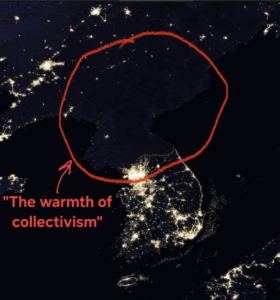
Pictures are sometimes worth much more than 1,000 words – as here, exposing the cluelessness of a newly (in)famous four words. (HT David Henderson)
The inaugural address of a mayor isn’t typically of national interest, but Zohran Mamdani is an exception. The New York City mayor’s speech on New Year’s Day laid out the large scope of his socialist ambition and how little it is rooted in reality.
Give him his due: He has real charisma and political talent. While he says Bernie Sanders is his hero, Mr. Mamdani is the anti-Bernie as a political actor: smiling not snarling, more optimistic than aggrieved. He can almost make socialism sound appealing if you missed the last century, which as it happens he did.
But every so often the 34-year-old mayor says something that reveals his harder-edged politics. In his inaugural it was this: “We will replace the frigidity of rugged individualism with the warmth of collectivism.”
That line could only be uttered by someone who overlooks the human misery that has been visited in the name of “collectivism.” The greatest killers of the 20th century put the virtues of the collective above individual rights and liberty. For the cold reality of collective warmth, we recommend “One Day in the Life of Ivan Denisovich” by Alexander Solzhenitsyn. It was a very cold day in Siberia.
Also appalled by the historical ignorance or indifference of Metropolis’s new mayor is Jonah Goldberg. (HT Scott Lincicome) A slice:
Colloquially, the reason collectivism acquired a bad odor that sometimes even communism did not emit was because of collectivization. At least when one denounces communism, communists spout the usual “but true communism was never really tried!” Precisely because of its bloodless academic nature, the word “collectivism” evades such defenses. No serious person can claim that “true collectivism was never really tried,” in part because, again colloquially, collectivization is the fully realized act of putting collectivism into practice.
The Soviets used collectivization to describe their effort to transform agriculture, and they killed millions in the process. In Ukraine in the early 1930s, collectivization led to such mass man-made starvation and cannibalism that Soviet authorities had to distribute posters that read, “To eat your own children is a barbarian act.”
When I first heard Mamdani refer to the “warmth of collectivism,” I immediately thought of Anne Applebaum’s Pulitzer Prize-winning Gulag: A History. In one scene, she describes how a slave-laborer fell in the snow from exhaustion. The other slaves—and they were slaves, owned by the state, as Chamberlin would put it—rushed to strip the fallen man’s clothes and belongings. The dying man’s last words were, “It’s so cold.”
Collectivization under Mao’s “Great Leap Forward” led to millions more Chinese famine deaths from 1959 to 1961—from a lowball estimate of 20 million to a high of 45 million.
Now, I don’t for a moment think Mamdani has anything like that in mind. Moreover, even if he did, nothing like that can be orchestrated from New York’s City Hall.
But here is what I do think is interesting and worrisome about his use of the term “collectivism.” I can only think of three possibilities for it: 1) Mamdani is ignorant of the term’s historically grounded connotation, 2) he knows it and doesn’t care, or 3) he knows it and does care.
Under the second and third options, he could be trying to reclaim the positive connotation of collectivism—a connotation it has not had for at least a century. Or he could be trying to troll people—like me—into attacking him and overreacting to a word his fans have no problem with.
I suppose there’s a fourth possibility. He has a bad speechwriter—or is one—and just made a stupid, lazy mistake. After all, he could have used “community,” “communal,” “solidarity,” “cooperation,” “shared sacrifice,” or some such treacle.

