

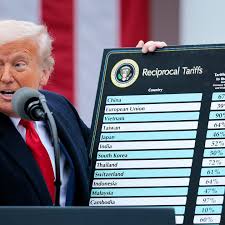
 Just after the daily close of financial markets on April 2nd, 2025, President Donald Trump announced a series of high hikes in tariffs – that is, a series of high hikes in punitive taxes on Americans’ purchases of imports – that, had these tariff hikes been announced the day before, the announcement would have been dismissed as an April Fools stunt.
Financial futures immediately tanked, and on April 3rd, 2025, the major indices all registered huge losses, with the Dow Jones Industrial Average losing 1,679.39 points (a four-percent loss), the S&P 500 index dropping by 274.45 points (almost a five percent loss), and the NASDAQ shedding 1,050.44 points (a six-percent loss). Within days, the White House announced a delay in the implementation of most of these tariffs.
Challenges to the legality of these tariffs – which were imposed under the 1977 International Emergency Economic Powers Act (“IEEPA”) – were quickly filed. These challenges were successful in the lower courts. But the risk of these tariffs becoming permanent remained until, on February 20th, 2026 – in the Learning Resources case – the U.S. Supreme Court ruled 6-3 that the administration’s use of IEEPA to impose these tariffs was unlawful. (And of course, very soon after this court ruling, the Trump administration announced its attempt to reimpose the tariffs under different statutes.)
In today’s Wall Street Journal, former U.S. Senator Phil Gramm (R-TX) and I look back on the past year and offer evidence that, contrary to Trump administration’s assertions, there is no evidence that these tariffs were a boon to the American economy. Quite the contrary. A slice:
Domestic investment also grew more slowly in 2025. Real gross private domestic investment last year grew by only 2% after growing in 2024 by 3% and 4.4% in 2017. As the global trade diversion makes our trading partners less reliant on U.S. markets and reduces our trade leverage, many of the verbal promises to invest in America are unlikely to materialize. Promised foreign investments that do materialize, being the result of political pressure and not of market forces, will further divert American resources into less-productive uses.
Real U.S. gross domestic product grew by only 2.1% in 2025, compared with 2.8% in 2024 and 2.5% in 2017. It is therefore unsurprising that job growth in 2025, at 0.5%, was slower than job growth of 1.2% in 2024 and 1.6% in 2017. Importantly, given Mr. Trump’s fixation on manufacturing, in 2025 the pace of losing manufacturing jobs accelerated to 1.2%, faster than the decline in 2024 of 0.7%. In 2017 manufacturing jobs actually increased by 0.7%.

