Here’s a letter to the Financial Times.
Editor:
Daire MacFadden parrots what is perhaps the single-most repeated line in today’s discussions of international trade and U.S. trade deficits: “persistent imbalances have hollowed out domestic manufacturing” (“A Keynesian solution to global imbalances,” May 10).
Although this claim about the alleged hollowing-out of domestic industry echoes hither and yon as if it’s beyond doubt, it is false.
It is false theoretically because a country can run persistent trade deficits (as the U.S. has done now for 50 consecutive years) as a result of that country attracting global capital that enlarges that country’s industrial base directly – for example, Kia building a factory in West Point, Georgia. An influx of global capital can also enlarge that country’s capital base indirectly by lowering domestic interest rates which, in turn, spurs domestic investment.
What’s so carelessly called “imbalances” in today’s world of flexible exchange rates are not imbalances at all, for trade (or “current-account”) deficits are exactly offset by capital-account surpluses.
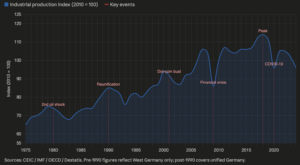
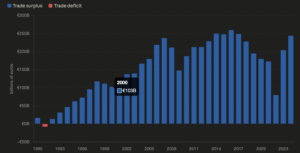
MacFadden’s claim is also false empirically. Since 1975 – the last year when the U.S. ran an annual trade surplus – both inflation-adjusted U.S. industrial production and U.S. industrial capacity have grown by 148 percent (as U.S. population has grown by 59%). It’s true that industrial production in America has been flat for the past 15 years, but the same is true, for example, for industrial production in Germany – which has run persistent trade surpluses.*
And the U.S. today produces more manufacturing output than does any country on earth except China – a country with more than four times the population of the U.S. Per-capita, Americans today produce 150 percent more manufacturing output than do the Chinese.
These assertions of the U.S. economy being “hollowed out” are, well, hollow.
Sincerely,
Donald J. Boudreaux
Professor of Economics
and
Martha and Nelson Getchell Chair for the Study of Free Market Capitalism at the Mercatus Center
George Mason University
Fairfax, VA 22030* See these figures, the first showing German industrial output, and the second showing Germany’s trade balances.