

David Henderson warns of “the deadly focus on income and wealth inequality.” Three slices:
You might think that the focus on wealth inequality has come about because of the huge growth in wealth of the 100 or so wealthiest people in the world, many of whom live in the United States. While that surely has made the issue more prominent, the upset about inequality began well before that. I date it at 1992. In 1992, Jeff Bezos, whose wealth is close to $300 billion, had not yet even started Amazon, the source of his wealth. He and his then-wife MacKenzie Scott started Amazon two years later, in a rented garage. In 1992, Elon Musk, now the world’s wealthiest man, was a twenty-one-year-old undergraduate at Queen’s University in Kingston, Ontario, who was about to transfer to the University of Pennsylvania.
…..
There are many myths about inequality. While I don’t have space to dispel all of them here, I’ll point to two that are highly relevant.
The first is the idea that increases in income inequality mean that the poor are worse off. French economist Thomas Piketty, author of Capital in the Twenty-First Century, often writes as if he thinks that wealth is zero-sum so that increases in various groups’ wealth and income must come at the expense of others. In discussing the United States in the late twentieth century, for example, he calls an increase in the income share of the top 10 percent an “internal transfer between social groups.” Yet, on the very same page, he admits that income for the bottom 90 percent slowly grew over that same period.
Consider Piketty’s statement about the United States and France: “And the poorer half of the population are as poor today as they were in the past, with barely 5 percent of total wealth, just as in 1910.” That is nonsense. If the poor have the same percentage of wealth as they had in 1910, they are much richer because wealth is much greater.
…..
Lower economic growth means more deaths
With real wages and real incomes growing more slowly due to higher taxes on wealth, people would invest less in safety. We wouldn’t demand that our jobs be quite as safe because, with lower real income, we would value safety less. We wouldn’t make our homes quite as safe. We might not replace that old Camry with a new safer-driving Tesla. We wouldn’t spend quite as much on medical care that raises our probability of living longer.
In short, higher taxes on wealth lead to more death. Even though they might not know it, and probably don’t, those who focus on reducing wealth inequality by reducing the wealth of the wealthy are advocating a system in which more people die.
Let’s not do that. Let’s have an economic system in which people live longer. To get there, we need to reject plans to have the government take more of people’s wealth.
The socialist program would be a catastrophe. So, here’s an awkward question: Why is a Republican administration quietly doing the public ownership of businesses part on its own?
Last week, the Commerce Department announced that letters of intent have been signed to provide federal incentives to seven more companies under the CHIPS program. Each letter of intent is conditioned on the government taking an equity stake. By a Cato Institute count, that brings the federal corporate portfolio to roughly 30 firms.
A year ago, these deals looked like improvisation—one-offs stitched together under pressure with President Donald Trump’s fluid negotiating style. Now, the department announces them in batches. Federal ownership of private companies has become routine, and it is happening on the right even as members busily point fingers at the left for its socialism.
To be sure, this is not the abolition of private property that some in the DSA would love to see. But strip away the label and look at the mechanism. Socialism’s defining move is to put ownership and decision making in the same collective hands. A government equity stake does exactly that. Washington already regulates these firms, buys from them, and subsidizes them. Now, it owns pieces of them. Every lever it controls—tariffs, permits, contracts, the next tranche of subsidies—moves the value of its own holdings.
Colorado Gov. Jared Polis, a Democrat, sees the implication of the government stake ownership more clearly than most Republicans do. “When government owns part or all of private companies,” he writes, “government is no longer just setting the rules—it becomes a player in the game and sets the rules to its own advantage and against the people.” Polis adds: “Socialism concentrates political and economic power in the same hands.” He is right, and it ought to sting.
…..
Finally, you can spare me the national-security argument about needing the domestic chip capacity, steel, and rare-earth materials that these companies provide. Government ownership is not the instrument. Procurement contracts and long-term purchase agreements can secure supplies without making the Commerce secretary a shareholder.
The DSA at least tells Americans clearly what it wants. The danger on the right is quieter: a government acquiring the means of production one letter of intent at a time, and a political party acting as though socialism is something only the other side can do.
Speaking of Trumpian government ownership of the means of production, here’s Bill Anderson.
US imposes 50% aluminum tariff.
Canadian aluminum imports collapse.
US aluminium prices increase (by ~50%).If only we could tease out a connection!
James Talevich’s letter in today’s Wall Street Journal is excellent:
Regarding Rob Arnott’s op-ed “Thank You for Your Success, He Said” (July 29): As my first economics professor at California State University, Fullerton, told us, “The beauty of capitalism is that all these greedy people milling about pursuing their own self-interest make life better for everyone.” Every high-school graduate should be able to articulate this principle, because its application is universal.
Every impoverished nation on earth suffers from a shortage of competent capitalists. With no capitalists, you starve. With one capitalist, you are underpaid and overcharged. With a hundred capitalists bidding for your labor and competing for your disposable income with lower prices and higher quality, everyone has a steadily increasing standard of living. With a million, you get America.
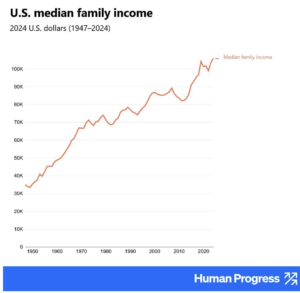
HumanProgress.org reports this happy reality:
Real median family income in the U.S. has roughly tripled since 1947, climbing from about $34K to over $105K in today’s dollars.
Despite all the doom and gloom, American families are far more prosperous than their grandparents were.
Here’s blue-sky insight from my GMU Econ and Mercatus Center colleague Bryan Caplan.

