Alan Dlugash accurately describes Bessent’s bond-buying scheme as “peak stupidity in action.”
The Treasury Department announced on Aug. 19 that it would double the size of its long-dated bond buybacks, from $2 billion to at least $4 billion per operation, aimed at the 10- to 30-year sector and running from Sept. 9 through Nov. 4. The announcement came after the 30-year yield touched a 19-year high. Yields fell within minutes. By the next afternoon they had round-tripped to levels above where they started. The market’s verdict was swift and correct: This wasn’t liquidity management, it was price management—and a mistake far larger than $4 billion suggests.
Treasury’s announcement gave the game away. It justified the larger operations as liquidity support in sectors with “consistent strong sponsorship from market participants,” but strong sponsorship is the definition of a healthy, working market. There were no failed auctions, no dealer balance-sheet seizure, no forced unwinds, nothing resembling Treasurys in March 2020 or U.K. gilts in September 2022, the sort of genuine dysfunctional episodes that justify official action. Volatility was contained, and trading was orderly—not a malfunction but the machine doing its job.
Consider what the machine was pricing. Inflation is 3% to 4% and has been above the Fed’s target since 2021. Unemployment is 4.1%, full employment by any definition. The deficit is running near 6% of gross domestic product, a number America has never before produced in peacetime at full employment. The national debt crossed $40 trillion the same week Treasury intervened. Net interest will exceed $1.1 trillion this fiscal year, more than the defense budget. The 10-year yield, even after the summer selloff, sits at or below the economy’s nominal growth rate. That means a borrower (federal government) running 6% deficits at full employment, with above-target inflation, still funds itself at roughly the rate its economy grows.
Historically, that configuration is accommodative, not restrictive, of financial conditions. The bond market wasn’t being a vigilante, as some would argue. It was being a pushover that had finally begun to clear its throat, and Treasury moved to quiet even that.
I have spent five decades trading on a simple premise: Markets aggregate information no committee possesses, and prices are how that information reaches decision makers. The long-term Treasury yield is the most important price in the world. It is also the only fiscal disciplinarian the U.S. has left. Neither party will run on entitlement reform. Both have spent the past decade expanding commitments while ignoring arithmetic. Democracies don’t repair their finances because a budget office publishes a table. They repair them only when the cost of inaction becomes visible and immediate, when mortgage rates bite, when auctions tail, when the political price of a rising long bond finally exceeds the political price of touching spending.
…..
What should happen instead is straightforward. Return buybacks to their stated purpose: small, scheduled, off-the-run liquidity operations announced at quarterly refundings, never off-cycle responses to yield levels. Term out the debt honestly and pay the price the market sets. If the 30-year must trade at 5.5% to clear, that isn’t a crisis. It is an invoice. Then do the only thing that durably lowers long-term yields: address the primary deficit. Reform entitlements gradually and honestly, through means testing, indexing changes, eligibility adjustments phased in over decades—so that the burden is shared across generations instead of dumped on the youngest.
The reward is enormous: A credible fiscal package would do more for the long end of the curve than a buyback program 1,000 times this size.
Governments defending prices against fundamentals always lose. The only variable is how much they spend before conceding. The U.S. shouldn’t put itself on the wrong side of that trade, not with the most important price in the world, and not when that price is trying to say the one thing Washington most needs to hear: Let the bond market speak.
Ramesh Ponnuru weighs in on J.D. Vance’s economically clueless remarks about the U.S. dollar’s role as global reserve currency. A slice (although I doubt that U.S. military power played much of a role here):
President Donald Trump has sometimes said he wants a weaker dollar, in line with Vance’s comments, but he’s emphatically defended its reserve status, too. “You know, if we lost that, that would be like losing a world war,” he said in July 2025. But even a somewhat weaker dollar comes with costs. To favor one is to want Americans’ paychecks to be able to purchase fewer foreign goods than they can now. Americans would produce more for the rest of the world and get less in return. Whatever other benefits that would bring, it would mean less affordability.
Viewing the dollar’s high status as a “curse,” as Vance has suggested, raises an additional question: How should the U.S. get rid of it? The dollar became the reserve currency less because of policies deliberately designed to achieve that than because of America’s prosperity and military power, the attractiveness of its capital markets, and confidence in its adherence to the rule of law.
Indeed, Long’s “every man a king” platform had nothing to do with locking up criminals or more restrictive immigration enforcement, as Vance suggested in the speech. It was, instead, a direct call for a more powerful federal government to seize and redistribute wealth.
“You must keep the wealth of the country scattered, and you must limit the amount that any one man can own,” Long said. To accomplish that goal, Long advocated for limiting individuals to owning no more than $50 million—though he admitted that “it may be necessary that we limit it to less.”
That’s the equivalent of about $1.2 billion today. Effectively, Long was calling for a populist uprising against the billionaires of his time. He was quite literal about it. “Our taxation is going to be to take the billion-dollar fortunes and strip them down to frying size,” he promised.
And that’s not all. The rest of the “every man a king” program called for loan forgiveness and a limit on the number of hours people worked. It is a speech and a political platform that, aside from a few bits of outdated language here and there, sounds like what you’d expect from the likes of Sen. Bernie Sanders (I–Vt.), New York City Mayor Zohran Mamdani, or the Democratic Socialists of America.
The U.S.-Canada trade war escalated again Tuesday as Prime Minister Mark Carney announced new tariffs on some $20 billion in U.S. goods. That includes doubling Canada’s tariff rate on U.S. steel and aluminum to 50% to match Mr. Trump’s, and the political back story here is worth more attention.
Multiple press reports say that an agreement to avert a 50% U.S. tariff on $20 billion in Canadian goods broke down last week in part because of objections by the U.S. steel and aluminum lobbies. The mooted deal would have reduced those tariffs on Canadian steel and aluminum to 25% from 50%.
Call it a case study in how a narrow special interest calls the tune for the rest of the American economy. The current U.S. tariffs on metals date to Mr. Trump’s first term, originally set at 25% for steel and 10% for aluminum, in the name of national security. But his first Administration exempted Canada and Mexico to mitigate the damage to downstream U.S. users in manufacturing and construction.
Soon after taking office for a second time, Mr. Trump removed these exemptions, later raising the tariffs to 50%. After U.S. manufacturers that use steel and aluminum complained that the taxes made them less globally competitive, he imposed a 25% tariff on so-called derivative imports that contain the metals. Who knew stainless steel pots were a national-security threat?
These sky-high border taxes have caused U.S. aluminum and steel prices to soar. The price premium for U.S. aluminum over the global benchmark has increased five-fold since Mr. Trump took office a second time. Americans are now paying roughly 75% more for aluminum than the rest of the world. Steel prices in the U.S. are also about 64% higher than in northern Europe. One reason these differential are larger than 50% is because the metal tariffs are stacked on top of other tariffs on China, which is the world’s largest producer of steel and aluminum.
The metal tariffs (including copper) have raised some $46.9 billion in revenue for the government during the current fiscal year through June, plus $21.8 billion in 2025. That’s good for politicians but a nearly $70 billion tax on Americans.
Don’t worry, America. As you lament the high cost of living, the president is here to protect you from the menace of … imported goods from Canada that he has decided are too cheap.
After U.S. trade talks with Canada broke down on Friday, a new tariff of 50 percent is going into effect on Crown Royal whisky, Canadian milk, ice hockey equipment, cement, furniture, lighting fixtures, various tools, fence components, lumber, wood moldings, and a variety of plywood, fiberboard and veneered panels, among other goods. This is separate from the existing U.S. tariffs on steel, lumber and automobiles.
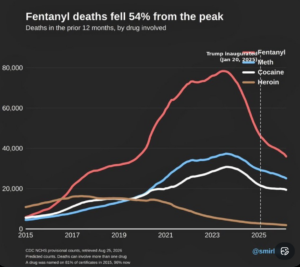
Scott Lincicome shares this revealing graph of Trump’s (non-)effect on U.S. drug overdoses: