

GMU Econ alum Dave Hebert documents Trump’s dishonest and erratic trade dealings with Canada.
…. because: (HT Richard Ebeling)
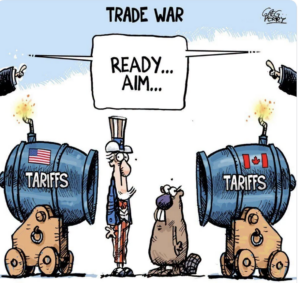
Also writing wisely about Trump’s trade war with Canada is Harold Black.
“How trade policy uncertainty weakens foreign direct investment.” (HT Scott Lincicome) [DBx: But hey, Trump – although not economically literate people – should applaud because reduced willingness of foreigners to invest in America will shrink the U.S. trade deficit!]
The Texas economy is heavily exposed to tariffs because of its cross-border trade and integrated supply chains with Mexico. Texas traded $303 billion in goods with Mexico and overall exported $299 billion of manufactured products in 2025. The latter include electronics and computers ($71 billion), chemicals ($55 billion) and transportation equipment ($29 billion).
Because Texas is the largest state exporter of goods, it suffers a bigger brunt from retaliatory tariffs, such as those that Canada plans to levy on the U.S. in response to Mr. Trump’s tariff escalation. In case he hasn’t noticed, the tariffs have become an albatross for Republicans in close races across the country, including Texas.
Republicans hoped to pick up a couple of House seats in south Texas with large Hispanic populations after redrawing the state map, but those districts are drifting in Democrats’ direction this year. Most recent polls show Democrat James Talarico leading Republican Attorney General Ken Paxton in the state’s Senate contest. Every time he threatens more tariffs, Mr. Trump is making Democratic leader Chuck Schumer’s day.
Warren Coats reflects on the rise in the U.S. of the popularity of socialism.
Meta’s settlement with state attorneys general is being celebrated as a victory over Big Tech. It may turn out to be something closer to the opposite: a case study in how regulation ends up entrenching the companies it’s meant to restrain.
Meta will pay billions to settle claims involving Facebook and Instagram. More consequentially, it agreed to an elaborate regulatory regime for users under 18—daily use limits, nighttime restrictions, school-hour notification limits, enhanced age verification, restrictions on certain features, stronger parental controls, and scrutiny from an independent auditor and the attorneys general themselves.
Some of this may be sound policy. But stack the pieces together and paradoxes emerge, ones that ought to bother conservatives—and anyone wary of government’s expanding footprint in private markets.
Start with privacy. Part of the original complaint was that Meta collected too much information about children. The fix requires Meta to get considerably better at identifying them. A 15-year-old claiming to be 19 can’t be taken at his word, so Meta needs sharper age-assurance tools—and the harder government pushes to stop teenagers from slipping past the restrictions, the more sophisticated that identification machinery has to get. We are protecting children’s privacy by requiring a company to know more about them.
Parental authority runs into a similar knot. The settlement is billed as empowering parents, and in places it does. But plenty of these decisions used to belong to parents alone, and now they don’t. Nobody’s mother or father decided that two hours was the right amount of Instagram for a 15-year-old—the attorneys general did. Nobody’s parents set midnight as the cutoff either.
Giving Meta a mandate to let parents impose limits is one thing. Having government impose the limits itself, with parents free to loosen them if they notice and bother to act, is another. The first approach hands parents real authority. The second substitutes a state official’s judgment for theirs and calls it choice.
…..
The deepest paradox is economic. For years the government’s message has been that Meta is too powerful—its acquisitions attacked, its dominance targeted for reduction. Now government is loading it up with expensive new obligations: age assurance, content controls, compliance infrastructure, parental-control architecture, an outside auditor checking the work. Meta can absorb costs like that without much trouble. Whether the next Instagram could is a different question entirely. Regulatory compliance behaves like a fixed cost, and a company of Meta’s size bears it far more easily than two programmers building a social app in a garage without Meta’s legal team, engineering bench or compliance department. What antitrust law is supposed to prevent—a barrier that keeps new entrants out—is exactly what this settlement risks building.

