

Here’s a note to a commenter at my Facebook page.
Ms. Rachel Mills
Ms. Mills:
To my Facebook post ridiculing Trump’s latest punitive taxes – a.k.a. tariffs – on Americans’ purchases of goods from Canada, you offer this comment: “Our starting point in this is not free trade to trade war and protectionism. The starting point was already tariffs and protectionism and shenanigans. The end point might be free-er trade though.” You close by writing that “Trump is playing a game,” by which I take you to mean that Trump is strategically using U.S. tariffs to lower tariffs globally.
For several reasons, I believe you to be mistaken.
First, from Adam Smith and Frédéric Bastiat centuries ago to Phil Gramm and Doug Irwin today, all informed advocates of free trade have repeatedly explained that the best trade policy for the home country is free trade regardless of the policies of other countries. While free traders recognize that the ideal world is one in which complete free trade is universal, they also recognize that, as a practical matter, such a world has never existed and will never exist, and so the best that each government can do is to leave its own citizens free to trade even when other governments abuse their citizens with protectionist restrictions.
The claim that free trade at home requires free trade abroad is made only by protectionists; it has never been made by informed free traders.
Second, while trade wasn’t completely free when Trump took office in 2017, it was darn close. I had ChatGPT construct the graph below, from data assembled by Julia Estefania-Flores, Davide Furceri, Swarnali Hannan, Jonathan Ostry, and Andrew Rose, showing changes over time in global trade restrictiveness.* As you can see, when Trump unilaterally began jacking up U.S. tariffs in 2018, world trade was largely free by historical standards and still becoming more free (if at a slower pace than before the early 1990s).
Third, Trump’s own decades-long pronouncements about trade make abundantly clear that he neither likes nor understands trade. After all, he scribbled in the notes of a speech “TRADE IS BAD,” and proudly calling himself “Tariff Man,” he has consistently asserted that so-called U.S. “trade deficits” with individual countries are evidence that these countries are ‘raiding’ the U.S. to steal our wealth. Despite the fact that bilateral trade deficits are utterly without economic significance, these phenomena nevertheless serve as the ridiculous justifications for Trump’s “Liberation Day” tariffs.
Trump’s comprehension of trade is akin to a flat-earther’s comprehension of astronomy. No one with such a preposterously poor understanding of trade should be presumed to be playing a long game aimed at making trade more free.
In short, there is no excusing Trump’s protectionist folly.
Sincerely,
Donald J. Boudreaux
Professor of Economics
and
Martha and Nelson Getchell Chair for the Study of Free Market Capitalism at the Mercatus Center
George Mason University
Fairfax, VA 22030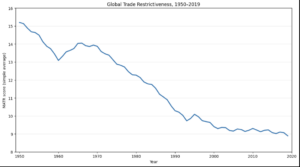
* A Measurement of Aggregate Trade Restrictions and Their Economic Effects (World Bank, 2022).

