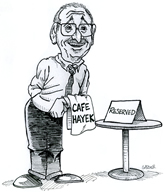
Megan McArdle writes insightfully about California’s pending proposal to soak the rich. Three slices:
These days, legislators generally don’t enact tax hikes so confiscatory that they trigger an immediate, obvious response. They adjust income tax rates by a few percentage points, fiddle with the deductions or impose new levies on some tiny portion of the economy, like using ride-hailing services. That can affect decisions about savings, work and investment, but probably not immediately. These gradual changes make it hard for economists to distinguish tax policy’s effects from everything else that’s happening in a $33 trillion economy. That leaves plenty of room to debate whether — and how much — taxpayers respond to incentives.
So economists can thank a California chapter of the Service Employees International Union for providing Americans a natural experiment: What happens when you slap a whopping wealth tax on some of the richest people in the world? The SEIU has sponsored Proposition 40, a ballot initiative to levy a one-time 5 percent wealth tax on California billionaires, with much of the money going to the health care system that (not coincidentally) employs many SEIU members. Depending on what California voters decide — a recent poll suggests the initiative is leading but still short of a majority — we may get a clear example of the limits of taxation.
…..
Several California billionaires have already announced their departures, including Peter Thiel and Google founders Larry Page and Sergey Brin. [Gabriel] Zucman’s paper notes that if some of the most prominent tech barons succeed in fleeing, revenue estimates fall to $89 billion, but then argues that there are many small-fry billionaires who escape Forbes’s wealth rankings but still have to pay the tax. Adding them back in raises revenue to $115 billion.
This assumes the undetected small fry haven’t done their best to exit, but why would we assume that? Why should we believe that those who loudly announced they were shifting their residency before the year began were the only people who fled ahead of the SEIU initiative?
…..
But billionaires, like economists, are capable of making assumptions. They probably assume that if the tax succeeds, progressives will come back for an encore. And if it fails, they’ll try, try again. Those seem like sound assumptions — sounder, in fact, than the assumption that Californians can grab 5 percent of everything the billionaires have, and the billionaires will just have to sit there and let them take it.
Because targeting Main Street businesses isn’t popular, Democrats instead lambaste billionaires. See California’s Proposition 40, which seeks to impose a 5% tax on the fortunes of residents with more than $1 billion in net worth. French economist Emmanuel Saez, one of the initiative’s architects, recently explained to the New York Times that targeting only billionaires was a strategic choice, since they “are no longer very popular.”
In 2020, Mr. Saez helped 14 California Democratic lawmakers, including now-Attorney General Rob Bonta, craft a bill to impose a 0.4% wealth tax on taxpayers with more than $30 million in assets. It foundered amid opposition from Gov. Gavin Newsom, but if Proposition 40 passes, don’t be surprised if wealth tax proponents later seek to lower the threshold.
New York City Mayor Zohran Mamdani names and shames billionaires like Citadel CEO Ken Griffin. This is a head-fake. His proposed tax hikes would primarily whack owners of local bodegas, plumbing companies and other small businesses. So, too, “millionaire taxes” popping up in states across the country.
Abdul El-Sayed, Michigan’s Democratic nominee for U.S. Senate, advocates imposing an additional death tax by requiring heirs to pay income tax on inheritances worth more than $1 million. Some 24 million Americans could get soaked, most of whom are solidly middle-class. He also wants to remove the $184,500 earnings cap on the 12.4% Social Security payroll tax “to make sure the rich pay their fair share.”
If you earn more than $184,500, you are rich. Congratulations. Progressives don’t merely want to redistribute wealth. They want to raise taxes to aggrandize their own power and level opponents. Then they can decide what’s fair and who has enough.
The wealth-tax dollar threshold is also likely to be reduced to hit more wealthy people, especially to compensate for income-tax losses from billionaires leaving. M. Zucman has said as much himself. “This one-time tax is just the starting point of what could be,” he told the Capital & Main news site this year.
He has also suggested an annual 2% wealth tax: “Even if you factor in the fact that some billionaires will move, the state would still be vastly better off with a 2% annual wealth tax.” So even he admits some billionaires will move out of California.
M. [Gabriel] Zucman laments that many billionaires use their wealth to advocate for free markets and individual liberty. “Everything that is downstream of the political system—including the courts, regulatory power, economic policy, media independence and so on—is affected by the surge of billionaire influence,” he said in an interview this summer posted on the UC Berkeley website.
Left-wing French economists are the leading intellectual architects of France’s—and Europe’s—current fiscal and political uproar. You almost have to wonder if they are so determined for the U.S. to make the same mistakes because America’s relative success is an embarrassing rebuke to their ideas.
[DBx: I put “economists” in quotation marks because, although Gabriel Zucman, Thomas Piketty, and Emmanuel Saez are credentialed and employed as economists, none of them gives any evidence of possessing the remotest familiarity with the economic way of thinking. Each supposes that wealth is produced independently of human incentives, institutions, and effort. And each specializes, not in analyzing how economic order emerges from decentralized human action, but instead in processing data in ways seemingly designed to stir that most dangerous of human emotions, envy.]
David Simon explains why Comrade Mamdani and other of today’s socialists ignore socialism’s history. A slice:
Our aspiring socialist leaders expect, more importantly, to enjoy the power to dictate every aspect of our lives.
Consider some of the aspects of life that various highly socialist nations have chosen to regulate to varying degrees and which those who seek to be our socialist rulers could choose to determine for each of us.
Where each of us lives, both in which city or town and in which specific house or apartment. The specific job in which we may or will work and for which employer. How much we may earn.
Which foods and other goods we may purchase. How much of each we may purchase. And from which vendor(s) we may purchase.
David Bier exposes some economic fallacies about immigration spread by Trump’s White House.
Kimberlee Josephson ponders consumer behavior.
Lula’s win for a fourth nonconsecutive term as president is hardly a mandate. His personal story of rising from a poor family, his charisma and his left-wing populism have made him a champion of organized labor and an icon of Latin socialism. He was a bosom buddy of Fidel Castro. Over the years he has carried many Workers’ Party candidates on his coattails. But this time he struggled.
Young Brazilians want affordability and opportunity, and Lula hasn’t delivered. In 2026 inflation is expected to come in close to 5.2%. Forecasts for next year put it above 4.3%. Wages haven’t kept up. With an inflation target of 3%, the central bank has set its overnight lending rate, known as the Selic, at a punishingly high 13.75%. The drag on the country’s many heavily indebted businesses and households is palpable. Growth for 2026 is expected to come in below 2%.
Richard Ebeling reflects on “John Stuart Mill on liberty, tyranny and restraints on government.”