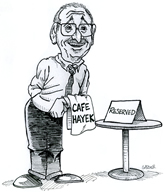
Also remembering Richard Posner is Dan McLaughlin. A slice:
Second was Posner’s fantastic capacity for work and talent for writing. He carried a workload much larger than the typical federal appellate judge, getting himself more writing credits as a result, while simultaneously writing more than 50 books and producing a nearly endless stream of scholarly articles, magazine articles, blog posts, and just about every other form of communication known to man. If he had lived longer, he might have joined TikTok. One of my favorite Posner rants was his 2003 book review of a biography of Justice William O. Douglas, whom he described unsparingly as:
one of the most unwholesome figures in modern American political history, a field with many contenders . . . a liar to rival Baron Munchausen. . . . Apart from being a flagrant liar, Douglas was a compulsive womanizer, a heavy drinker, a terrible husband to each of his four wives, a terrible father to his two children, and a bored, distracted, uncollegial, irresponsible, and at times unethical Supreme Court justice who regularly left the Court for his summer vacation weeks before the term ended. Rude, ice-cold, hot-tempered, ungrateful, foul-mouthed, self-absorbed, and devoured by ambition, he was also financially reckless — at once a big spender, a tightwad, and a sponge — who, while he was serving as a justice, received a substantial salary from a foundation established and controlled by a shady Las Vegas businessman.
The third, unfortunately, was Posner’s own conviction that he knew best. He was a genuinely great common-law judge, capable not only of producing concise, clear rules of law that made sense of the general drift of prior law even in areas with vast and sometimes apparently contradictory precedents, but also of situating them within a framework that encouraged commerce and human liberty. But the longer he sat on the bench, the more Posner grew unduly dismissive of a judge’s most fundamental duty in constitutional and statutory cases to follow the written law enacted by the people’s representatives. His mostly one-sided broadsides against his former Chicago colleague Antonin Scalia reflected poorly on Posner, who often wrote of Scalia in the same tone that Salieri used toward Mozart in Amadeus. Posner had gifts to equal those of Scalia, save for one: Scalia’s humility in the face of legitimate democratic authority and its traditions. There is more to law, as Scalia understood, than homo economicus.
Here’s one of my favorite observations made by Richard Posner.
Roughly 1,600 buildings in New York with rent-stabilized apartments now have expenses exceeding rental revenue, according to the city’s Rent Guidelines Board. Meanwhile, the financing that keeps such properties functioning is becoming harder to obtain. Mortgage originations for buildings in which at least half the apartments have regulated rents fell from $27.6 billion in 2019 to $11.3 billion in 2025. Signature Bank collapsed during that period, and other lenders retreated as interest rates rose and government policies made owning regulated housing less attractive.
Jonah Goldberg rightly criticizes Oren Cass’s attempt to escape blame for damage that he and his economically clueless movement have helped to inflict on Americans. (HT Scott Lincicome) Two slices:
In Cass’ telling, the Reaganites and the new right are both “distancing” themselves from Trump as if this were some kind of reverse-jump ball, with both players plausibly equidistant from the line between them. “Success for either side,” he says, “will depend on finding a way to shed Mr. Trump’s toxic political baggage” as if both sides are carrying equal portions of that toxin.
This is political and philosophical nonsense. The political part is easy enough to demonstrate. The Reaganites, with a few convoluted and contorted exceptions, never claimed Trump. The new right carried him around like a frickin’ golden calf.
…..
And that points to the philosophical problem. Cass talks about Reaganism as if the ideas that broadly defined it were little more than a program of political necessity. He assumes that because his “ideals” change with political reality, everyone else’s ideals are equally mercenary, mercurial, and malleable. But Reagan’s ideals drew on something more than political expediency. We know this in part because he was espousing those ideals when they weren’t to his political advantage. We know this because he expressed these ideals privately in his diary. But most importantly, we know this because the ideals of limited government—personal and economic liberty—didn’t start with Reagan. They’re found in the seminal documents of this country going back to the Declaration of Independence and the Constitution. They’re on display in the lives of Lincoln, Coolidge, and Taft, and in the works of generations of conservative scholars, journalists, and philosophers. Reagan didn’t invent that stuff, he drew from it. Reagan was a political giant, but intellectually he stood on the shoulders of greater giants.
Cass’ theory of politics is his theory of policy. He thinks experts—like him—can design the economy on a grease board, pick winners and losers, and be smart enough to Kobayashi Maru Hayek’s knowledge problem. Obviously, government can do important and useful things. Reagan believed that. Hayek believed that. Adam Smith believed that. But they also believed there were limits to what good the government could do and trade-offs even in the areas where government could do good. One rarely hears anything like that epistemic humility from Cass—or Trump. Of course, Trump is far cruder and dumber than Cass, but they both share the fatal power-of-positivity conceit that you can create the economic and political outcomes you want through will and rank assertion.
The story the new right folks used to whisper, but now increasingly shout, is that Trump was never anything more than the political equivalent of the Stay Puft Marshmallow Man in Ghostbusters—the form of the destructor they could use to smash the status quo so that they could claim dominion over the rubble. In the interim they thought they could guide their orange golem for their own ends. But Trump proved unguidable, so now they want to point at the wreckage they midwifed and proclaim: The Reaganites did it!
Wall Street Journal columnist Barton Swaim reflects on the recent electoral drubbing of Republicans. A slice:
Writing in these pages in 1985, Irving Kristol alluded to the political scientist Martin Diamond’s dictum that American democracy “is based on one key assumption: that the people are usually sensible, but rarely wise.” Readers can judge if the people acted either sensibly or wisely by licensing one form of chaos to restrain another, but that is what they did on Nov. 3.
The incoming Democratic majority gives no signal that it’s ready to play the part of rational, grown-up opposition. In ordinary times, an electoral victory by a minority caucus like the one congressional Democrats achieved last week would ensure the elevation of its leadership. Yet restive factions in both House and Senate hint at coming confrontations. In the House, the size of the far-left “Squad,” now dubbing itself the “Bloc,” has more than doubled, to 16 members, and has additional allies on specific radical items.
For his part, Minority Leader Hakeem Jeffries, the only rational candidate for speaker, doesn’t seem inclined to waste time and votes pursuing an all-for-show agenda set by the Democratic Socialists of America—Medicare for All, a “transgender bill of rights,” abolishing Immigration and Customs Enforcement and so on. A pointless and bruising fight for the speakership, of the sort Republicans staged three years ago, may not happen in January, but the ideological and attitudinal differences are wider on the Democratic side than they were in the GOP in 2023. Don’t expect a display of sanity and cohesion.
George Will warns that reality will soon slap Democrats in the fact – and that Democrats will resist. Here’s his conclusion:
Climate change as a menace has been exaggerated, and as a political issue has never been salient. Fifty years of Supreme Court rulings have insulated political campaigns from speech-restricting regulations. The popularity of Medicare-for-all varies inversely with the understanding of it. Racial considerations in voting are rapidly receding.
Progressives should acknowledge all this. That will not happen.