by Don Boudreaux
on February 28, 2018
Here’s a letter to Cafe Hayek reader Tony Hart:
Mr. Hart :
Thanks for your e-mail. Unhappy with my counsel for Americans to stop worrying about the so-called U.S. trade deficit, you write: “Surely the US owes this money to foreign countries. At some stage, it will need to be repaid. I have asked this before; exactly what assets does the US sell in order to pay for its trade deficit.”
No. No. No.
First, the only portion of the U.S. trade deficit that must be repaid is that portion that Americans borrow from foreigners. Much of the trade deficit – for example, that portion that results from foreign direct investment in the U.S. – imposes no obligation on any American to repay anything to anyone.
Second, Americans need sell no assets in order, as you put it, “to pay for” the trade deficit. The amount of capital – the number of assets – in the world and in the United States is not fixed. It can and does grow. When, say, a Swede builds a retail furniture store in Tucson the U.S. trade deficit rises by the dollar amount that the Swede invests in that store and, if the store is run profitably, the amount of capital in the U.S. rises. If the store is unprofitable, the loss falls on the Swede. Either way, no Americans had to incur a net reduction in asset ownership in order to “pay” for the Swede’s construction and operation of this retail store in Tucson (and the resulting rise in the U.S. trade deficit).
You’ll reply “Oh, but an American sold to the Swede the land – an asset! – on which the store is situated.” To which I respond, ‘Not necessarily. Perhaps the American rents her land to the Swede.’ But even if the land is sold to the Swede, the value the American seller fetches for it is higher the larger are the number of potential buyers (or renters) of that asset. Therefore, reducing the U.S. trade deficit through trade restrictions thereby artificially lowers the value of Americans’ asset holdings by reducing the number of people who compete to purchase or to rent American-owned assets.
Finally, the American seller of the land might well invest the proceeds from the sale elsewhere and in a manner that yields to this American net returns greater than she would have earned had she maintained ownership of that piece of land.
It is simply untrue that a U.S. trade deficit either must be “repaid” or funded with net asset sales by Americans.
Sincerely,
Donald J. Boudreaux
Professor of Economics
and
Martha and Nelson Getchell Chair for the Study of Free Market Capitalism at the Mercatus Center
George Mason University
Fairfax, VA 22030
{ }
by Don Boudreaux
on February 28, 2018
Here’s a letter to the Wall Street Journal:
By offering not one justification, but two, for punitive taxes on Americans who buy imported steel, U.S. Steel’s David Burritt reveals the shallowness and shadiness of the steel-industry’s case for protection from foreign competition (Letters, Feb. 28).
In one argument, Mr. Burritt insists that a thriving domestic steel industry is vital for U.S. national defense. If this argument is valid, it renders irrelevant Mr. Burritt’s second argument for high tariffs – namely, the allegation that the only reason U.S. steelmaking capacity is threatened is that foreign governments subsidize and “dump” steel in the U.S. This second argument – assuming it to be correct and relevant – implies that if foreign steel producers were to have a natural comparative advantage over Americans at producing steel, the loss of U.S. steelmaking capacity would be acceptable and, therefore, it would be improper for Uncle Sam to protect U.S. steelmakers.
If Mr. Burritt’s national-defense argument is correct and relevant, then the specific reasons why steel imports threaten U.S. steelmaking capacity become irrelevant. If a thriving domestic steel industry truly is vital to U.S. national security, protective steel tariffs would be justified regardless of the policies and practices of foreign steel producers and, therefore, it would be pointless to inquire into whether or not U.S. steel imports are subsidized, “dumped,” or otherwise ‘unfairly’ offered for sale in America.
Mr. Burritt’s case for punitive taxes on American buyers of imported steel has the powerful stench of special-interest pleading that emits from all producers who clamor for protection. Logic, consistency, and conformity with economics are cast aside and replaced with illogical trains of assertions meant, not to clarify and enlighten, but to confuse and frighten.
Sincerely,
Donald J. Boudreaux
Professor of Economics
and
Martha and Nelson Getchell Chair for the Study of Free Market Capitalism at the Mercatus Center
George Mason University
Fairfax, VA 22030
….
I’m too busy this morning to spend the time necessary to figure out how to add the following point to the above letter, but the following point is relevant: To the extent that a thriving U.S. steel industry is important for national defense, protecting U.S. steel producers from foreign competition diminishes their incentives and motivation to innovate and to keep production costs as low as possible. This negative consequence of protectionism should, at the very least, be weighed against the allegedly ‘positive’ effect of ensuring that the U.S. steel industry is larger than it would be in the absence of U.S. government-imposed punitive taxes on Americans who buy imported steel.
{ }
by Don Boudreaux
on February 28, 2018
… is from pages 199-200 of the 2015 Fourth Edition of Douglas Irwin’s important volume, Free Trade Under Fire:
 The greatest example of a country turning its back on the world economy is China in the fourteenth century. The imperial court prohibited any foreign trade (without official permission) for about two centuries after 1371, even going so far as to forbid the construction of new seagoing ships in 1436. While these efforts did not completely eliminate trade, they severely curtailed it at a time when Chinese merchants were very active in the Indian Ocean and Africa. China’s action did not stop globalization. But China lost its technological leadership and fell very far behind the rest of the world in military and commercial strength. Eventually it fell prey to political domination by the West in the nineteenth century.
{ }
by Don Boudreaux
on February 27, 2018
… believes that when a foreign government unethically inflicts injuries upon the consumers and taxpayers of its country, the proper response is for “our” government to respond in kind – namely, by inflicting the same injuries upon the consumers and taxpayers of “our” country. Put differently, a protectionist is someone for whom two wrongs do indeed make a right. Or differently still: a protectionist is someone who believes that A’s robbery of B justifies C’s robbery of D.
{ }
by Don Boudreaux
on February 27, 2018
… is from page 97 of Jagdish Bhagwati’s and Douglas Irwin’s 1987 paper “The Return of the Reciprocitarians: U.S. Trade Policy Today,” as this paper is reprinted in Political Economy and International Economics, a 1991 collection, edited by Doug Irwin, of some of Bhagwati’s writings (footnote deleted):
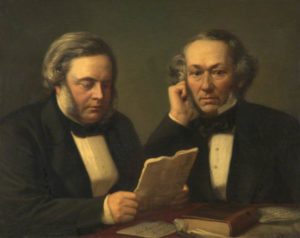 Thus after the removal of the Corn Laws in 1846, unilateralism in free trade became a critical feature of British free trade doctrine. As the economist Thomas Tooke described it, the policy was ‘not to render our own commercial reforms in any way dependent on the fears, the wishes or the diplomacy of other states’, but ‘to act at once upon the principle that every reduction of duties which admits a larger quantity of the produce of foreign countries must at least be paid for by commodities which it is profitable for this country to export, whatever may be the degree of folly or wisdom displayed in the tariffs of the foreign countries to which they are sent’.
DBx: Pictured above are the great John Bright and Richard Cobden – leaders of the Anti-Corn Law League. These men and their compatriots pushed in Britain for complete, unilateral free trade – a strategy that paid off, to the benefit of ordinary Brits, with the repeal of the corn laws in 1846.
{ }
by Don Boudreaux
on February 27, 2018
… believes that if we Americans had spent the first six months of 2017 and one-half our national income doing nothing but using teaspoons to dig a giant hole in the middle of the country, and then had spent the final six months of 2017 and the other half of our national income doing nothing but using spoons to refill that giant hole, that we Americans would have been just as wealthy on January 1st, 2018, as we actually were on that date (our having in fact spent 2017 doing all the many productive things that we actually did that year). The protectionist is led to this conclusion because, for the protectionist, all that matters is the performance of jobs for which workers are paid money; protectionists pay no attention to the amount of goods and services available to purchase and consume.
Nay! In fact, as I think about it, the protectionist would reckon that we Americans would have been even wealthier on January 1st, 2018, than we actually were if in fact we’d all spent all of 2017 pointlessly digging and filling-in a giant hole. The reason is that, had we spent all of 2017 doing nothing but digging and refilling a hole, the scarcity of goods and services available to us in 2018 would have been much greater than it actually was – a fact that, according to the ‘logic’ of the protectionist, would have meant greater wealth for us in 2018.
{ }
by Don Boudreaux
on February 27, 2018
Here’s a letter to the Wall Street Journal:
Walter Russell Mead rightly proclaims that “protectionism remains a dangerous drug” (“Don’t Misjudge Trump’s Trade Tirade,” Feb. 27). Yet by implicitly granting the correctness of what in fact is an essential error in Mr. Trump’s economics, Mr. Mead inadvertently promotes overdosing on this dangerous drug.
As he did in the CPAC speech to which Mr. Mead refers, Mr. Trump repeatedly insists that America’s trade deficit with China is evidence of Beijing’s nefariousness combined with official Washington’s spinelessness. Yet what really is on display here is Mr. Trump’s cluelessness.
First, in a world of more than two countries, any bilateral trade deficit or surplus is as absolutely and indisputably meaningless as is, say, my trade deficit with my grocer and my grocer’s trade surplus with me. The Wall Street Journal should not be party to allowing talk of such “deficits” or “surpluses” to pass as if such gibberish makes economic sense.
Second, while the U.S. has for decades consistently run trade deficits with the rest of the world, China has, since its 2001 entry into the WTO, overwhelmingly run trade surpluses with the rest of the world – a reality that means exactly the opposite of what Mr. Trump believes it to mean. What this reality in fact means is that the U.S. continues on net to attract global investment funds while China generally is a net loser of global investment funds. It’s bizarre that Mr. Trump interprets this reality as evidence of America ‘losing’ and China ‘winning.’ And it’s even more bizarre that this man who brags about his business acumen thinks that a net inflow of global investment funds to the U.S. weakens our economy while a net outflow of global investment funds strengthens the Chinese economy.
Sincerely,
Donald J. Boudreaux
Professor of Economics
and
Martha and Nelson Getchell Chair for the Study of Free Market Capitalism at the Mercatus Center
George Mason University
Fairfax, VA 22030
{ }
by Don Boudreaux
on February 27, 2018
{ }
by Don Boudreaux
on February 27, 2018
George Will rightly objects – and hopes that the U.S. Supreme Court will also – to state-imposed restrictions on what voters can wear to the polls.
Gary Galles is right that Herbert Spencer was right that protectionism is aggression-ism (although I don’t agree with Prof. Galles that Smoot-Hawley, despite its many faults, was a major cause of the Great Depression). A slice:
However, protectionism cannot protect all. It provides special treatment for the politically favored at the expense of others’ rights and well-being. In fact, it harms all American consumers not given special protection by removing options their choices demonstrated were preferable to them. The harm to preferred foreign suppliers is also important, and not just to foreigners. Their reduced earnings due to the protectionism will harm other American producers and workers by reducing overseas demand for their products.
Going beyond the protection of our common rights, protectionism cannot benefit all. It restricts choices and competition, crowding out mutually beneficial arrangements for all but a favored few. It means that most of us “win” less than before, not more, and leaves unanswered the question of why some should receive government imposed coercive charity from the rest of us.
Liz Mair warns of the dangers of Trump’s protectionism.
Chris Edwards writes wisely – with help from Chuck Baird – on collective bargaining.
Vincent Geloso is correctly critical of accepted wisdom on the Sherman Antitrust Act.
Katherine Mangu-Ward asks why it’s so difficult to get pervs out of politics.
Tom Bell reviews GMU Econ alum Lotta Moberg’s superb book on special economic zones.
Matt Ridley reviews the history of the “nuclear-winter” scare.
This PBS News Hour interview of Steven Pinker is great.
{ }



