

Recently, Don welcomed Muirgeo back to the comments section of the blog and I noticed a mere 242 comments were made in response. I started reading and stopped when I got to the posting of a chart by Muirgeo. I recognized the chart immediately and stopped reading any further into the comments. So forgive me if some people have responded already.
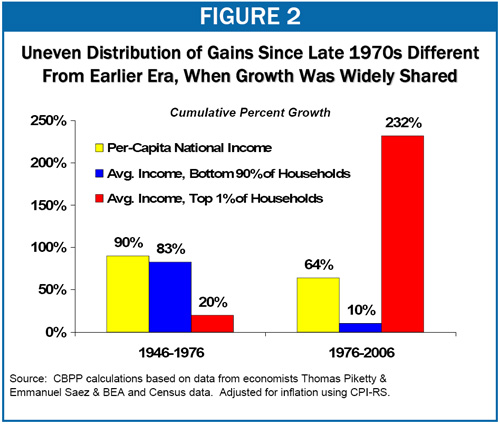
Muirgeo’s comment on the chart is:
"Anyone care to take a shot at explaining this data and how it’s consistent with libertarianism?" I’m not quite sure what to make of this comment. But I’ve seen the chart before and I’ve thought it would make an excellent basis not for a blog post, but rather for a course on how to think about numbers. Certainly the authors of the chart and the authors of the study that the chart is based on, see something wrong with an era where economic growth goes disproportionately to the richest 1%. The implication of these authors (I am not indicting Muirgeo here so let’s stay away from that) is that something has gone terribly wrong with the American economy. Perhaps they are right. And of course there are many things that have been done since 1976 that were wise and many things that have been unwise.
Numerous folks believe, however, that the economy has become too unregulated, too unfettered, too free market since 1976 and that that is what explains the pattern of the data in the chart.
So here’s the contest:
Write ONE sentence explaining ONE thing that is wrong with concluding that these numbers are evidence that the US economy has become more tilted toward the rich at the expense of the poor.
You can submit more than one sentence. But only one at a time. So each comment can have only one sentence. Any comments containing references to Muirgeo or others will be deleted.
I will take the best sentences and post them (with the author’s names) along with the chart along with comments of my own if there is anything else to be said.
At that point, Muirgeo (and others) will have the opportunity to defend the chart or critique the critiques.
Particularly diligent contestants will want to consult this source for further information on how the numbers were generated.
UPDATE: There are now more than 200 comments so I am closing the contest. Tomorrow, August 21, I hope to post the best sentences with some commentary.




{ 50 comments }
The people in the first set of numbers are not the same people in the second set of numbers, rendering the data irrelevant.
It doesn't taake into account skilled vs. unskilled labor or immigration or migration between groups.
Immigration heavily skews the data for the poor to become poorer because quite a few of the immigrants arrive in a state of poverty.
The data usually counts illegal immigrants as poor, they are either illegal or they are American poor but they can't be both.
The data assumes that the rich are doing something to make poor people poor, which if there is no mechanism, then the data is irrelevant.
It doesn't indicate the relative responsibility for economic growth between the two groups.
If most people work to achieve happiness, not to become in the top 1% of wage earners, then this graph could just as easily be chronicling the point at which US citizens are satisfied with their effort and subsequent pay.
Income is either consumed or reinvested, so income statistics conflate consumption benefiting the individual receiving income with investment benefiting people more generally.
Percentages tell us nothing about the size of the pie.
The data assumes that there is a zero sum level of wealth that is being consumed by a tiny fraction of the population.
The chart says nothing about the wealth gains made by the bottom 90% from one period to the other as goods previously considered luxury became affordable to most.
A naive interpretation of the data assumes that much of the rising income of the top one percent is consumed at all.
The data assumes that if the spread between the numbers weren't so great, then the poor would be better off, but as in the case of North Korea, India, China or Russia (20 years ago) a relatively flat spread usually means poverty for all, not prosperity.
The data says nothing about wealth, as opposed to income, whereas one could be wealthy and have no income.
By the way, I reserve the right to argue the other side of this debate as well, because the issue is far from simple.
The data has no capacity for incorporating effort or risk taken by any of these groups, making a conclusion based on these graphs, premature.
The meaningful gains of the top one percent grew more than 20% between '46 and '76, but more affluent people in the later period realized more of their gains in a form qualifying legally as "income" for income tax purposes.
The bottom 90% does not constitute the poor, the top 1% may constitute the rich, and the remaining 9% should not be ignored.
Throughout the twentieth century, progressively more wealth takes the form of monetary "income", as people barter less, as they cease growing their own food, as they labor more for corporations, as women enter the paid labor force, with some women paying other women to tend their children while they earn wages otherwise, and so on.
If this were womens' gymnastics we would eliminate the top 10% and the bottom 10% to find out who is really better (off).
The composition of U.S. households has changed from 1946 through 1976 and through 2006.
The idea of a top 1% of a population is misleading, as individual people and families are constantly moving into and out of that group; more specifically, those who take risks and succeed stay or move in, while those that take risks and fail drop out.
This chart compares a very large group to a relatively small group so you can expect extraordinary numbers at the far end of the distribution.
There is inconsistency in the data because these numbers are for households and not individuals and will be affected by changes in the marriage and divorce rate.
the people in the top 10% and the bottom 90% change every year (so within the two measured periods, let alone between them, rendering the data even less relevant).
535 Congressmen and Senators spent over three trillion dollars last year, roughly six billion apiece, but income statistics don't reflect their influence at all.
It costs a lot more to be rich these days.
US income data does not include redistribution of income from higher earners to lower earners, understating some of the income of the "bottom" 90% of earners.
Pre-tax income distribution is not equivalent to wealth distribution.
Three million individuals receiving a million dollars apiece would also spent three trillion dollars, thirty million individuals receiving a hundred thousand apiece would spend as much, so how much more effectively are 535 politicians at spending money than millions of individuals?
Three million individuals receiving a million dollars apiece would also spend three trillion dollars, and thirty million individuals receiving a hundred thousand apiece would spend as much, so can 535 politicians spend this volume of money more usefully than millions of individuals?
This chart creates the false impression that you are in one group or the other when there is a significant (99-90= 9%) of households missing from the chart.
Besides obscuring income movement of people over time in that period, the sampling size of the comparison is groups is also too bottom heavy in that we are looking at 1% of the population vs. the other 90% and such comparisons do show gains of transient income groups within that 90%.
Chart says nothing about the middle 89% of the population.
Income data from the IRS does not take into account benefits such as health care which has been steadily making up a larger percentage of total compensation.
There are more winner take all tournaments (emerging from free association in the marketplace) with audiences large enough to support big prizes today than in the period from 1946 to 1976.
The first time series on this chart appears not to make sense as the national average is higher than either group, so the missing 9% must have done real well then.
On a consumption note, the chart ignores growth in marginal income by saying nothing about the costs of goods purchased by the poor over the periods.
Number of people per household and number of earning members per household have changed drastically over the years and those changes might not be uniform across different income brackets.
The national comparison is "per capita" while the group data is "per household"- not a good idea to have mixed metrics.
Historically speaking, weren't there also wage controls in place during the war that prevented real wage gains from being realized until they were lifted? (not sure about this one)
Presumably, income of the top 1% is spent, invested, or saved, thus creating more "national income" to be distributed among those in the bottom 90%.
household composition changed over time as well.
Income shifting (from corporate tax returns to individual returns) has exaggerated the growth of top incomes, while excluding a third of personal income (including Social Security and other transfer payments) has exaggerated the top groups income share.
Percent changes in total income are irrelevant, so a revised chart should show percent changes in spendable income (gross income plus government support minus all local, state, and federal taxes).
Rich people have feelings too and since they have most of the money we should try not to hurt them.
Large % of people don't file income tax return, which is the source of this data.
[in Haiku form] Hidden C-corp wealth — Since '58 moves to S — Household returns grow
Even setting aside such factors as changes in household size (overall and within groups) and technological innovation, even the richest 1% in 1946 did not have the standard of living that the bottom 90% have today.
Poorer households are more likely to receive government handouts and hence more broken families.