

Technique fascinates me. Part of my fascination comes from my interest in specialization. But most of it, I think, comes from being a teacher and a parent and a very amateur baseball coach. Some things are easy to teach. Facts. Some simple insights. But many things are not so easy. How to swing a baseball bat. How to sing. How to be an economist. Some of these things we learn simply by doing them over and over. But sometimes, doing them over and over—learning by doing—is unproductive or worse. We learn a bunch of bad habits and they become ingrained in muscle memory.
For many things, there is a best or close to best technique. Swinging a baseball bat is a simple example. Virtually every major leaguer swings in a very similar manner and it is very different from how it is usually taught. (FYI, here is the only material I have seen on the web or in a book that actually helps a kid make progress toward a quality swing.) There’s a lot of advice given by many coaches that I think is the wrong technique. (Keep your elbow up). Some advice is simply unhelpful. (Keep your eye one the ball. No eight year old knows how to implement this advice without further assistance, it requires you to rotate your head toward home plate as the ball comes in and your body toward the field at the same time. Nearly impossible.) But sometimes the technique, though well known, is so complicated that only a skilled teacher knows how to teach the technique well. The worst case is the unskilled teacher of a complex technique who points out every flaw. Because there are so many things to remember, the beginner has no chance of making progress.
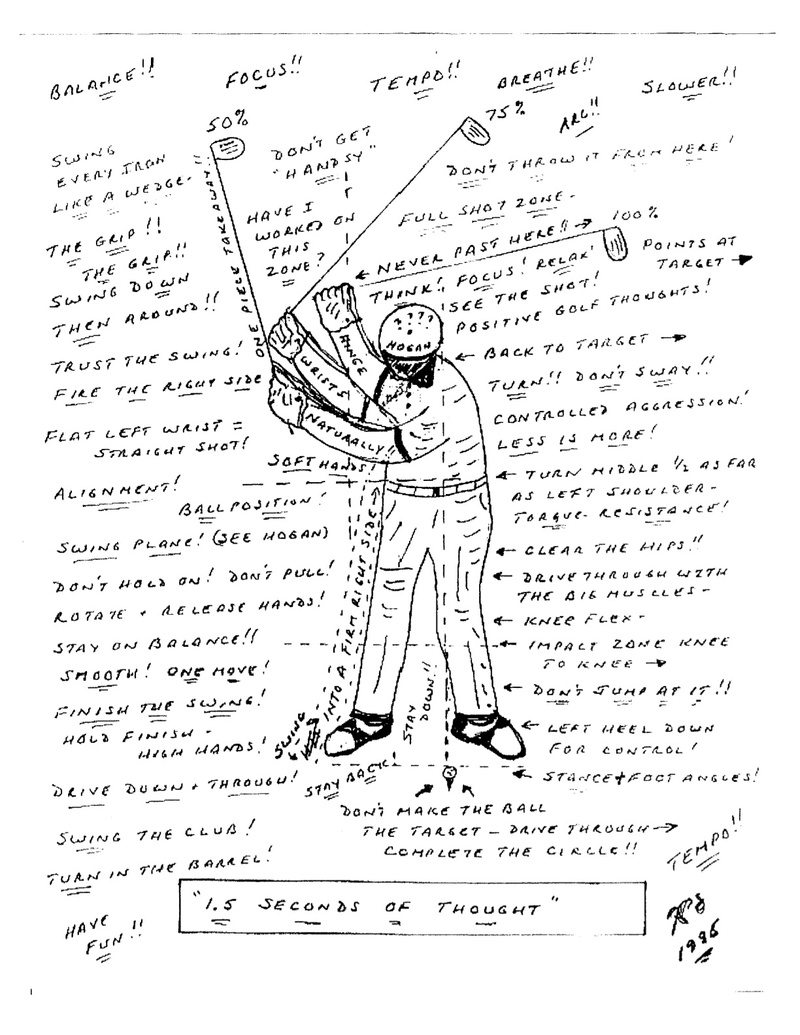
This wonderful drawing illustrates this last problem perfectly. A good teacher knows which flaws to start correcting and which flaws to ignore. This illustration, which I found in the office of a voice teacher, is the guide to a great golf swing. (I don’t know who drew this. If anyone recognizes the artist, please let me know.) If you can keep these few things in mind (and you have a full 1.5 seconds to execute the swing while remembering these rules), you’ll have a good chance of succeeding at the game. Good luck!




{ 13 comments }
I have heard a similar statement about the saying 'Practice makes Perfect.' That is, you can practice all you want, but if you aren't trained in the proper way to do something (being taught how to keep your eye on the ball), you can only get so good, or possibly worse since you are ingraining bad techniques.
I know what you mean. I've been swimming competitively since before I can remember, and the technique involved in swimming is just immense and pretty unteachable. Not only are there a million and one things to remember, there are tons of things that are physically impossible to remember and think about. It's almost mind-boggling to think about how I could've even learned how to swim, considering that the only way you can learn many things is to do them over and over, but if you do them over and over wrong then that isn't helpful at all.
Not to mention the impossible to explain idea of "feel" in the water. Ask any serious swimmer about their "feel" and you'll get a million different ineffective responses that do nothing to explain it at all, yet somehow it's one of the most common and important parts of swimming fast and when you don't have it, it's very easy to tell.
I think swimming is an excellent example. I taught myself or should say I'm teaching myself using the totalimmersion techniques found at http://www.totalimmersion.net they break the strokes into increments and teach drills that involve different parts. I think the begining of the journey for any of these is when you start to have muscle memory of the correct way to do it then you can begin to distinguish right way from wrong in your practices. It is an unending process. Best coaching facilitates that process by helping to notice bad habits and reinforce good habits.
I agree with the need for basic instruction on fundementals, but I think the true sharpening of skills only comes from practice.
I had a job in a mail room as a teenager and we had to hand weigh every piece of mail that went out of the office. On some days this could be thousands of letters. After a few weeks into this job, I could tell the difference between a one ounce and a two ounce letter just by holding it in my hand. You don't get that from a teacher.
My favorite anecdote on this topic came from a coworker who once worked in a dog kennel. He would say that he got so good at cleaning up the dog crap that he could tell just by looking which turds he had to scoop up and which ones he could just hit with the hose.
There is actually a fair amount of interesting study done about this. In a nutshell, it seems that activities can be divided into those that give direct feedback and those that give indirect feedback. Of course everything gives at least a little of each, but the ratio is important.
Things that give direct feedback are things like judging the weight of that package, doing a science experiment, or throwing a javelin. You do the few steps involved, and you know pretty quickly whether what you did was "right" or not.
Indirect feedback is when there are either so many variables or the results are so far in the future that any particular change in how you do things is not particularly evident in the result, or worse, a change might make a small improvement but hamper a large improvement later. Competitive speed pistol shooting is an example, as is the golf swing picture. It seems such things allow people to get into "ruts" where they don't seem to improve despite doing every step exactly right. The troube is that they need to change a few steps to another configuration to get better results, but it might require making three changes, any one of which will actually hurt their performance.
The catch phrase for pistol shooting around here is not "Practice makes perfect" but rather "Practice makes Permanant." In other words, if you learn to do it wrong and practice doing it so, you will not get better at doing it right, you will just do it wrong more easily.
As far as skills go, I think it pretty much boils down to what works best for you, personally. If you look at a line of competition long-range shooters in their positions you will see that each one is very different from the others, and yet it works for each individual. Put one shooter into the position of a different shooter and he will not be able to shoot as accurately.
I have been practicing flint knapping for several years, and the teachers I have had and all the dvd instructions say about the same thing: Do "this" and "that" will happen. But the "this" is a nuanced technique that is not visible to the beginner's untrained eye. Only the result is apparent. So, if the beginner sits down with 500 pounds of raw knappable stone and starts hammering away on the stone, in a while he starts to see what happens when he does certain things and he builds on that experience. After going through all that raw stone he has a much better idea of how to flint knap, even if he can't explain it to someone else.
Bob, I think you relate to a good point, that individual distinctions are relevant factors in what works. A small woman is going to do certain things such as say handling a large pistol differently than a large man. However, there are other things that are very universal, often as a result of an individual's features being less influential variables in the process. Math is wholely independant of the person doing it, which is one reason very young people can excel at it compared to their elder compatriots.
As a child I was told that imitation is the most sincere form of flattery.
I also found that it was one of the most available means of learning how to do things. Find a person who does successfully what one wants to do, study him, and imitate him. With a little practice one soon becomes as skilled or proficient in the task.
We should never discount our own native intelligence in its role played in improving technique. The mind can be very spontaneously creative. To me, thinking ability is critical to learning and improving any technique (performance).
When I coached baseball, T-Ball to Little League, in Spain in the mid 1970s, because we had no TV or Video playback capabilities at that time, I wanted to teach the boys the best way to do certain things and I wanted the best examples I could get. I had credibility with the children but not the big impressive name of “the best”.
In order to utilize the value in imitation of the best, I spent months collecting photos from Sport Illustrated and other publications that showed a well known professional doing correctly what I wanted to teach the boys. I then mounted those photos on manila folders and used them as teaching aids. I wrote notes in the margins to remind myself of all the pieces of technique I wanted the children to learn. (I didn’t go to the extent of that breakdown of the golf swing above.). After a session of show and teach, we then practiced what I had taught. I still have my training aids. I found that effective in teaching children. See, then do. See, then do; until it became habit with them.
Others above have mentioned the value of practice and that is certainly a factor in development of good technique; but practice without purpose is not going to elevate your performance. It can hone your performance, but that is simply becoming proficient in what you already know. One must couple that practice with a practice that stretches you beyond what you can do, competition with others who are simply better than you.
One can take a basketball and practice a cross-over dribble and reverse lay-up all day until one can do it blind; but, you won’t be successful in a using it in a game until you do it with at least one other bigger better player on the floor trying to stop you. When you can make the shot, when you go for it, consistently against a bigger better player, he isn’t necessarily better anymore, just bigger. And, in the process you also learn how to handle the “bigger” problem he presents. How does this happen? It means you’ve learned to develop other facets of your game that open him up to your opportunity to drive the basket; you’ve developed the consistent jump shot, head and body fakes, so that he no longer can sit back and just let you come to him. In other words competition against others has improved your technique primarily because your own intelligence has shown you the way.
Practice to improve must always include predominant practice against standards one can not achieve. You must fail and fail again as you strive to meet that standard until one day you find that miracle of truth.
Look at the most flawless performances you can find, the incredible inventions, the inspired creations, and then one realizes the truth, that they came, not because of perfection, but because of the striving for perfection.
Hitting a baseball is one of the most difficult things I ever learned to do and by far the most difficult to teach. I looked at the page Russ linked to and the guys has some good illustrative photos up and some comments, which would be beneficial to anyone trying to learn of teach hitting. But, for myself, it wasn’t until I was able to find a hitting cage in Japan that shot the baseballs at about ten MPH faster than I would ever see them on the field that I improved my hitting to become someone to be reckoned with when I stepped in to hit. But, no matter how I tried, I could not transfer what I had learned to the people I had to teach. In my mind it was facing competition (the machine) that made me slowly but surely gear up the reactions of my mind and body until I was able to hit for average against that speed. When I went out on to the field against live competition the balls pitched to me seemed bigger, easier to see, and definitely hittable. I found few others at the amateur level that cared enough to do what I did.
This is why I have often wondered to myself why the major leagues do not use machines firing baseballs at 105-110 MPH in their batting practice. Even if the players never hit that speed consistently, attempting to do so will speed up their perceptions and reactions so that a 95 MPH fastball is see-able and hit-able. Consistent use of that technique throughout the years would keep all players geared up. (This may have been tried, but my own experience has shown me that often the obvious is overlooked …..even for a very very long time.)
Bob's comments and experience as he related above parallels mine with hitting a baseball. I learned to do it, but I was not successful at teaching it. I could only give broad guidance.
Imitation is certainly valuable. Thus we have intellectual property of ever greater scope and duration. Everything of value ultimately must be taxed.
Russ is really dragging his feet on part II of the inequality debate.
Martin,
These two sentences are "tied at the hip".
"As a child I was told that imitation is the most sincere form of flattery.
I also found that it was one of the most available means of learning how to do things."
What I meant by that is that most of what a human needs to know to be successful at anything does not require specialized instruction in formal settings, all it requires is that one show up and pay attention to the people who are doing what you want to do. That is available, free, to anyone who wants it.
Agreed. Formal education is vastly overrated. A system of apprenticeship makes more sense. We should authorize parents to sell their children into apprenticeship again, but we must limit the authority.
I essentially advocated apprenticeship as an approach to educational privatization here. Parents select an educator, and this educator accumulates entitlement to a negotiable share of the child's income, say ten percent, for a period following the age of majority, say thirty years. Courts don't enforce an entitlement beyond these limits (10% for 30 years), and the entitlement is limited to this share of the child's income. The title holder may not compel the child to accept particular employment or even to earn income at all, but he may sell the entitlement.
The educator needn't be an individual. It could be a school, a church, a commercial corporation, an individual or the parents themselves.
Sort of … for the moment.
What happened to the results from the graph responses?