Here’s a note to “proud Trump man” Nolan McKinney.
Mr. McKinney:
You’re unhappy with my sharing on Facebook the Wall Street Journal report on job growth in 2025 – a report about which I commented:
2025 was the third-worst non-recession year of the 21st century for job growth. Put differently, 19 of the past 26 years (for the year 2000 is included in these calculations) saw more job growth than did 2025. In fact, even one recession (2007) year saw more job growth than did 2025. Make of this fact what you will – but you’ll tear several muscles trying to square this fact with the MAGA claim that Trump’s economic policies overall are good for ordinary American workers.
You counter by alleging that “this is all a result of President Trump’s D.O.G.E. job cuts, which are a great development.”
Your attempt to explain away the labor-market’s anemic performance in 2025 is factually inaccurate. DOGE reduced the U.S. government’s payroll by about 320,000 – or a monthly average of 26,667. To make your case as strong as possible, let’s assume (contrary to reality) that none of these fired federal workers found new employment in 2025.
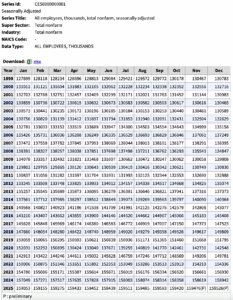
According to Bureau of Labor Statistics figures,* the average monthly net job gain in 2025 was 48,667. If we add to this number the 26,667 monthly DOGE job losses, we arrive, for 2025, at a monthly job-gain figure of 75,334. Yet even with this addition – that is, even if we assume that the ‘real’ average monthly net job gain in 2025 was 75,334 – it remains the case (as I wrote on Facebook) that “2025 was the third-worst non-recession year of the 21st century for job growth. Put differently, 19 of the past 26 years (for the year 2000 is included in these calculations) saw more job growth than did 2025.”
Here’s more perspective. From 2000 through 2024, excluding recession years and excluding also 2021 and 2022 (as the enormous job gains in these years might fairly be distorted by the recovery from covid lockdowns), the average monthly net job gain was 169,250. Even if DOGE hadn’t ended a single job, the resulting average monthly net job gain in 2025 of 75,334 is a paltry 45 percent of the average monthly net job gain dating back to 2000 (again, excluding recession years as well as 2021 and 2022; were we to include 2021 and 2022, the non-recession-year average monthly net job gain would be much higher, as during those two years an average of 491,000 jobs were added each month).
In short, the disappointing 2025 job-creation statistic is not an artifact of DOGE job cuts.
Sincerely,
Donald J. Boudreaux
Professor of Economics
and
Martha and Nelson Getchell Chair for the Study of Free Market Capitalism at the Mercatus Center
George Mason University
Fairfax, VA 22030* I attach here a screenshot of the monthly employment data.