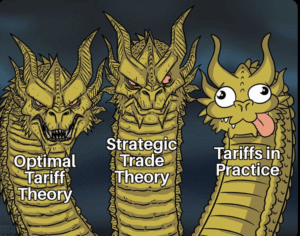
The lightly examined nostrums of our day are different. Consider Secretary of State Marco Rubio’s recent, widely (and justly) praised speech in Munich. He claims that “we embraced a dogmatic vision of free and unfettered trade” while other countries took advantage of us.
Really? Here’s Scott Lincicome writing in 2016, during the supposed reign of free-trade dogmatism:
First, although the United States maintains a relatively low average import tariff of around 3 percent, it also applies high tariffs on a wide array of “politically-sensitive” (read: highly lobbied) products: 131.8% on peanuts; 35% on tuna; 20% on various dairy products; 25% on light trucks; 16% on wool sweaters, just to name a few. (Agriculture is particularly bad in this regard.) We also maintain a long list of restrictive quotas on products like sugar, cheese, canned tuna, brooms, cotton, and baby formula. . . .
Second, while America’s tariffs and other “formal” trade barriers have indeed been declining for decades, they are only a small part of the overall story. U.S. non-tariff barriers – export subsidies, discriminatory regulations, “buy local” rules, “fair trade” duties, etc. – have exploded in recent years. In fact, according to a recent analysis by Credit Suisse, when you add up all forms of trade barriers imposed between 1990 and 2013, the biggest protectionist in the world isn’t China or Mexico but none other than… the United States.
Sounds pretty fettered.
John Puri praises Justice Neil Gorsuch’s concurring opinion in Learning Resources v. Trump.
Also applauding Justice Gorsuch’s concurring opinion in Learning Resources is David Henderson.
The smart play after his legal defeat would be to take an off-ramp and forgo or pause new tariffs. Instead the White House this weekend dusted off Section 122 of the Trade Act of 1974 as a work-around. That provision lets a President impose tariffs of up to 15% across the board for up to 150 days “to deal with large and serious United States balance-of-payments deficits.”
What a relic, which wasn’t intended to manage a trade deficit per se. Instead it’s a holdover from a bygone era of the gold standard, fixed exchange rates and periodic panics about global liquidity.
The balance of payments is much broader than the balance in the trade of goods or services. It encompasses an economy’s total international position, including trade and capital flows. These days the U.S. balance of payments deficit is effectively zero because trade and capital flows exactly offset each other. The balance of payments is such a nonissue that the feds stopped publishing several data series about it in the 1970s.
…..
The larger reality is that Mr. Trump is so bull-headed about tariffs that he’s going to re-impose them any way he can. Along with Section 122, he’ll fire up more Section 201, 301 and 232 (national security) studies and tariffs. But as our friend Don Luskin points out, these are pea shooters compared to the IEEPA tariffs the Court struck down. They are limited in scope and duration.
That isn’t to say they won’t do harm. They’ll create more uncertainty for business, at least for a while. And with the midterm elections coming soon, this timing is fraught for Republicans. Amid an “affordability” panic, Mr. Trump says he is going to impose more border taxes on enough imports to make up for his lost emergency tariffs. Democrats must be thrilled at their dumb luck.
I would only add that Trump destroyed whatever legitimate argument his administration had by exercising his powers in ludicrously capricious ways, announcing he increased tariffs on Canada because he didn’t like a television commercial and when he increased tariffs on Switzerland because he didn’t like the tone of the country’s former president. We can debate what the Founding Fathers intended about the powers of the presidency, but they surely did not intend that. A lot of leaders might be tempted to exercise powers in arbitrary and capricious ways and some may do it, but Trump is unique in that he feels the need to publicly brag about doing it.
The oral arguments went badly for the administration; no one following the issue should have been that surprised that the Supreme Court ruled the way that it did.
And yet, it triggered a presidential meltdown at the White House, with the whole world watching. Besides the accusation of foreign influence, Trump raged that the Supreme Court majority is “just being fools and lapdogs for the RINOs and the radical left Democrats. And not that this should have anything at all to do with it, they’re very unpatriotic and disloyal to our Constitution.” Echoing his previous nonsense claims about his former Vice President Mike Pence and the certification of the 2020 presidential election, he fumed, “They don’t want to do the right thing.”
In Trump’s mind, everyone who disagrees with him is always corrupt, driven by sinister motives, and likely part of some shadowy conspiracy. Everyone who agrees is always the best.
It was my pleasure to be a guest yesterday on Duane Lester’s radio program.
Philip Hamburger argues that California’s proposed wealth tax is an unconstitutional taking. Two slices:
California’s proposed billionaire tax is unconstitutional. The ballot initiative calling for one-time retroactive 5% tax on the net worth of the state’s billionaires has prompted much unease, but the legal arguments against it have remained elusive. It’s therefore important to recognize that this tax is an uncompensated taking or at least a deprivation of property without due process, contrary to the Fifth and 14th amendments.
…..
axes can be targeted without being unconstitutional. They can take aim at particular events, goods and materials, and exceptions can excuse particular companies. California’s tax, however, targets a small class of individuals, billionaires, and doesn’t burden anyone else, even for small amounts. This is distinctive and worrisome—particularly when imposing massive payments.Similarly, retroactivity isn’t uncommon, and taxes don’t have to be recurring. But when added to the targeting, these considerations confirm that the California measure is confiscatory.
The combination of these features sets the billionaire tax apart. A retroactive nonrecurring tax that profoundly targets a small group and no one else is an uncompensated taking or at least a deprivation of property without due process. It should, therefore, be held unconstitutional.
Kristian Niemietz asks if a wealth tax would reduce wealth inequality.
Your editorial “Edward H. Crane, Libertarian Builder” (Review & Outlook, Feb. 14) rightly celebrates Ed’s extraordinary contributions to libertarian ideas and institution-building. But another dimension of his legacy is worth noting: his commitment to free speech.
Ed said that the “core of libertarianism is a defense of free speech,” and he often put himself on the front lines of its defense.
As a Libertarian Party official, Ed gave testimony on behalf of the party, one of the plaintiffs in Buckley v. Valeo, the landmark 1976 Supreme Court case that saved free speech in election campaigns.
Ed joined me as a plaintiff in SpeechNow.org v. Federal Election Commission, in which the U.S. Circuit Court of Appeals for the District of Columbia ruled in 2010 that Americans had a First Amendment right to pool resources for independent political speech without contribution limits.
Ed also played a consequential role in shaping the Federal Election Commission. It was through Ed’s encouragement that Bradley A. Smith—then an emerging scholar on free speech—came to the attention of policymakers. That connection eventually led to Brad’s appointment to the FEC as a commissioner, where he became one of the most consequential advocates for free speech in the agency’s history.
After Brad left the FEC in 2005, he founded the Institute for Free Speech, with Ed as an original director. Ed’s invaluable guidance and support through the rest of his life demonstrated his passion for free speech.
Ed Crane leaves behind a remarkable legacy. For those of us defending free speech, it is a legacy we carry forward with gratitude.