This letter was submitted last week to the New York Times, but not published there.
Editor:
Ana Swanson reports on a new paper purporting to find, in Ms. Swanson’s words, “that American workers in communities that were more exposed to competition from Mexican imports saw a significant shortening of their life spans after the trade deal went into effect in 1994” (“‘A Lot of Life Years Lost’: How NAFTA Shortened American Life Spans,” March 13). One of the paper’s co-authors describes this apparent loss of life as “an underappreciated cost of globalization.”
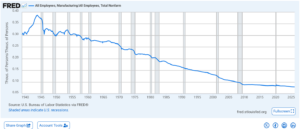
I’m skeptical that freer trade, by causing manufacturing job losses, is to blame for increased mortality. From 1958 through 1980, the average monthly rate at which manufacturing jobs were destroyed was 1.6%, or about 275,000 jobs each month. Yet during NAFTA’s first 15 years – the period studied by the paper – the average monthly rate at which manufacturing jobs were destroyed was lower, at 1.3%, or 206,000 jobs each month.* (NAFTA, by the way – using an estimate from the Economic Policy Institute, an anti-NAFTA outfit – destroyed each month a mere 3,900 jobs.)
Because U.S. life expectancy rose from 69.5 years in 1958 to 73.0 years in 1980 – and because manufacturing’s share of total employment was much higher in those years than it was in the years studied by the paper** – it’s likely that the increased mortality described in the paper was caused by something other than NAFTA specifically, or by globalization generally.
Sincerely,
Donald J. Boudreaux
Professor of Economics
and
Martha and Nelson Getchell Chair for the Study of Free Market Capitalism at the Mercatus Center
George Mason University
Fairfax, VA 22030
571-426-5751 (mobile & text)* Calculated from data found here.
**