Here’s a letter to the Harvard Gazette.
Editor:
Interviewed by Paul Massari, “China Shock” researcher David Autor correctly notes that the decline in U.S. manufacturing employment from 1999 through 2006 was unusually steep (“The Human Cost of Trade,” March 12). Mr. Autor is incorrect, however, to describe this ‘shock’ to employment in a major sector of America’s economy as being “unlike anything we have ever seen.” A somewhat larger ‘shock’ hit agricultural employment exactly 50 years earlier.
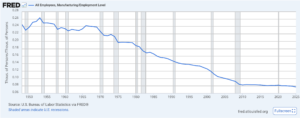
As a share of total employment, agricultural employment in 1949 was, at 13.3%, roughly the same as was manufacturing employment, at 13.0%, in 1999. And from 1949 through 1956 the absolute number of agricultural jobs fell by 18%, the same as the 18% fall in the absolute number of manufacturing jobs from 1999 through 2006. But because the workforce was smaller during that earlier period, the 1949-1956 fall in agricultural employment as a share of total employment was, at 26%, steeper than was 1999-2006’s 24% fall in manufacturing employment as a share of total employment.*
Notably, the steep mid-20th-century fall in agricultural employment had nearly everything to do with labor-saving technology and almost nothing to do with trade. (Although the U.S. ran agricultural trade deficits for most of those years, those ‘deficits’ were overwhelmingly driven by imports of coffee, which was never a major crop in the U.S.)
Mr. Autor can undoubtedly identify details that distinguish the “Farm-mechanization Shock” of the mid-20thcentury from the “China Shock” of 50 years later. But because the U.S. economy handled that earlier employment shock quite well even as agricultural employment as a share of total employment continued to fall (to less than 1.4% today), skepticism should greet Mr. Autor’s claim that the “China Shock” reveals a need for industrial policy to protect against employment shocks.
Sincerely,
Donald J. Boudreaux
Professor of Economics
and
Martha and Nelson Getchell Chair for the Study of Free Market Capitalism at the Mercatus Center
George Mason University
Fairfax, VA 22030*
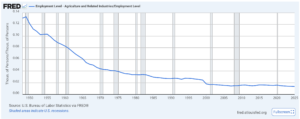
Agricultural employment as a share of total employment in the U.S.
Manufacturing employment as a share of total employment in the U.S.