

Clark Packard makes a powerful case that “Congress should retire Section 122.” A slice [original emphasis]:
My Cato colleague Kyle Handley has also laid out the historical case for why the administration’s Section 122 invocation doesn’t hold up. As he explains in a recent blog post, Section 122 emerged from the Bretton Woods era of fixed exchange rates, when a balance-of-payments deficit could become a direct claim on US gold reserves. Handley notes that French President Georges Pompidou literally sent a ship to New York to retrieve French gold deposits, a vivid illustration of the kind of payments crisis the statute was actually designed to address. Under today’s floating exchange rate system, no such problem exists—trade deficits are simply mirrored capital inflows. Handley also shows that the current account deficit in 2024, measured as a share of GDP, is not historically unusual and was well below the peaks registered in 2002–2008. Not even then did presidents declare a balance-of-payments emergency. As Handley, who also signed an economists’ amicus brief in support of plaintiffs challenging the Section 122 tariffs in the US Court of International Trade, surmises: “If ‘balance-of-payments deficits’ can be redefined to mean some politically salient trade imbalance, then Section 122 stops being a narrow emergency provision designed for a fixed-exchange-rate system and becomes a standing reservoir of discretionary tariff authority.”
David L. Cohen tweets: (HT Scott Lincicome)
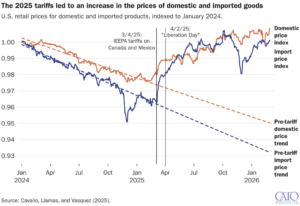
Visual of the Week: Facts are facts. Tariffs raise prices. After a steady decline through 2024, both import and domestic prices shot up right after the 2025 tariff moves, sharply reversing the downward trend line of domestic prices pre-tariffs. Not surprising given the consistent research findings that most tariffs are passed along to American consumers. And it’s also pretty clear that higher prices cut into purchasing power for businesses and consumers which slows economic activity.
Markets, however, are very good at responding to demand — unless they are unreasonably restricted from providing supply. (To be fair, Vance has also talked about the supply problem, and even Mamdani, as little as he understands markets, has been pushing for more housing construction, even with funds the city is supposed to be investing for its pensioners.) Imposing new tax costs on second-home housing, and trying to stifle demand by excluding institutional buyers from the market, is not the way to incentivize more housing construction.
My Mercatus Center colleague Satya Marar explains how to get bureaucracy out of broadband.
What’s the secret of affluence? In modern America, high-income households are powered not by a single breadwinner, but by two sustained professional careers. The Great Decompression—the phenomenon of incomes rising faster for families above the median—is often blamed on slow wage growth for middle-class men since the 1970s. But the rise of educated women is the true driver of the change.
Fifty years of progress in women’s education and career opportunities have led to professional men and women marrying each other, staying in the workforce and leaving traditional couples behind. Inequality between the sexes has declined, but inequality between classes has increased.
The two-income model is generating significant household wealth. The median two-income family today earns about $140,000, double what the median single-income family earns. Roughly 30% of two-income families have an income of more than $200,000 a year, compared with only 11% of single-income families. Today, more than two-thirds of young couples buying homes are dual-income. In the 1970s, the opposite was true.
The Editorial Board of the Washington Post reveals “what most predictions miss about AI job loss.” A slice:
Many people believe that there’s a fixed amount of work to be done, so changes in how the work is allocated are zero-sum. One person’s gain is another person’s loss.
This is not how labor markets actually work. The amount of work is never fixed because humans’ desire for goods and services is unlimited. AI will allow for new production opportunities that weren’t possible before, which will create new jobs that didn’t exist before.
Further, there’s no guarantee that a job will be automated simply because it can be.
It’s technologically possible to grow pineapples in Alaska. Heated greenhouses, with artificial lighting during the dark winter months, could yield fruit. But Hawaiian pineapple growers don’t have to worry about their jobs being taken by Alaskan rivals because it would be so much more expensive to grow pineapples there than in Hawaii.That’s an extreme example, but the principle holds: something being technologically possible doesn’t mean it’s economically possible. AI is expensive, and it won’t make financial sense for companies to automate many jobs that perhaps could be automated in theory.
My intrepid Mercatus Center colleague, Veronique de Rugy, debunks five zombie myths about taxation. A slice:
Corporations write checks to the IRS, but they don’t bear the tax burden. Every dollar collected for corporate tax comes from a human: the worker who’s paid a lower wage, the shareholder who earns less, and the consumer who pays higher prices at checkout. Research shows that workers bear somewhere between one-third and two-thirds of the corporate tax burden through lower wages. If you have a 401(k), you’re paying it too, quietly, through lower returns on every stock in the fund.
Further, corporate profits are returns on investment. Tax them and you get less investment. Less investment means lower productivity, which leads to lower wages over time. Decades ago, economists Robert Hall and Alvin Rabushka showed a better way: Replace the corporate income tax with a consumption-based system under which businesses deduct all wages and capital investment immediately. No double taxation, no penalty on investment, and revenue without unintended economic damage.
The corporate tax survives because voters mistakenly believe someone else pays it. This belief is expensive.
Stefan Bartl writes insightfully about the three ways governments finance themselves. A slice:
The second way America pays for government is through borrowing. If taxation is the visible bill presented to the public today, debt is the bill postponed until tomorrow. Public choice economics helps explain why this method is so politically attractive. Elected officials seek reelection, and few build careers on openly imposing higher taxes. Borrowing lets them preserve the benefits of spending while muting the immediate pain. The cost is not removed, only transferred. As James Buchanan argued in Public Principles of Public Debt, “The primary real burden of a public debt is shifted to future generations.” That is precisely what makes debt so tempting in democratic politics. Present officeholders get the benefit of spending, while later taxpayers, often not yet born, inherit the obligation.

