

Here’s a letter to Project Syndicate.
Editor:
Glenn Hubbard rightly denounces Trump’s tariffs, but he weakens his case by conceding, to protectionists, points that shouldn’t be conceded (“The Policy Pivot Trump Needs,” May 26). Most importantly, it’s simply untrue that what Mr. Hubbard calls “distributional effects” – the demise of some industries and jobs and the rise of others – are uniquely caused, as many protectionists insist, by trade deficits.
Any and all economic changes – including improvements in labor-saving technology and changes in consumer tastes – affect some domestic industries, jobs, and regions negatively as they affect other domestic industries, jobs, and regions positively. Nothing in economics or ethics justifies singling out for special consideration the “distributional effects” caused by foreigners’ strong desire to use their dollars to invest in the U.S. rather than to buy U.S. exports. Such a concession inadvertently treats as factual two of protectionism’s most egregious fallacies, namely, that trade with foreigners differs categorically from trade with fellow citizens, and that countries that run trade deficits suffer greater economic disruption than do countries with ‘balanced’ trade.
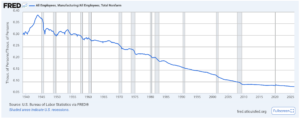
Mr. Hubbard also mistakenly accepts as true the false belief that the dollar’s role as global reserve currency is a “detriment” to manufacturing employment. The steady decline in U.S. manufacturing employment, as a share of total nonfarm employment, began in 1954 (only to slow down a bit starting in 2010).* If this decline in manufacturing employment resulted from the dollar’s reserve-currency status pushing manufacturing out of the U.S., U.S. manufacturing output would also have fallen. But it hasn’t. Today, U.S. manufacturing output is 153 percent higher than it was in 1975 (the last year the U.S. ran an annual trade surplus) and 464 percent higher than it was in 1954.
Mr. Hubbard should continue to speak out against protectionism. But his welcome voice would be stronger if he were to stop treating as factual so many of protectionism’s fallacies.
Sincerely,
Donald J. Boudreaux
Professor of Economics
and
Martha and Nelson Getchell Chair for the Study of Free Market Capitalism at the Mercatus Center
George Mason University
Fairfax, VA 22030* See attached screenshot.
…..
UPDATE: At Facebook, David Henderson offered this fair comment on my letter:
I read his piece and while I largely agree with your criticism, I didn’t find the part where he says the problems are uniquely caused by trade deficits.
Indeed, Hubbard wrote, “Trump’s economic agenda recognizes the adverse effects of globalization and technological advances on certain parts of American society, in contrast to economists’ emphasis on averages and overall benefits.” So notice that he granted part of your point–that technological advances can hurt certain segments of society.
And I replied there:
Fair enough. But the thrust of the piece is that the “imbalances” are real, with troublesome downsides that should be addressed, although with policies other than tariffs.
One can write a piece about the proper role of government in protecting workers from the downsides of economic change. But Hubbard’s piece is about trade – specifically, about what he (unfortunately) grants to be trade “imbalances.” I wonder how many readers will encounter his mention of technological advances and think that Hubbard is offering counsel, not about how to respond to trade deficits, but about how to respond to economic change more generally. I doubt many (but perhaps I’m mistaken). I’ll grant that the policies that Hubbard proposes at the end do address the more general phenomenon of economic change (rather than only change caused by trade or trade deficits). But, again, the thrust of the piece is about U.S. trade deficits, with the suggestion – if not strictly the logical implication – that these deficits are a sufficiently distinct source of economic problems, one that warrants attention and policy responses.

