

The tariff damage is already concrete. Toyota alone expects tariff-related costs to reach $9 billion in its current fiscal year and has warned of up to three separate price increases in 2026 if tariffs continue. It comes as no surprise, then, that the Wall Street Journal recently reported that companies like Honda, Nissan, and Toyota may have to pull affordable, entry-level cars off the market if the tariffs continue because those vehicles are no longer profitable. Meanwhile, new vehicle prices overall have surged back toward all-time highs since “liberation day,” with midsize SUVs jumping 2.8 percent, adding more than $1,300 to the sticker price. Used vehicles are no refuge: The Manheim Used Vehicle Index is up 6.2 percent since March 2025, as higher new-car prices push buyers into an already tight used-car market. Keeping older cars on the road is no bargain either: Auto repair costs are up 6.1 percent since March 2025, driven by tariffs on the more than 44 percent of collision parts that are imported.
The car, particularly the affordable car, is quintessentially American. Henry Ford famously wanted to make cars his employees could afford to buy. Thanks to his breakthrough assembly line, millions of everyday Americans discovered the joy and convenience of automotive travel. More than a century later, personal vehicles enable individuals to chase employment opportunities far from their chosen neighborhoods while juggling family responsibilities and maintaining in-person friendships despite the distance. Cars equal freedom and adventure. That is why the first edition of the Independence Index, published by Advancing American Freedom (AAF), where we work, tracked car affordability as a metric indicating Americans’ ability to pursue happiness. Affordability cratered post-Covid, as the number of weeks of median income needed to buy a new car skyrocketed from 34 weeks prior to Covid to 45 weeks by mid-2022. Prices have increased further since then. With maintenance costs increasing to more than 80 cents per mile, declining car affordability disincentivizes teenagers (barely one in three of whom are in the workforce) and those without a higher education from obtaining gainful employment.
The Cato Institute’s Alfredo Carrillo Obregon talks about the recent ruling against Trump’s Section 122 tariffs. (HT Scott Lincicome)
Brian Albrecht writes insightfully about AI and jobs. Four slices:
The economy is not one production function. It is many activities. When AI makes some of them cheaper, people don’t just buy more of the same thing. They buy something else.
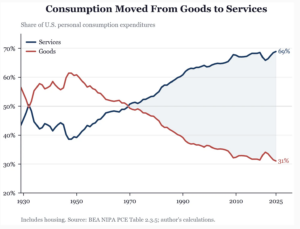
Every dollar you spend lands somewhere. Some dollars land in activities with lots of human labor inside them: a restaurant, a therapist, a roofer. Some land in activities with almost none: a streaming subscription, an automated checkout, cloud storage. So when we are tracing out what happens when AI gets cheaper, it’s not just “Can AI do my job?” It is “When everyone saves money because AI did my job cheaper, what do they buy next?”
…..
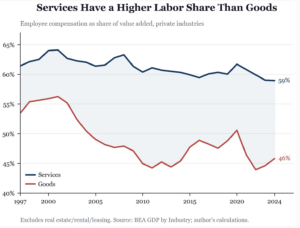
Start with software as a microcosm. This is a sector that has already been heavily automated by digital inputs for decades. If substitution were going to drive labor out of a sector, this is where you’d see it first…. The most software-intensive industries don’t just retain human labor; they have a higher labor share (67%) than the least software-intensive ones (55%). Heavy digital inputs didn’t drive out human labor. If anything, the industries that automated the most are the ones that spend the most on workers. BLS projects U.S. employment to increase by 5.2 million from 2024 to 2034. Software-developer employment? Up 17.9%, despite direct AI exposure.
…..
…..
Properly understood, this is a confession. It is, of course, patently untrue that one “can’t earn a billion dollars” in the United States, because around 1,000 people have done it. Some of those people — Michael Jordan, Tiger Woods, Magic Johnson, and LeBron James, to name a few — are in sports. Some, such as Steven Spielberg, Taylor Swift, and Jay-Z, are in entertainment. Many, such as Elon Musk, Jeff Bezos, and Palmer Luckey, are in business. All of those people “earned” their billion dollars and did so by providing something — athletics, movies, cars, music, technology — that people wanted to buy. That isn’t a “myth”; it’s as close to a stone-cold fact as exists in our economy. What Ocasio-Cortez means when she disputes it — what she is confessing — is that she can’t earn a billion dollars.
And, indeed, she cannot, because, to put it bluntly, she is useless. I have never understood why AOC’s critics like to razz her for having been a bartender. There is nothing at all wrong with being a bartender. Bartenders are useful. Bartenders supply a service that is in demand and, at the high end at least, are able to do things that most people cannot. The problem with AOC is that she is a socialist politician, and socialist politicians are to a dynamic economy as rice is to a garbage disposal. Were all the bartenders to disappear in a puff of smoke tomorrow evening, the United States would be a considerably worse place. Were all the socialist politicians to disappear, we would have occasion for the mother of all celebrations.
Also rightly critical of Ocasio-Cortez is Reason‘s Christian Britschgi.
David Henderson makes a strong case against the provision of TSA-style security for Amtrak.
It’s a gutsy decision, two weeks after 3.1 million Virginians voted to adopt the gerrymander, 51.7% to 48.3%. But don’t blame the court for this timing. All along, Justice Kelsey says, the state “insisted that we cannot lawfully decide this case prior to the referendum.” Democrats were betting that if the amendment won at the ballot box, the court would flinch at countermanding the will of the people.
Yet as the majority rightly holds, if the state Supreme Court can’t decide the constitutionality of the amendment before the vote, then it has to make the legal call afterward, unless Virginia is going to give up on judicial review. The upshot is that Virginia’s midterms will be held under the old House map, which is split 6-5 in favor of Democrats, more or less fairly reflecting the state’s purple politics.
Bill Conerly is a fan of Tyler Goodspeed’s Recession. A slice:
Tyler Goodspeed, Recession’s author, is unusual in not focusing on one particular issue. He describes a market economy as generally resilient in the face of small shocks. But an unusually large shock, such as the pandemic of 2020, can cause a recession. More commonly, the unlucky coincidence of several small shocks occurring at once will trigger recessions. Some economies are more resilient—handling the shocks better—especially with regards to their banking systems, a point Goodspeed emphasizes.

