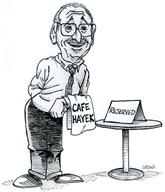
The federal government just closed fiscal year 2026 with a deficit of nearly $2 trillion, according to figures the Congressional Budget Office (CBO) released last Thursday. Only the two pandemic years of 2020 and 2021 were worse. Today, though, there is no recession and no emergency. These enormous budget deficits are the new normal.
The usual response to a deficit warning is that the government just needs more money. It doesn’t. Thanks to the remarkable strength of the private sector, federal revenue rose by 3 percent, to more than $5.4 trillion, over the fiscal year. But spending rose by 6 percent, reaching $7.4 trillion.
…..
As for Medicaid, the problem is one of pricing. And yet competition based on price—the best cost-control tool—has never been seriously tried. Washington covers 90 percent of the cost of states’ expanded Medicaid programs for adults. A state can buy a dollar of spending with just a dime of its own money. Changing the states’ incentives would be key here. Implementing risk-adjusted per-capita caps, through which the federal government would give states a fixed amount per enrollee, would do just that. States would pay for their own inefficiencies or would be able to use every dollar they save by becoming more efficient.
John O. McGinnis writes wisely about AI. Two slices:
Artificial intelligence presents two very different dangers. One is that AI systems will slip out of human control and wreak havoc. The other is that AI systems will do exactly what malevolent humans direct them to do. These dangers can coexist, but they have different implications for AI regulation.
Anthropic CEO Dario Amodei recently called for slowing frontier development to allow more coordination among leading firms and more time to test new models. Pacing the frontier may help with the first risk. But it likely delays the tools to address the second. Advanced AI is already being used to find software vulnerabilities and help repair them. Some companies are also giving selected defenders access to capabilities not available to ordinary users.
The first risk gets much attention because it is so novel. It is claimed that, for the first time, a technology we develop may act autonomously against our interests. Not surprisingly, because this is an unprecedented kind of danger, experts disagree about how serious the threat is. If the danger is that nobody can control the most advanced AI, then being the first country to build it doesn’t solve the problem.
The second danger is the opposite. The machine is dangerous because people control it. The problem is with our fellow humans: criminals, terrorists and officials of geopolitical adversaries, including authoritarian nations like China and Russia. Unlike a catastrophic loss of control brought on by autonomous AI, this all-too-human threat isn’t speculative. Throughout human history, evil people and tyrannical states have used the latest technology to cause massive harm. Here, slowing down AI may delay defenses against AI that the wrongdoers already possess or will acquire regardless of what we do.
…..
These dangers also show that even international treaties to slow down may create more risks. A treaty limiting future development wouldn’t remove models already in circulation. That genie is out of the bottle. Better AI may be our best defense against its granting the wrong wishes.
This point is even clearer when it comes to geopolitical threats. The U.S. government could take advantage of models from frontier companies, perhaps including more advanced ones that aren’t yet publicly available. This access could give the U.S. a military advantage that may be decisive in this technological age. And because other nations know this, they may be deterred from attacking in the first place.
Frontier AI is itself a firewall. Slowing its development can postpone new defenses and leave existing threats in place. A slowdown can cost protection as well as progress.
Beinhocker and Hanauer engage in a strawman argument by distorting or simplifying “libertarianism,” which can also be called “liberalism” or “classical liberalism” (Boaz 2015, p. 8). As David Boaz pointed out, “Libertarianism is the philosophy of freedom.… We should be free to live our lives as we choose so long as we respect the equal rights of others” (Boaz 2015, p. 1). Liberalism is not absolute freedom. Liberals going back to John Locke and Adam Smith bounded freedom by what Friedrich Hayek called “rules of just conduct.”
Two years ago, Democrat Sherrod Brown failed to win a fourth Senate term, losing by just 3.6 points while Donald Trump was carrying Ohio by 11.3 points. This year, Trump is as unloved in football-crazed Ohio as Michigan’s Wolverines. Brown probably will turn 80 in 2032 as a senator.
He plunged from Yale into politics, elected to the state legislature at age 21. His thinking is familiar to Ohioans after half a century advocating economic populism and cultural liberalism. He was for same-sex marriage during his seven terms in the House of Representatives, two decades before the Supreme Court settled the issue. His protectionist credentials are so impeccable he must feel plagiarized by Trump. He favored protectionism before this foolishness became fashionable.
Brown’s opponent, Sen. Jon Husted, was appointed in 2025 to the seat JD Vance filled for just over two years before becoming vice president. Husted’s thinking might not be a concern for voters. They might reasonably assume his convictions are supplied by the president, toward whom almost all congressional Republicans are vigorously subservient.
…..
Brown spoke about his devotion to Social Security, but not — why spoil a balmy autumn day? — about the 2032 exhaustion of its trust fund. There will be plenty of time after the election to ignore this certainty.