
GMU Econ alum Julia Cartwright is no fan of Mariana Mazzucato’s latest book. Two slices:
Something strange has been happening on the American right. A movement that spent the Reagan years quoting Friedrich Hayek now quotes industrial-policy memos with the enthusiasm Bernie Sanders reserves for Scandinavian tax brackets. Tariffs are statesmanship again; the state’s picking industrial winners is “strategic.” Meanwhile the left has rediscovered “the common good” as a rebrand of the dirigisme it never abandoned. Both camps agree on a diagnosis: Capitalism, left to itself, produced shuttered factories, BlackRock landlords, and a financial sector that exists mainly for itself. Both are right that something has gone wrong, and both are wrong about what it is.
What they’re describing, almost without exception, isn’t the failure of the free market. The state’s fingerprints are all over the scene of the crime, which features all kinds of interventions, from bailouts and occupational licensing to a tax code written by lobbyists for the companies that are lobbying the state. The left’s and the right’s misdiagnosis has led each side to prescribe more cronyism dressed up as benevolent planning. That confusion is the terrain Mariana Mazzucato claims with her new book, The Common Good Economy.
…..
The book’s opening chapters survey roughly 25 centuries of thought on “the good.” There are Plato’s philosopher-kings, Thomas Aquinas’s natural law, John Rawls’s veil of ignorance, and the communitarian critiques of Michael Sandel and Alasdair MacIntyre. All of it serves a single argument. Mainstream economics, Mazzucato says, “treats humans as isolated agents and markets as neutral mechanisms,” reactively patching market failures rather than pursuing collective goals. This is the book’s load-bearing wall, and it’s paper-thin. Economics studies individual decision-making because that’s the level at which decisions are made. This is not because economists are hostile to community but because they recognize that aggregate outcomes are the sum of millions of individual actions in response to prices, incentives, and information that not one person possesses in full. It is the same insight behind Leonard Read’s famous example: No single person on earth knows how to make a pencil completely, and yet pencils are being made by the billions. Read thereby makes a methodological claim about how strangers coordinate without a planner, not a moral claim about what’s good.
Mazzucato’s framing therefore amounts to faulting nature. But economics is a positive science that describes how scarce resources are allocated, not a normative one that certifies outcomes as virtuous or vicious. Nor does Mazzucato pause on the literally impossible problem lurking beneath her talk of “co-creation” and collective goal-setting. Nobel laureate Kenneth Arrow proved mathematically that no voting system, committee process, or method of collective deliberation can consistently aggregate everyone’s preferences into a single decision. “The common good” isn’t a destination that Mazzucato’s compass can locate. That she relitigates the individual-versus-collective distinction for three chapters without once seriously engaging the socialist-calculation debate — the argument decisively won by Hayek and Ludwig von Mises a century ago, about why no central planner can replicate the information that a price system aggregates from millions of dispersed decisions — suggests that the author’s straw man isn’t an oversight but a central feature of her thought.
From this shoddy premise, the remainder of the argument follows naturally. Mazzucato assumes that economics has little to say about coordination, incentives, or the unintended consequences of well-meaning government intervention. Each of her prescriptions proceeds as if public-choice theory didn’t exist. But this branch of economics, which applies to public policy the same assumption of self-interest that economists use to study markets, predicts that voters, politicians, and bureaucrats respond to incentives just as everyone else does. Mazzucato cites public-choice scholars James Buchanan and Gordon Tullock and defines “government failure” reasonably well but then ignores the concept over the next 200 pages. She envisions government as “an active shaper of markets” and a “public investor of first resort” that sets “conditionalities” on the firms it funds. She never asks what happens when state agencies are staffed with politically accountable humans who respond to incentives, get lobbied, and eventually see those agencies captured by the industries they’re meant to direct. She diagnoses regulatory capture as a market problem. To address it, she prescribes the exact mechanism — discretionary state power over capital allocation — that produces it.
Mazzucato is at her least convincing on business and finance. She revives Milton Friedman’s shareholder-value essay from 1970 as the villain of her story but never grapples with the mechanism that Friedman described: Profit, under competition, is a signal that a firm has created more value than it has consumed, and loss disciplines the firms that don’t. Mazzucato writes as if every dollar of profit is extracted rather than earned. She considers none of the people whom a profitable company makes better off: employees with paychecks, shareholders (including pension funds that hold ordinary people’s retirement savings), and customers who voluntarily hand over money for something they value more than the cash.
The Cato Institute has released its new report titled “Freedom in the 50 States.”
Since the White House is now plagiarizing Oren Cass’s stupid chart, here is the corrected version.
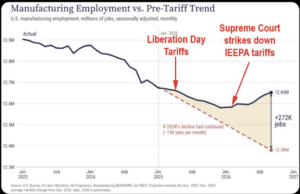
And just a reminder: the job/output gains are concentrated IN THE INDUSTRIES WITH THE LEAST TARIFF PROTECTION.