≡ Menu

Oh, Look Who’s Paying Trump’s Tariffs

Emeritus University of Tennessee economist Harold Black sent the following email to me this morning. I share it here with his kind permission.

Morning Don, Today I read your open letter to the president and this notice from ebay: “Due to US Customs policies, you will need to pay import fees for this order to the shipping carrier prior to delivery.” I thought the president said that the exporter paid the duty so should I refuse delivery because there must have been some mistake in that they want me to pay it?
All the best,
Harold

{ 0 comments }

Some Links

Roger Pielke, Jr., reports this great news: “Globally, 2025 has had one of the lowest annual death ratesa from disasters associated with extreme weather events in recorded history.” A slice:

What we can say with some greater confidence is that the death rate from extreme weather events is the lowest ever at less than 0.8 deaths per 1,000,000 people (with population data from the United Nations). Only 2018 and 2015 are close.

To put the death rate into perspective, consider that:

  • in 1960 it was >320 per 1,000,000;
  • in 1970, >80;
  • in 1980, ~3;
  • in 1990, ~1.3;

Since 2000, six years have occurred with <1.0 deaths per 1,000,000 people, all since 2014. From 1970 to 2025 the death rate dropped by two orders of magnitude. This is an incredible story of human ingenuity and progress.

To be sure, there is some luck involved as large losses of life are still possible — For instance, 2008 saw almost 150,000 deaths and a death rate of ~21 per 1,000,000. Large casualty events remain a risk that requires our constant attention and preparation.

But make no mistake, 2025 is not unique, but part of a much longer-term trend of reduced vulnerability and improved preparation for extreme events. Underlying this trend lies the successful application of science, technology, and policy in a world that has grown much wealthier and thus far better equipped to protect people when, inevitably, extreme events do occur.

Wall Street Journal columnist Allysia Finley argues that “the scandal of American welfare goes beyond fraud.” Two slices:

Economist John Maynard Keynes suggested that the government pay people to dig holes in the ground and then fill them up. This is an apt metaphor for progressive government these days: It creates social dysfunction, then shovels out money to correct it. Dredge, fill and repeat.

…..

The goal of the welfare-industrial complex isn’t to ameliorate social problems but to extract more money from the government. Social workers employed by a nonprofit—funded by hospitals and health insurers—spent recent weeks searching for undocumented immigrants to sign up for Medicaid before a deadline that would make them ineligible.

A story in the Atlantic this fall described how drug addicts and the mentally ill have been cycling in and out of California hospitals. Every emergency-room visit, typically covered by Medicaid, means more money for hospitals. It’s no coincidence that hospitals are the loudest opponents of Medicaid reforms.

California’s Medicaid spending—which pays for Native American exorcisms, music lessons, cooking classes and many other nonmedical services—has ballooned by nearly 50% over the last two years. “Healthy living starts with a chef in your kitchen. Paid by Medi-Cal,” one company advertises. A state audit last month flagged it as high risk for fraud, waste and abuse. You don’t say.

Say this for a union-backed ballot measure that aims to tax the wealth of billionaires to boost spending on Medicaid: It might awaken wealthy liberals to the welfare racket that masquerades as a public service.

GMU Scalia Law’s Ilya Somin offers sensible thoughts on the “capture of Maduro and Trump’s attack on Venezuela.”

Max Skjönsberg reflects productively on F.W. Maitland’s productive reflections on Adam Smith and trade. A slice:

Smith’s still valid argument for free trade was more skeptical and levelheaded than Bastiat’s theory of harmonious interests. In Maitland’s interpretation, Smith’s main point was that government interference failed to achieve the desired results, partly because of rent-seeking, but also because of the government’s inevitable lack of sufficient information (a view we more often associate with Hayek). Smith’s real service had thus been to show that government meddling with trade had been futile or even hurtful. His followers in the nineteenth century extended this insight to government interference in general. According to Maitland, this position was more solidly grounded in the limited knowledge of political leaders rather than the harmony of interests.

Maitland was sympathetic to the principle of what he called laissez-faire, as long as it did not rest on any notion of harmonious interests. In this way, he connected his discussion of economic policy with religious politics. “Religion and commerce seem ideas widely removed from each other, but yet in the eye of the statesman they have points in common,” he wrote. First, laws regulating commerce and religion were often futile, as it is too easy to smuggle goods as well as express forbidden opinions. Second, interference on the wrong side can produce the worst effects, by causing starvation or preventing the spread of truth. Third, it is very likely that government interference will be mistaken because of the lack of knowledge. Maitland concluded: “The most convincing pleas for laisser faire, and the most convincing pleas for religious toleration, are those which insist a priori on the great ‘probable error’ of any opinions on matters of religion, and matters of political economy, and those which relate a posteriori the history of the well-intentioned failures of wise and good men.”

Many of these arguments later became key to Hayek’s critique of central planning. Hayek was clear that individuals have diverse and often competing aims, which means that interests frequently clash. For Hayek, diverse interests could be best coordinated via the price system, whereby various actors communicate and reach compromises. The price system, rather than government interference, is the proper mechanism for coordinating competing interests, because of the impossibility of government officials possessing enough information to organize the different parts of the economy effectively. The emphasis on the coordination of clashing interests rather than natural harmony is also arguably a more fruitful way of understanding The Wealth of Nations. Maitland’s reading of Smith thus helps us to disentangle the more realistic elements from the utopian strands of the classical liberal tradition.

Here’s the abstract of a new paper by Viral Acharya and Toomas Laarits (emphasis added): (HT Scott Lincicome)

We explain how the “Tariff War” shock of April 2025 affected the safe-asset status of US Treasuries. Convenience yield erosion for long bonds is consistent with a reduction in the hedging property, reflected in a rising stock-bond covariance. Decomposing the Treasury yield into risk-free rate, credit spread, and convenience yield components reveals that covariance due to the convenience yield component increased for long bonds. The short end of the Treasury curve, however, continued to exhibit the safe-asset hedging property. These effects are consistent with a withdrawal of safe-asset investors from long-term Treasuries and a rotation towards shorter-term Treasuries and gold.

Mitchell Bahnsen is correct: “The threat to the modern media landscape isn’t Netflix or Paramount — it’s regulation that protects incumbents and strangles competition.” A slice:

As free markets come under fire from the political right as well as the left, it has become fashionable in Washington to be suspicious of mergers that could reduce competition, thereby leading to higher prices, fewer options for consumers, and weaker incentives to innovate. In the media sector, it is argued that vertical integration — unified control of content’s production and distribution — risks creating barriers to entry for smaller studios or streaming platforms. This would allow dominant firms to dictate terms to filmmakers, theaters, or talent agencies. Critics also argue that large, oligopolistic media firms would be risk-averse, relying on existing franchises instead of backing new creators. Even if they do innovate, it may be more defensive or incremental relative to the disruptive creativity of newer entrants.

The problem with such criticisms is that, for the most part, they assume that the media market is static and unchanging. That is an assumption that overlooks how quickly the marketplace can change, an odd thing to disregard given how rapidly the rise of streaming services like Netflix disrupted traditional entertainment media. The same dynamism that restructured the entire media landscape over the course of 15 years can also uproot a large corporation’s market share, even after an acquisition that makes it appear “too big to fail.”

The Austrian political economist Joseph Schumpeter famously argued that one of the components of an effectively functioning capitalist system is capitalism as creative destruction, the process by which a new product or service — or even a whole way of business — can disrupt an entire industry based only on what best meets the consumer’s needs. It is a common phenomenon, as markets are reorganized through waves of disruption, old business models collapse, and new industrial configurations emerge. The rise of streaming and the associated decline of legacy television, cable, and moviegoing are the result of technological innovations that consumers preferred over their predecessors.

Mergers are typically the response to such market changes, not the cause of them. Preventing consolidation could freeze industries rather than allowing them to transform, while the strengthened market power or even “temporary monopoly” that mergers create can encourage innovation from challengers, not the reverse. As Schumpeter points out, “In capitalist reality as distinguished from its textbook picture, it is not the large firms that hamper progress. . . . On the contrary, they are the most powerful engine of progress . . . because they are in a position to finance innovation on a large scale and because they have something to lose: the gains from temporary monopoly.”

Mark Perry remembers that “the ‘warmth’ of collectivism in East Germany was so intense that they had to build a wall to contain it.”

{ 0 comments }

Quotation of the Day…

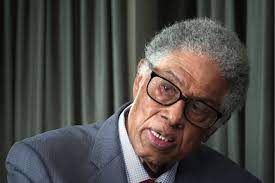
… is from page 152 of Thomas Sowell’s Compassion Versus Guilt, a 1987 collection of some of his popular essays; specifically, it’s from Sowell’s June 14th, 1985, column titled “Chances versus Guarantees”:

People who bought homes in a quiet little town often become resentful when other people begin moving in, expanding and changing the community. They pass laws depriving other people of the right to buy and sell property freely. The excuse for depriving other people of their rights is that the people who were there first came to enjoy an atmosphere and lifestyle that will no longer be the same if they can’t keep others out.

What the original people paid for when they moved in was a chance for a particular way of life – not a guarantee. If they wanted a guarantee, they would have had to buy up the surrounding property as well. Instead, they go into court to get a guarantee free of charge.

American laws call for equal treatment and property rights. Yet people who happen to have been in town first are treated as more equal than others. Judges wave aside both the equal-treatment principle and property rights, in order to transform the chances that were originally bought into permanent guarantees. From an economic point of view, it’s the same as if judges declared that everyone who bought a raffle ticket [for a chance to win a car] is entitled to a car.

DBx: Profound and important.

Notice that the same principle applies to jobs. When protectionists plead for high tariffs to protect the existing jobs of particular workers, they plead for transforming workers’ ‘purchase’ of a chance not to lose those jobs into a guarantee – a guarantee paid for by fellow citizens in the form of higher prices for goods and services, as well as lost economic opportunities. The workers for whom protectionism is demanded could, after all, greatly increase their chances of keeping their current jobs by paying to do so – specifically, by taking wage cuts or by working harder with no corresponding increase in pay. But, obviously, these workers don’t themselves value the additional job security and non-wage benefits of their existing jobs highly enough to pay for these benefits themselves. These workers, however, are more than happy to have other people pay for these benefits. Protectionism is a means of compelling other people – mostly, fellow citizens – to pay for these benefits.

The core case for protectionism offered by Oren Cass, for example, is pretty much as described above. Ironically, Cass accuses free traders of being narrowly obsessed with money while, in contrast (he says) he and the workers whom he champions have higher, nobler, non-economic goals. But in fact the goals that he and the workers whom he champions have are neither non-economic nor ‘higher.’ The goals they have are not only very much economic (‘keep my job without having to take a pay cut’), they also are greedy in the accurate sense of this term (‘I want other people to pay for the benefits I enjoy but am unwilling myself to pay for; I want to force other people to subsidized my standard of living.’)

{ 0 comments }

Another Open Letter to Tariff Man

Mr. Donald J. Trump
President, Executive Branch
United States Government
1600 Pennsylvania Ave., NW
Washington, DC 20500

Mr. Trump:

On New Year’s Eve your office released a “Fact Sheet” stating that you “imposed reciprocal tariffs to take back America’s economic sovereignty, address nonreciprocal trade relationships that threaten our economic and national security, and to remedy the consequences of nonreciprocal trade.”

Two things.

First, by its nature, all trade is reciprocal. Each party gives something to the other party and receives in exchange something that each party values more highly. Therefore, your punitive taxes – a.k.a. tariffs – on Americans’ purchases of imports are aimed at correcting a problem that doesn’t exist.

Your only possible retort that would retain as much as a tenuous connection to logic would be to insist that foreigners regularly dupe us Americans into buying things that we don’t want to buy – that is, to insist that we Americans are incurably stupid at conducting our own economic affairs, while foreigners are so astonishingly clever that they routinely swindle us out of our own money. Do you, sir, really believe that your fellow Americans are generally the intellectual inferiors of foreigners?

Second, by obstructing each of your fellow Americans’ voluntary, peaceful trades with foreigners you diminish the economic sovereignty of each and every one of us. What (il)logic leads you to conclude that by obstructing – with your taxes on our purchases of imports – the economic sovereignty of 340 million Americans, you thereby “take back America’s economic sovereignty”?

Your tariffs do for us Americans the opposite of what you assert: they diminish our economic sovereignty and, in this sorry bargain, also make us poorer than we’d otherwise be.

Sincerely,
Donald J. Boudreaux
Professor of Economics
and
Martha and Nelson Getchell Chair for the Study of Free Market Capitalism at the Mercatus Center
George Mason University
Fairfax, VA 22030

{ 0 comments }

Some Links

George Will describes the Trump administration’s recent actions in Venezuela as “monster-hunting, untainted by a whiff of legality.” A slice:

As Bishop Joseph Butler (1692-1752) said, “Everything is what it is, and not another thing.” Narcotics trafficking is a serious crime. It is not a terrorist activity. Neither is the self-“poisoning” of Americans who ingest drugs.

So, the administration must improvise post facto rationalizations for the forcible regime change in Venezuela, rationalizations harmonious with the president’s recent pardoning of Juan Orlando Hernández, the former Honduran president convicted in a U.S. court of shipping here more than 400 tons of cocaine. “The Honduran regime,” McCarthy writes in National Review, “figures prominently in the indictment of Maduro brought by the first Trump administration.” Maduro’s lawyers will have fun with this.

And perhaps with this: When Theodore Roosevelt asked Attorney General Philander Knox to concoct a legal justification for the unsavory U.S. measures that enabled construction of the Panama Canal, Knox replied, “Oh, Mr. President, do not let so great an achievement suffer from any taint of legality.”

Also writing about Trump’s seizing of Maduro is Washington Post columnist Megan McArdle. A slice:

It’s hard to imagine a worse leader for Venezuela than Nicolás Maduro, who combined corruption, economic mismanagement and brutal repression in one repulsive package. That doesn’t mean America was right to invade the country and arrest him, which strikes me as both unconstitutional and unwise. And while it’s hard to imagine a worse leader than Maduro, that doesn’t mean there isn’t one out there, waiting in the wings.

The Cato Institute’s Ian Vásquez, Justin Logan, Brandan Buck, Marcos Falcone, Katherine Thompson, Clark Neily, and Jeffrey Singer ponder Trump’s seizure of Maduro.

Reason‘s Eric Boehm explains what shouldn’t – but, alas, what nevertheless today does – need explaining, namely, Trump should have gotten Congressional authorization if he wanted to strike Venezuela and capture Maduro.” A slice:

The U.S. Constitution gives Congress the sole authority to approve military strikes against foreign countries. Federal laws, like the War Powers Resolution, allow for unilateral executive action only in response to an imminent threat against Americans or U.S. troops. That separation of powers is fundamental to American democracy—not an optional arrangement for presidents to discard when it is politically or logistically inconvenient.

At a press conference on Saturday morning, President Donald Trump termed the attack an “extraordinary military operation,” which he claimed was unlike anything seen since World War II. Therefore, there should be no debate about what this was: a military strike, one that utterly lacked congressional authorization.

Trump also clarified that the U.S. would “run the country until such time as we can do a safe, proper, and judicious transition” to a new leader. “We are going to stay until such time as a proper transition can take place,” he added.

Again, that leaves little room for debate. This was a regime change operation, and one that creates an ongoing responsibility for the American military.

Vice President J.D. Vance tried a different line of argument earlier on Saturday, when he claimed on X that Trump did not need congressional authorization for the attack on Venezuela because “Maduro has multiple indictments in the United States for narcoterrorism. You don’t get to avoid justice for drug trafficking in the United States because you live in a palace in Caracas.”

That argument, however, shreds the concept of separation of powers. The executive branch makes indictments. If it is also allowed to use the existence of those indictments to authorize military strikes in foreign nations, then there is no need for Congress to be involved at all.

Carlos Martinez assesses 67 years of communism in Cuba. A slice:

Even Cuban economists largely agree that the island’s problems stem not from the U.S. embargo but from the regime’s own policies. In addition, recent research by João Pedro Bastos, Jamie Bologna Pavlik, and Vincent Geloso found that the embargo explains only 3–10% of Cuba’s economic decline. The real culprits are nationalizations, the destruction of private property and markets, and their replacement with centralized economic planning. By 1989, even before Soviet support collapsed, these policies had already made Cuba approximately 55% poorer than it would have been otherwise.

Why haven’t Trump’s tariffs had a bigger impact?” (HT Scott Lincicome) Three slices:

President Trump raised the taxes that the United States charges on imports last year to levels not seen in a century.

Prices of goods have increased as a result, and businesses that depend on imported products and supplies have struggled, with some closing their doors. Still, the effects have not been felt as strongly as some experts predicted after early April when Mr. Trump announced double-digit tariffs on imports from countries worldwide.

A new working paper from economists at Harvard and the University of Chicago helps explain why. It shows that the tariff rate importers have paid is significantly lower than the tariff figures that Mr. Trump announced. The reasons include exemptions for certain countries and industries, rates that were lowered for some goods by the time they arrived in the U.S. and evasion of the rules by some companies.

By analyzing the government’s tariff revenue and the value of imports, the economists concluded that the actual U.S. tariff rate was 14.1 percent at the end of September.

…..

This phenomenon does not mean that tariffs don’t burden U.S. companies and consumers. The researchers demonstrated that Americans were bearing the cost of Mr. Trump’s tariffs, in contrast to what he and his advisers have claimed.

….

U.S. consumers and manufacturers are also paying higher costs. A working paper published in November by economists at Harvard Business School and elsewhere found that tariffs had pushed up the price of imported goods by roughly twice as much as domestic ones.

Ms. Gopinath and Mr. Neiman also traced the effect of tariffs on U.S. manufacturers, which often depend on foreign parts and metals. They found that companies making heavy-duty trucks, construction vehicles, cars and car parts, agricultural implements, and oil and gas machinery were among the most affected by higher tariffs.

“The logic was if foreign firms wished to sell to the mightiest consumer market in the world, they would have to pay a price,” Ms. Gopinath said. “In reality, the price has been borne by U.S. firms, and not by foreign firms.”

Writing at Civitas Outlook, Jon Miltimore reminds us of warnings by Hayek and Orwell that the more the state takes charge of people’s lives, the more it corrupts our access to, and grasp of, truth. Two slices:

The COVID-19 pandemic was a vast economic experiment. The federal government issued a wide array of public health “recommendations” that soon became dogmas. To question the efficacy of masks or social distancing — a policy we learned in 2024 had no basis in science — was to risk being censored or accused of spreading “misinformation.” Scientific debate gave way to official decree, and many who questioned “the plan” or resisted it lost their jobs or were booted from platforms.

None of this would have surprised Hayek, who warned that the plans constructed by central planners must be “sacrosanct and exempt from criticism.”

“If the people are to support the common effort without hesitation, they must be convinced that not only the end aimed at but also the means chosen are the right ones,” he wrote. “Public criticism or even expressions of doubts must be suppressed because they tend to weaken public support.”

Hayek’s chapter is not primarily about censorship. Instead, he argues that the rise of state power will systematically undermine the concept of truth itself and the human pursuit of it.

…..

The economist Daniel Klein recently called “The End of Truth” the most important chapter in Hayek’s most important work. I couldn’t agree more. The chapter serves as a reminder that the human mind is not something to be controlled but something to be unleashed. If we forget this simple lesson, we risk surrendering the very capacity for independent thought that sustains civilization.

“The tragedy of collectivist thought,” he noted, “is that, while it starts out to make reason supreme, it ends by destroying reason because it misconceives the process on which the growth of reason depends.”

In March, 250 years after the publication of Adam Smith’s An Inquiry Into the Nature and Causes of the Wealth of Nations, a new oratorio – to be performed by the New York Philharmonic – will celebrate this magnificent work. (HT Tyler Cowen)

Gustavo Dudamel — the Oscar L. Tang & H.M. Agnes Hsu-Tang Music & Artistic Director Designate — conducts the World Premiere of the wealth of nations, a highly anticipated commission from the Pulitzer Prize–winning composer David Lang. Inspired by economist Adam Smith’s 1776 magnum opus, Lang dramatizes this foundational work about economics as inspired by Handel’s treatment of Biblical texts in Messiah. “I want this work to be enjoyable and thought-provoking,” says Lang, “encouraging audiences to consider what we truly value.”


{ 0 comments }

Some Links

Steven Greenhut decries the current condition of the Republican Party. A slice:

We’ve become numb to narcissistic rage posts from our president, but the highly publicized Turning Point USA convention last week offers a preview into where the Republican Party is going after Donald Trump exits the stage. It’s not pretty. As we’ve seen recently in other squabbles within the conservative movement, the fireworks centered on the rhetoric of some conspiracy minded—but highly popular—right-wing personalities. TPUSA had it all: in-fighting, name-calling and innuendo.

In the old days, the conservative movement tried to police itself, as it shoved authoritarians and conspiracy theorists to the sidelines. Buckley took on the John Birch Society, which in its zealous anti-communism argued the United States government was controlled by communists. Standing up to the Evil Empire was a core part of conservative philosophy, but Buckley realized that allowing the fever swamps to engulf his movement only tarnished that goal.

Some critics argue Buckley wasn’t all that successful, but he was successful enough to keep the party from becoming what it has become now—where reasonable voices are drowned out by the likes of Nick Fuentes, Tucker Carlson and Candace Owens. If there are no adults in charge—and the party’s leader acts like a toddler, as he savages his foes in petty tantrums, renames buildings after himself and adds insulting White House plaques below the portraits of former presidents—then the whole trashy movement will one day be heaved into the dumpster.

Dan Rothschild offers this reason for optimism: The ideas currently peddled most prominently by politically ascendant individuals on the right and on the left are all old ideas. Two slices:

Put simply, fighting old bad ideas is a very different task in terms of scale, scope, and challenge than fighting new bad ideas.

The online new right is awash with intellectual energy, but it is almost entirely placed into service of revanchist efforts to re-popularize old bad ideas, or in the American context, to take various strains of foreign conservatism that have never had purchase in the United States and bring them to our shores. Among the more prominent of the online right philosophers is Curtis Yarvin, the Pied Piper of the so-called Dark Enlightenment. Yarvin has certainly been prolific over his decades of blogging and popular writing. But his underlying idea—that America needs to replace the constitutional order with an unelected CEO-king—is simply a pre-modern absolutist, non-hereditary monarchy with 21st-century characteristics.

Yarvin’s affect is novel, no doubt. Rather than writing for clarity, he seems to relish purple prose, non-sequiturs, and halting transitions. As John Horvat wrote for Law & Liberty, “He is brash, sarcastic, skeptical, and cynical. His style is irreverent and vulgar. He cares little for rules and formality.” No doubt he’s a good marketer to the very online set. But adopting the cocky, rebellious mien of a very online 21st-century Mick Jagger doesn’t make his ideas original.

The Catholic integralists similarly embrace an explicitly medieval view of the relationship between temporal authorities and religious ones; to wit, they believe as a normative proposition that the former should be directed by the latter. Not only is there nothing new about this idea (it was, of course, the pre-modern status quo throughout most of Europe), but it is also, as Law & Liberty contributing editor James Patterson has shown, based on a conception of Catholicism with no historical background in the United States. The story of modern Christian nationalism, to the extent it’s even a discernible ideology, is largely the same.

The less intellectual corners of the new right offer something even less novel; ideologically, they present a grab bag of racial essentialism, ethnic grievance, and antisemitism of varying degrees of gentility. As with Yarvin, novelty here is restricted to the realm of presentation and promotion, in particular, a delight in subverting social norms of decency.

…..

F. A. Hayek wrote that “old truths … must be restated in the language and concepts of successive generations.” So too must the critiques of the old falsities. In this regard, we find ourselves at least somewhat fortunate: old bad ideas may be making a comeback, but we stand on the shoulders of giants as we square up to the task of placing them back on the ash-heap of history. We cannot desist from the battle of ideas, but our task is qualitatively different than when we were facing genuine intellectual innovation and foment from illiberals on the left and right.

C. Jarrett Dieterle urges progressives not to “force 20th-century rules on 21st-century workers.” A slice:

According to surveys, gig workers prioritize flexibility and autonomy. Imposing one-size-fits-all rules will result in outcomes such as arranged scheduling for car-share drivers.

In other words, drivers will have less ability to spontaneously log into their apps and earn extra cash whenever they can fit it in. Many companies are likely to restrict and control the number of drivers allowed on their platforms at any one time to manage heightened labor costs under the new rules.

Ultimately, there are better options for helping gig workers. Concepts such as a portable benefits model, which establishes flexible benefit funds that operate similarly to retirement accounts for the self-employed, would allow drivers access to more of the benefits available to full-scale employees without unduly restricting flexibility. A bevy of states, including deep-red Tennessee, deep-blue Maryland and purple Pennsylvania, have launched portable benefit pilot programs in recent years, underscoring the bipartisan potential of this alternative model.

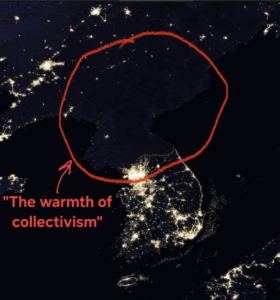
Pictures are sometimes worth much more than 1,000 words – as here, exposing the cluelessness of a newly (in)famous four words. (HT David Henderson)

Pondering Comrade Mamdani’s promise of “the warmth of collectivism” is the Editorial Board of the Wall Street Journal. A slice:

The inaugural address of a mayor isn’t typically of national interest, but Zohran Mamdani is an exception. The New York City mayor’s speech on New Year’s Day laid out the large scope of his socialist ambition and how little it is rooted in reality.

Give him his due: He has real charisma and political talent. While he says Bernie Sanders is his hero, Mr. Mamdani is the anti-Bernie as a political actor: smiling not snarling, more optimistic than aggrieved. He can almost make socialism sound appealing if you missed the last century, which as it happens he did.

But every so often the 34-year-old mayor says something that reveals his harder-edged politics. In his inaugural it was this: “We will replace the frigidity of rugged individualism with the warmth of collectivism.”

That line could only be uttered by someone who overlooks the human misery that has been visited in the name of “collectivism.” The greatest killers of the 20th century put the virtues of the collective above individual rights and liberty. For the cold reality of collective warmth, we recommend “One Day in the Life of Ivan Denisovich” by Alexander Solzhenitsyn. It was a very cold day in Siberia.

Also appalled by the historical ignorance or indifference of Metropolis’s new mayor is Jonah Goldberg. (HT Scott Lincicome) A slice:

Colloquially, the reason collectivism acquired a bad odor that sometimes even communism did not emit was because of collectivization. At least when one denounces communism, communists spout the usual “but true communism was never really tried!” Precisely because of its bloodless academic nature, the word “collectivism” evades such defenses. No serious person can claim that “true collectivism was never really tried,” in part because, again colloquially, collectivization is the fully realized act of putting collectivism into practice.

The Soviets used collectivization to describe their effort to transform agriculture, and they killed millions in the process. In Ukraine in the early 1930s, collectivization led to such mass man-made starvation and cannibalism that Soviet authorities had to distribute posters that read, “To eat your own children is a barbarian act.”

When I first heard Mamdani refer to the “warmth of collectivism,” I immediately thought of Anne Applebaum’s Pulitzer Prize-winning Gulag: A History. In one scene, she describes how a slave-laborer fell in the snow from exhaustion. The other slaves—and they were slaves, owned by the state, as Chamberlin would put it—rushed to strip the fallen man’s clothes and belongings. The dying man’s last words were, “It’s so cold.”

Collectivization under Mao’s “Great Leap Forward” led to millions more Chinese famine deaths from 1959 to 1961—from a lowball estimate of 20 million to a high of 45 million.

Now, I don’t for a moment think Mamdani has anything like that in mind. Moreover, even if he did, nothing like that can be orchestrated from New York’s City Hall.

But here is what I do think is interesting and worrisome about his use of the term “collectivism.” I can only think of three possibilities for it: 1) Mamdani is ignorant of the term’s historically grounded connotation, 2) he knows it and doesn’t care, or 3) he knows it and does care.

Under the second and third options, he could be trying to reclaim the positive connotation of collectivism—a connotation it has not had for at least a century. Or he could be trying to troll people—like me—into attacking him and overreacting to a word his fans have no problem with.

I suppose there’s a fourth possibility. He has a bad speechwriter—or is one—and just made a stupid, lazy mistake. After all, he could have used “community,” “communal,” “solidarity,” “cooperation,” “shared sacrifice,” or some such treacle.

{ 0 comments }

Quotation of the Day…

is from pages 128-129 of Norbert Michel’s excellent, data-rich 2025 book, Crushing Capitalism: How Populist Policies are Threatening the American Dream:

Critics who are dissatisfied with America’s free-enterprise economy reject the notion that people’s voluntary associations in markets, civil society, and families benefit the common good. By implication, these critics want whoever is in power politically to define the common good.


On the other hand, a true free-enterprise system that maximizes people’s ability to freely cooperate to improve their lives produces the closest to a broadly agreed-upon version of the common good. One of the main reasons that the critics’ approach has repeatedly failed is that it denies this reality. Instead, it empowers one small group of people to define the common good for everyone else. Tragically, supporters of this scheme ignore the evidence that more economic freedom leads to more opportunity and more prosperity, and that government barriers to economic freedom reduce people’s ability to improve their lives.

{ 0 comments }

Here’s another follow-up letter to a new, and persistent, correspondent.

Mr. L__:

Thanks for sharing the Wall Street Journal report that mentions that, in response to Trump’s tariffs, Nissan is producing more automobiles in the U.S. You conclude that “this is a clear victory for Americans, and, vindication of the president’s tariffs.”

Not so.

First, because producing these vehicles in the U.S. is more costly than producing them abroad, insofar as these vehicles will be offered for sale to Americans, American automobile buyers are made worse off because they’ll pay higher prices. At the very least, neither you nor Trump has any way to know if the gains to U.S. autoworkers from Nissan’s expanded U.S. production exceed the losses inflicted on American auto purchasers.

Second, Nissan’s increase in U.S. automobile production necessarily decreases U.S. production of other goods and services. These tariffs draw American workers, capital, and raw material away from activities at which they have a comparative advantage and into an activity for with they have a comparative disadvantage. The productivity of the U.S. economy falls, causing economic growth over time to be lower than it would otherwise be.

Suppose Trump hires hoodlums to prevent your household from, say, buying chicken from supermarkets and other specialized suppliers. As a result, you set up chicken coups in your backyard and commence to raise and slaughter your own chickens. Your neighbor then shows up, and admiring your chicken coups and observing the time and energy that you and your family members exert to supply your own chickens, announces that Trump has engineered a “victory” for you: Before his intervention, no chicken production occurred in your household, but now, because of Trump’s intervention, you produce your own chickens.

Surely you’d regard your neighbor’s announcement as cockamamie. If it were in your best interest to produce chickens yourself, you’d do so absent Trump’s intervention. The very fact that you produce your own chickens only because Trump has made it too costly for you to acquire chickens from specialized suppliers means that Trump’s protectionism has made your household, not better off, but worse off. The same logic applies to the U.S. and its acquisition of automobiles.

Sincerely,
Donald J. Boudreaux
Professor of Economics
and
Martha and Nelson Getchell Chair for the Study of Free Market Capitalism at the Mercatus Center
George Mason University
Fairfax, VA 22030

{ 0 comments }