≡ Menu

Quotation of the Day…

… is from pages 179-180 of Mark Zupan’s 2011 Cato Journal paper, “The Virtues of Free Markets” (link added):

In his award-winning The Invisible Hand of Peace, [Patrick J.] McDonald (2009) undertakes a painstaking empirical analysis of hundreds of conflicts between nations over the past two centuries. He finds that the propensity of nations to promote free markets when it comes to matters of international trade is positively correlated with a reluctance to resort to war. Furthermore, a laissez-faire attitude with regards to international trade is a better predictor of peace than democracy. McDonald argues that this is because democracies still can be associated with systems of poorly defined private property rights that lead to greater zero-sum redistribution and unproductive rent-seeking. Waging war against other nations is but an extension of such a zero-sum mentality.

{ 0 comments }

Some Links

The Wall Street Journal‘s Editorial Board ably defends Ronald Reagan’s free-trade creds against the Trump administration’s baseless efforts to conscript Reagan into its protectionist ranks. Two slices:

The MAGA crowd likes to dismiss Ronald Reagan as irrelevant today, but apparently he still matters to President Trump. How else to explain Mr. Trump’s tantrum against Canada after the province of Ontario invoked the Gipper on trade in a television ad?

The Ontario government had the temerity to buy ad time to run clips of Reagan’s 1987 remarks warning about the dangers of protectionism. Mr. Trump pitched a social-media fit in response late Thursday, claiming Ontario “fraudulently used an advertisement, which is FAKE, featuring Ronald Reagan speaking negatively about Tariffs.”

The President said the ad was intended to interfere with the Supreme Court as it considers the legality of his claim that he can levy tariffs on anything he wants, for any amount he wants, whenever he wants. He immediately declared an end to trade talks with Canada.

Ontario then said it would pull the ad, but when it still ran during sporting events on the weekend, Mr. Trump escalated with an additional 10% tariff on Canadian goods on top of the taxes he has already imposed.

The Supreme Court isn’t likely to be influenced by anything other than the law, but Mr. Trump’s Canada eruption is a good argument for the Justices to rein in his tariff power. The President gets angry at a TV ad and imposes on a whim a 10% tax on Americans who buy goods from their northern neighbor. Mr. Trump claims he’s not “a king,” but on tariffs he is acting like one, and without a proper delegation from Congress as the Constitution requires.

…..

Mr. Trump has been fortunate that his tariffs haven’t triggered much retaliation, which has spared us from a global trade war. But the tariffs are doing economic damage by raising costs for consumers and businesses and by dampening animal spirits that should be soaring with his tax bill and deregulation. He can boast about tariffs all he wants, but he shouldn’t get away with taking Reagan’s trade beliefs in vain.

Katherine Mangu-Ward reports on the Trump administration’s abuse of “emergency powers.” Two slices:

But the intense acceleration of the quest to aggregate power in the White House is now unambiguously the more immediate threat to liberty. It’s visible every day on my commute to work, as National Guardsmen linger in my D.C. Metro stop. It’s visible in the September gathering of the nation’s top military officials for something between a pep rally and a company retreat. It’s visible everywhere Immigration and Customs Enforcement is staging raids and setting up warrantless checkpoints. It’s visible in the administration’s moves to take a stake in Intel and broker a TikTok sale.

…..

The emergency is now the default. Most of the knobs and levers a modern president uses to bully companies, police speech, or move bodies around aren’t new laws—they’re standby powers that switch on with a magic word: emergency. Congress littered the U.S. Code with these shortcuts; the Brennan Center for Justice has cataloged 137 statutory powers that spring to life the moment a president declares one. (Many never fully turn off.) As of mid-2025, there were roughly 50 simultaneous national emergencies still in force; they are renewed annually, spanning everything from sanctions to tariffs. That architecture lets the White House reach for trade controls, financial blockades, and tech blacklists without returning to Congress. If you like your powers separated, this is the opposite.

Washington Post columnist Jason Willick urges the opponents of Trump’s IEEPA tariffs to choose, as the person to argue their November 5th case before the U.S. Supreme Court, Michael McConnell rather than Neal Katyal. A slice:

McConnell is bookish and not at all bombastic. He is one of the leading originalist scholars in the United States, especially on executive power and its limits. His 2020 book, “The President Who Would Not Be King,” was cited multiple times in Justice Neil M. Gorsuch’s dissent (joined by Justices Clarence Thomas and Samuel A. Alito Jr.) in a related separation of powers case last term.

McConnell might not be a fan of Trump’s tariff approach, but he also is not reflexively opposed to the president politically. He strongly criticized the criminal cases against then-candidate Trump during the 2024 election season and rebuked at length the efforts to have him removed from the ballot for “insurrection.”

At 70, McConnell is the same age as the chief justice — the most likely hinge vote in the tariff case. They came up together in conservative legal circles; both held legal roles under President Ronald Reagan, and McConnell was also considered for a Supreme Court seat during the George W. Bush administration. (He served on the same appeals court as Gorsuch from 2006 to 2009.)

In short, McConnell speaks the conservative and originalist language of the court’s majority more fluently than Katyal. That matters. As Justice Amy Coney Barrett wrote in her recent book defending her originalist philosophy: “Occasionally, argument has changed my mind even when I had a relatively strong view before entering the courtroom. And even when it doesn’t change my bottom line, argument has prompted me to rethink certain aspects of a case or reframe the path of decision.”

I’m proud to be among the signers of this amicus brief submitted to the U.S. Supreme Court in opposition to Trump’s IEEPA tariffs.

After studying tariffs on imported solar panels, Todd Gerarden, Bryan Bollinger, Kenneth Gillingham, and Daniel Xu report that “the tariffs generated modest gains for domestic manufacturers and for government revenues, but larger losses in domestic consumer surplus and environmental benefits, thereby reducing domestic welfare.”

My Mercatus Center colleague David Beckworth talks with Brian Albrecht about the 2025 Nobel laureates in economics.

Nathalie Janson and GMU Econ alum Nikolai Wenzel ponder “Argentina’s midterm moment.”

Also writing about the Argentine election is Ian Vásquez.

Milei Wins Mandate for Free-Market Revolution in Argentina’s Election.” A slice:

With nearly 99% of votes counted, Milei’s Freedom Advances party won almost 41% of the national vote, more than doubling its representation in Congress. That means his party and allies secured at least one-third of the seats in both chambers—the critical threshold that allows Milei to preserve his veto power and defend his sweeping decrees.

The result, stronger than most polls had predicted, gives Milei fresh political momentum after months of unrest over deep spending cuts and a grinding recession last year. It also shores up his standing with Washington and the International Monetary Fund, which have tied future financial support to the survival of his austerity experiment. Market analysts expect Argentine bonds and the peso to rally when trading opens Monday, reflecting relief that Milei still has political traction after taking office two years ago.


{ 0 comments }

Quotation of the Day…

… is from pages 191-192 of my GMU Econ colleague Mark Koyama’s, and his co-author Jared Rubin’s, superb 2022 book, How the World Became Rich (references omitted; links added):

In fact, the existence of slavery slowed Southern industrialization and urbanization. Southern elites held their wealth primarily in the form of slaves. Investing in slaves was profitable, and it took resources away from other, industrial, pursuits. This limited local market size, making industrial production all the less attractive. As [John] Majewski notes, “slavery severely limited the size of markets for southern manufacturers. Cities such as Richmond, Norfolk, and Charleston, serving sparsely populated hinterlands, lagged behind northern rivals. The southern economy certainly generated substantial profits for the region’s many planters and farmers, but slower growth of cities, industry, and population created a sense of relative decline.”

{ 0 comments }

Yet More on American Households’ Real Net Worth

Here’s a note to Duke University economist Ed Tower.

Ed:

Thanks again for your email in which you correctly note that “we should subtract the whole government debt from the accounting figure for the net worth of households, not just the government debt owed to foreigners.” (As for private debt owed to foreigners, that debt – unlike each household’s share of the public debt – already shows up, or so I assume, as liabilities in calculations of households’ real net worth.)

Total U.S. publicly held debt is now approximately $30.4 trillion. When divided by the number of U.S. households (132,216,000), we find that the average share of the public debt per household is $229,927. (Unlike domestically held U.S. government bonds, none of the roughly $7.6 trillion in intergovernmental U.S. government debt shows up as assets on American households’ balance sheets; there is, therefore, no need to subtract intergovernmental debt from households’ net worth.)

The average household’s net worth today (not counting public debt) is $1,224,686. Subtracting from this net worth each household’s average share of the total public debt leaves the average American household’s real net worth today at $994,759.

Today (last quarter of 2024), therefore, the average American household’s real net worth, after subtracting what’s owed through the government to all public holders of its bonds, is 173% higher than in 1975, the last year America ran an annual trade surplus (and 97% percent higher than in 1994, the year NAFTA took effect, and 46% higher than in 2001, the year China joined the WTO).

The figures in the previous paragraph actually underestimate the growth in real household net worth. The reason is that, in calculating these figures, I did not adjust for the share of public debt owed by American households in those previous years (1975, 1994, and 2001). Because making this adjustment would only strengthen my case that 50 consecutive years of annual trade deficits didn’t result in a net drain of wealth from Americans’ pockets, I rest content at the moment to use the above figures to make my case.

To be clear: I’m a budget-deficit hawk. The U.S. government’s fiscal incontinence makes us Americans poorer than we’d otherwise be. Fortunately, our economy, at least until now, has been so entrepreneurial and open that the depredations wrought by Washington have been swamped by market forces – market forces that, fortunately, prompt foreigners to invest heavily in America (and, thus, generate that calamitously misleading accounting artifact known as “trade deficits”).

Sincerely,
Don

{ 0 comments }

Some Links

Dan Mitchell is among those who are rightly criticizing Trump and the Reagan Foundation for suggesting that Ronald Reagan would have approved of Trump’s tariffs punitive taxes on Americans’ purchases of imports.

Peter Earle imagines “a counterfactual world in which the trade war ends abruptly, setting off a cascade of economic renewal.” A slice:

Tariffs force many companies to build inefficient, defensive supply chains. Firms reroute imports through third countries or scramble to find suboptimal domestic substitutes. With tariffs gone, supply chains realign on the basis of cost and quality rather than politics. Container traffic through major ports like Long Beach and Savannah spikes, while logistics companies report volumes reminiscent of pre-tariff highs. Freight forwarders, trucking firms, and rail operators all feel the downstream effects of renewed activity.

Inventory positioning sees rapid restrategizing. Where, starting earlier this year, companies stockpiled vast amounts of goods to hedge against possible tariff hikes or retaliatory duties, now they return to leaner, just-in-time models. This frees up working capital for expansion. The elimination of uncertainty — something businesses value almost more than favorable regulation itself — creates efficiencies across the system.

The parallel-universe tariff rollback quickly reverberates through consumer markets. Prices of goods that quietly creep higher — appliances, apparel, electronics — begin to ease. Retailers, once forced to pass higher import costs along to shoppers, now find breathing room to discount and promote. Households, feeling the combined effect of lower prices and rising job opportunities, loosen their wallets. Consumer confidence indexes register sharp upticks, echoing levels not seen in years. A small measure of deflation, the actual decline of prices rather than their deceleration (disinflation), enters the US economy.

Financial markets respond in kind. Equity analysts upgrade earnings forecasts, citing restored margins and reduced input costs. The stock prices of retailers, automakers, and manufacturers jump, while capital-goods and logistics firms trade at premiums reflecting renewed investment. Bond yields rise modestly, reflecting expectations of stronger growth. Even the dollar firms up, as global investors interpret the tariff withdrawal as a sign of restored policy rationality.

Beyond the immediate uplift in spending and hiring, the tariff rollback opens the door to longer-term gains. Tariffs function as a tax on productivity: firms spend time and money dodging duties, redesigning supply chains, and lobbying for exemptions rather than innovating. With those distractions gone, resources flow back into efficiency-enhancing investments.

Vance Ginn tweets: (HT Scott Lincicome)

SCOTUS Alert: The biggest trade threat to America isn’t ending tariffs — it’s keeping them.

463 economists, including me, just told the Court that using “national emergency” powers under IEEPA to justify endless tariffs is economic nonsense.

Tariffs don’t protect U.S. jobs — they raise costs for manufacturers, shrink exports, and slow growth. Trade deficits aren’t disasters; they reflect investment flows that have helped fuel U.S. prosperity for 50 years.

The Supreme Court’s upcoming Trump v. V.O.S. Selections case isn’t just about executive power — it’s about whether America chooses free markets or managed decline.

Let’s call “Liberation Day” what it should be: the day the U.S. economy is freed from fake emergencies and real tariffs.

Inspired by Thomas Sowell and W.H. Hutt, Art Carden explains that “profits are social authentication.” A slice:

One of the great ironies of elite humanitarianism is the way people dismiss the “voice of the people” when it cries out loudly for things the elites don’t like, like Walmart Supercenters, action movies, and professional wrestling. What the people demand loudly, as measured by letting their money talk, however, is what the market will supply dutifully. When elites claim that the market doesn’t give the people what they want, their complaint is really that the market is all too happy to oblige unwashed masses who want the wrong things.

Hutt argued that this illustrates the importance of tolerating bad taste. He equated it with religious tolerance. We might disagree with people and think them vulgar and base. But they have voices to which we should listen carefully, precisely because they are human and because those voices have important things to say about how the world operates—or should operate. In a society of free and equal people, consumers’ sovereignty means that people with refined tastes have to accept a lot of what they might consider chaff along with their cultural and commercial wheat.

Mark Janus’s letter in the Wall Street Journal is excellent:

Marie Dupont understands the injustice of her money being used to support a political candidate without her authorization (“A Teachers Union Candidate Took My Money and Ran for Office,” Cross Country, Oct. 18). This is no surprise when it comes to public-sector unions. Since the Supreme Court’s ruling in Janus v. Afscme (2018), I have learned more about the nefarious ways these entities mislead, subvert and treat their members like ATM machines. Ms. Dupont found perhaps the simplest way to remedy the abuse: to resign. Without funds, the unions can’t operate in the way her legal filing alleges. Under Janus each public-sector union member has that right. Exercise it.

{ 0 comments }

Quotation of the Day…

… is from page 399 of The Thomas Sowell Reader (2011):

The national debt is the ghost of Christmas past.
DBx: Yep.

It’s unsurprising that ‘progressives’ have no problem with deficit financing of government spending; ‘progressives,’ after all, are all about spending other people’s money and denying that scarcity is a universally binding constraint.

It is, however, surprising that a number of conservatives and free-market advocates have no problem with deficit financing of government spending. Even if, contrary to fact, the U.S. government will never face a serious fiscal crisis, deficit financing enables excessive and wasteful government spending because it allows citizens-taxpayers today to spend the money of citizens-taxpayers tomorrow.

{ 0 comments }

Here’s another note to the person who emailed me about John Cochrane’s recent piece in the Wall Street Journal.

Mr. B__:

Thanks for your follow-up email to my reply.

You ask: “What happens with the net worth of American families if we consider their shares of the national debt [owed to foreigners]?” Great question, for such indebtedness is real and burdensome. (A side note: Also burdensome is the government debt that’s owed to fellow Americans – but that’s a point best left for another post.)

Currently, foreigners hold about $9.73 trillion in U.S. government debt, which is 32 percent of outstanding publicly held U.S. government debt. On average, that’s $73,592 for each of America’s 132,216,000 households.

The average household’s net worth today (not counting public debt) is $1,224,686. Subtracting from this net worth each household’s average share of the government debt owed to foreigners still leaves the average American household’s real net worth quite high, at $1,151,094.

Today (last quarter of 2024), therefore, the average American household’s real net worth, after subtracting what’s owed through the government to foreigners, is 215% higher than in 1975, the last year America ran an annual trade surplus (and 128% percent higher than in 1994, the year NAFTA took effect, and 69% higher than in 2001, the year China joined the WTO).

Sincerely,
Donald J. Boudreaux
Professor of Economics
and
Martha and Nelson Getchell Chair for the Study of Free Market Capitalism at the Mercatus Center
George Mason University
Fairfax, VA 22030

{ 0 comments }

Some Links

George Will rightly decries the authoritarian abuse by ICE of a born-in-America American citizen (and Army veteran) – abuse inflicted apparently for no reason other than that ICEmen thought this innocent person’s skin color isn’t sufficiently American. Three slices:

The ICEmen were presumably looking for undocumented immigrants. Retes’s driver’s license, which he says the ICEmen never asked to see, identifies him as “Veteran Army.” His license plate includes “DV”: disabled veteran. While ICE’s warriors were trying and ultimately succeeding in smashing his driver’s-side window (the better to pepper spray him), they apparently did not notice his rear window’s “Iraq Combat Veteran” sticker.

…..

In today’s hiring binge, ICE recruiting ads ask: “Which way, American man?” Testosterone is the not-very-sub subtext. Recruits will “defend the homeland,” “recapture our national identity,” stymie an “invasion,” halt “cultural decline” and even save “civilization.”

Something uncivilized is indeed happening. What jobs, if any, are recruits leaving for the glory of donning battle gear and masks (hiding what from whom?) and roaming U.S. communities, throwing their weight around and throwing unarmed people to the ground?

…..

How many appalling incidents are occurring during today’s tsunami of sometimes lawless “law enforcement”? ICE might not know and, if it does, might not speak truthfully.

As this Reason report reveals, George Will’s worry about today’s immigration-enforcement officials not speaking truthfully is justified.

GMU Econ alum Caleb Petitt exposes the deep misunderstanding in Chris Griswold’s attempt – in an essay at American Compass – to discredit “I, Pencil.”

Dan McLaughlin ponders Trump’s assertion that an ad featuring Ronald Reagan expressing support for free trade is “fake” – a Trump assertion that, appallingly, seems to be endorsed by the Reagan Foundation. Two slices (first link added):

As you can see from major excerpts from Reagan’s fairly short speech, his free-trade principles were strongly grounded in both economic theory and practical economic history.

…..

Much of the Trump trade posture, however, is explicitly protectionist, rejecting Reagan’s entire framework of seeking an end goal of free trade, or it’s based on the anti-free-trade assumption that trade deficits in manufactured goods are somehow proof of an absence of fair trade. So you can see why Trump, even aside from his general dislike of a foreign government running TV ads targeting American voters, would be hypersensitive to this message. In fact, Trump was harshly critical of Reagan’s stance at the time for being too soft on Japan: He spent nearly $100,000 in September 1987 running a full-page ad  in the New York Times, the Washington Post, and the Boston Globe arguing that Japan was ripping us off by not shouldering the costs of its own defense, a theme similar to what he says today.

Listen also to this November 20th, 1982, radio address by Reagan:

The Editorial Board of the Washington Post describes as ‘petty’ Trump’s breaking off of trade negotiations with Canada over the ad featuring Reagan. A slice:

The White House notes that Reagan defended imposing tariffs on Japanese semiconductors during his April 25, 1987, radio address. But listen to the whole thing, and the 40th president clearly explains why this was an isolated move to address a particular problem — not the kind of broad-based tariffs Trump now embraces.

Perhaps the most disappointing element of this episode is that the Ronald Reagan Presidential Foundation and Institute released a statement that said the ad “misrepresents” Reagan’s speech with “selective” edits. While the clips are edited and excerpted, the message is the same: Trade barriers hurt American workers and consumers.

Reagan’s legacy as a free-trader should be a point of pride for the organization charged with keeping his flame burning. Jason Kenney, the Conservative defense minister under former Canadian prime minister Stephen Harper, called out the Reagan Foundation’s “gormless leadership.” He has a point.

Doug Irwin weighs in with this tweet:

OMG so ridiculous . . .Reagan vetoed several protectionist bills passed by Democrats in Congress 🤡

The Editorial Board of the Wall Street Journal is correct:

President Trump also bears some responsibility. Many of his policies, such as extending the 2017 tax reform and deregulation, should be disinflationary as they encourage more supply. But his tariffs are contributing to higher prices in many goods.

Jeff Jacoby decries the notion of putting a sitting president’s image on a U.S. coin. A slice:

In the private sector, such relentless self-promotion could be dismissed as simply the vanity of a vulgarian. In the public sector, it is something more corrosive: the personalization of government authority.

A president who cannot distinguish between personal renown and constitutional responsibility has ample opportunity to turn symbols of national unity into props for self-worship. When the state itself becomes a billboard for the executive’s name and public institutions are turned into extensions of a single man’s vanity, government of the people grows hollow and citizenship is replaced with veneration.

The birth of the American republic was a repudiation of the idea that a nation and its ruler were one and the same. From the beginning, the United States resisted the Old World norm of chiseling a sovereign’s likeness into its money. Elsewhere, kings and Caesars might mint coins bearing their own image, but currency in America was engraved with eagles and allegories of liberty. The message was deliberate: The nation’s identity was not embodied in its incumbent leaders, but in its permanent ideals.

{ 0 comments }

Quotation of the Day…

is from page 113 of Anne Krueger’s 2020 book, International Trade: What Everyone Needs to Know (footnote deleted):

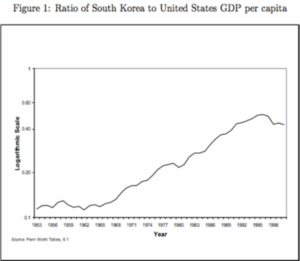
Protection, however, proved to be a very counterproductive measure for fostering economic growth. Those countries, such as South Korea, that dismantled their protection and provided a more level playing field for the production of import-competing and exportable goods alike found that their growth rates accelerated to astonishingly high levels. By the end of the twentieth century, QRs [quantitative restrictions on imports] and industrial policy were almost entirely abandoned.


DBx: It’s no coincidence that when South Korea greatly liberalized its trade in the mid-1960s, South Korea’s rate of economic growth rose.

{ 0 comments }

On Rising American Living Standards

In my latest column for AIER I again argue that it’s simply untrue that Americans’ living standards haven’t improved enormously over the past half-century. Two slices:

Start with what is perhaps the single most important feature of living standards, namely, the amount of time we live to enjoy those standards. Life expectancy has risen. Life expectancy today is three percent longer than in 2000, five percent longer than in 1990, eight percent longer than in 1980, 12 percent longer than in 1970, and 13 percent longer than in 1960.

In light of this happy trend it’s no surprise that the percentage of the US population who are age 100 and older is today (2020) 78 percent larger than in 2000, twice as large as in 1990, 4.2 times larger than in 1980, 6.3 times larger than in 1970, and 8.3 times larger than in 1960.

Because life expectancy rises when wealth increases, Americans’ rising living standards are not only themselves a component of wealth, they also reflect Americans’ rising wealth.

…..

Today, the average floor size of a new single-family home is 2,408 square feet. The floor size of this home is 6.3 percent larger than that of a new single-family home in 2000 (the year before China joined the World Trade Organization). It’s 16 percent larger than in 1990 (four years before the North American Free Trade Agreement was launched), 38 percent larger than in 1980 (five years after America last ran an annual trade surplus), 61 percent larger than in 1970, and 90 percent larger than in 1960.

This positive trend is even more impressive when accounting for the fall in the number of people who live in the average American household. Today, each resident of that household has 11 percent more square feet of living space than did a resident of an average new single-family home in 2000, 22 percent more space than in 1990, 53 percent more space than in 1980, 102 percent more space than in 1970, and 149 percent more space than in 1960.

I’m unable to find reliable data on the cubic footage of the average American home, and of how this measure has changed over time. (If you know of a source of such data, please share that source with me.) I’m willing to bet (literally!) that the average US home today not only has more square footage than it did in the past — say, in 1975 — but also more cubic footage.

{ 0 comments }