≡ Menu

Some Non-Covid Links

Art Carden celebrates Gordon Tullock’s birthday. A slice:

Every year, Tullock was still considered one of the favorites for the [Nobel] prize. He had been passed over for his contribution to the development of public choice, but his path-breaking research on what came to be known as the theory of rent-seeking deserves the prize in its own right. Tullock’s 1968 [DBx: 1967] article “The Welfare Costs of Tariffs, Monopolies, and Theft” paved the way for a new understanding of how resources are used in political processes. In 1974, the economist Anne Krueger would coin the term rent-seeking to describe spending in pursuit of a fixed pie. Their insight is insufficiently recognized in public and popular discussions of the political process even today. Lost consumer surplus–the reduction of output to a point where the marginal benefit is greater than the marginal cost, meaning that there are unexploited gains from trade–is not the only cost of tariffs, monopolies, and theft. The resources invested in getting the policies are wasted, as well.

Here’s David Henderson on Ezra Klein’s recent New York Times op-ed on how the goings-on in California are making Progressives squirm.

Biden is separating families at the border. Billy Binion asks “Where’s the outrage?”

My colleague Pete Boettke shares this interesting talk on economic growth by Ricardo Hausmann.

Juliette Sellgren talks with Brian Riedl about the federal budget.

Tunku Varadarajan talks with Shelby Steele. A slice:

Americans look at statistics and disparities and many think “there’s another explanation for inequality other than racism,” Mr. Steele says. “Inequality may be the result of blacks not standing up to the challenges that they face, not taking advantage of the equality that has been bestowed on them.” He points to affirmative action and diversity—“the whole movement designed to compensate for the fact that blacks were behind”—and says that blacks today have worse indices relative to whites in education, income levels, marriage and divorce, or “any socioeconomic measure that you want to look at” than they did 60 years ago.

Wall Street Journal columnist Holman Jenkins mourns the intellectual and ethical disintegration of the New York Times. A slice:

The element that really sings institutional cowardice isn’t the firing or flip-flopping, but the apparent need to extort a North Korea apology from Mr. McNeil as he left. “I thought the context in which I used this ugly word could be defended,” he conceded probably on the advice of his bank manager. “I now realize that it cannot.”

William Jacobson exposes the cancerous “critical race theory” that is destroying so-called “higher education.”

{ 0 comments }

Some Covid Links

Noah Carl provides further evidence that Covid-19 is indeed seasonal. A slice:

Bishop’s criticisms of the Imperial College model are well-taken. In the remainder of this essay, I want to present additional evidence for the seasonality of COVID-19. Before looking at studies that deal specifically with COVID-19, it is worth mentioning that other human coronaviruses are known to be seasonal, with the peak of infections occurring in February (in the northern hemisphere). As one recent study – which analysed eight years of data on a cohort in Michigan – concluded, “Coronaviruses are sharply seasonal”. Hence it would be somewhat surprising if COVID-19 didn’t behave in the same way.

Ethan Yang decries the devastation that Covid lockdowns inflict on the world’s poorest people.

British MP Charles Walker continues to champion good sense and freedom over Covid hysteria and tyranny.

Peter Hitchens is rightly angry that the British government took the reckless, destructive, and tyrannical advice of the Imperial College’s Neil Ferguson rather than follow the advice that that government itself in 2011 had formulated carefully and not while infatuated with police-state tactics. Here’s Hitchens’s opening:

Supporters of strangling the country always demand ‘What would you have done?’ if I dare to criticise the Government’s wild, unprecedented policy for dealing with Covid.

They assume, as backers of crazy policies always do, that there is no alternative to mass house arrest, enormous police powers, Maoist travel bans and the crippling of large parts of the economy.

Well, there is an alternative. Sitting in the Government archives is a 70-page document called UK Influenza Pandemic Preparedness Strategy 2011. Don’t be put off by that ‘influenza’. The plan could easily be adapted to deal with a coronavirus or any similar threat.

Agreed by all four governments of the UK, it was revised after the 2009 H1N1 influenza pandemic. It is typical of careful, commonsense UK state planning before the hysteria outbreak of March 23, 2020.

The longest three weeks in history.”

Kylee Zempel’s justified fury at the push for double-masking is expressed eloquently and effectively. Three slices:

Continuing the trend of Babylon Bee headlines being prophetic, Twitter on Monday decided to promote a Quartz article about “Why it’s time to start double masking.” Just like clockwork, the CDC on Wednesday decided to add double masking to its COVID-19 guidance.

…..

In fact, if we care about science, we’ll stop letting the same people who have tanked our economy, kept our kids home from school, and banished us from churches dictate our lives for one more minute. So much of the nonsense that has poured out of their mouths, over the airwaves, and into our homes and institutions these past many months has proved to be utter hogwash — about masks, “flattening the curve,” nursing homes, schools, “essential” versus “nonessential” businesses, the vaccine, and getting “back to normal.” The rules served corporatists’ interests, not public health or the general welfare.

They told us Costco was safer than the ballot box. They said Gov. Andrew Cuomo, who sent COVID-19-positive patients into nursing homes as superspreaders among the most vulnerable, was an exemplary leader. They said mass protests and riots were OK but worship was reckless. They ignored science to please teachers unions, told you to stay in your house for the holidays then jetted off to their vacation homes, and said mask up to save lives — lying even about the efficacy of masks.

…..

That regime, however, doesn’t deserve your allegiance. It derives its power not from truth and science but from the capitulation of the panicky masses. Don’t cave to the bullies who will undoubtedly scream that you’re a science-denier if you refuse a second mask. Tomorrow, they’ll be shouting that you’re a murderer because you won’t slap a third swatch of fabric over your mouth. The more the better, right? There’s no limiting principle; we know how this goes.

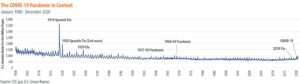
Spot the pandemic year.

What’s that about the wonders of New Zealand’s successful response to the coronavirus?

{ 0 comments }

Quotation of the Day…

… is from page 137 of Vol. 1 of the 1980 printing of the marvelous 1945 Knopf edition of Alexis de Tocqueville’s brilliant work Democracy in America:

It is impossible to consider the ordinary course of affairs in the United States without perceiving that the desire to be re-elected is the chief aim of the President; that the whole policy of his administration, and even his most indifferent measures, tend to this object; and that, especially as the crisis approaches, his personal interest takes the place of his interest in the public good.

{ 0 comments }

Here’s a letter to Bloomberg:

Editor:

In “The Burger Flipper Who Became a World Expert on the Minimum Wage” (Feb. 3), Peter Coy equates the losses that some workers suffer as a result of minimum wages with the costs that some workers pay as a result of free trade.

This comparison is inapt. For many reasons, the losses from minimum wages differ categorically from the costs of free trade. The most fundamental of these reasons is that free trade is simply the absence of artificial restraints on peaceful commerce while minimum wages are the imposition of such restraints.

To better see the relevance of this distinction it’s helpful, when discussing trade, to replace “foreigners” with “blacks.” Would any right-minded person believe that the elimination of Jim Crow restraints on Americans’ ability to conduct commerce with blacks created losers who deserved special consideration, and perhaps compensation, because they lost some particular jobs to blacks? Of course not. For the same reason, workers who lose particular jobs to foreigners as a result of free trade deserve no special consideration or compensation.

Trade across national boundaries is identical, economically, to trade within national boundaries. And because in competitive economies jobs are incessantly being destroyed as others are created – with only a fraction of this job churn in the U.S. caused by international trade – to single out those individuals who lose jobs to imports as if they are categorically distinct from the many other workers who lose jobs because of economic competition is economically mistaken and ethically improper.

What is not mistaken or improper is to single out and take pity on workers who lose jobs to minimum-wage legislation. Such legislation coercively prevents low-skilled workers from increasing their employment prospects by offering to work at wages below the minimum. These workers are stripped of a human right. These workers lose jobs not as a result of the rightful operation of competitive markets. Instead, they lose jobs because they are denied their full rights to compete for jobs.

Sincerely,
Donald J. Boudreaux
Professor of Economics
and
Martha and Nelson Getchell Chair for the Study of Free Market Capitalism at the Mercatus Center
George Mason University
Fairfax, VA 22030

{ 0 comments }

Some Non-Covid Links

Glenn Loury speaks some unspeakable truths about racial inequality in America. A slice:

Or, consider the educational achievement gap. Anti-racism advocates, in effect, are daring you to notice that some groups send their children to elite colleges and universities in outsized numbers compared to other groups due to the fact that their academic preparation is magnitudes higher and better and finer. They are daring you to declare such excellence to be an admirable achievement. One isn’t born knowing these things. One acquires such intellectual mastery through effort. Why are some youngsters acquiring these skills and others not? That is a very deep and interesting question, one which I am quite prepared to entertain. But the simple retort, “racism”, is laughable—as if such disparities have nothing to do with behavior, with cultural patterns, with what peer groups value, with how people spend their time, with what they identify as being critical to their own self-respect. Anyone actually believing such nonsense is a fool, I maintain.

And here are George Leef’s reflections on Glenn Loury’s speech.

I can’t wait to read Bryan Caplan’s next book, Poverty: Who to Blame?

Scott Lincicome worries that Biden will repeat Trump’s mistakes on trade policy. Here’s his opening paragraph:

The New York Times yesterday provided an in-depth look at the Biden White House’s plans to “transform the economy” through “dramatic interventions to revive U.S. manufacturing” – heavy on economic nationalism, industrial planning, and manufacturing jobs. If that approach sounds familiar, it should: it’s essentially the same gameplan that Biden’s predecessor used, with the only major difference being Biden’s emphasis on “green” industries like wind turbines, as compared to Trump’s love of steel and other heavy industry.

Eric Boehm wonders why Janet Yellen suddenly sounds like Trump on trade. (Any economist who remotely sounds like Trump on trade has seriously lost his or her way.) Here are two slices from Eric’s essay:

The best explanation, of course, is that Yellen is just trying to be a team player here. The Biden administration has signaled that it is unwilling to make a sharp break with Trump’s trade policies, likely because the White House sees domestic political benefits of talking about protectionism. Biden’s first major trade policy moves were the announcement of a “Buy American” plan for federal procurement that will force taxpayers to pay higher prices for goods the government buys, and the reimposition of tariffs on aluminum imported from the United Arab Emirates. Neither of those things should be expected to do much to boost American manufacturing, but both will marginally increase costs and complicate some of those global supply chains that Yellen knows are key to ongoing economic growth.

…..

Furthermore, the decline of manufacturing as a share of the whole American economy has been more or less on a steady downward march since the end of World War II. This isn’t a crisis created by the rise of China or the creation of the World Trade Organization (WTO) in 1995.

Cato’s Chris Edwards isn’t buying the argument that state governments need more bailout money from Washington.

Also from Chris Edwards is this post on minimum-wage legislation. A slice:

Yesterday, the CBO estimated that a minimum wage increase would eliminate 1.4 million jobs. Entry level workers would be hard hit. Milton Friedman noted that the “minimum wage law is most properly described as a law saying employers must discriminate against people who have low skills.

David Henderson shares Audrey Redford’s eloquent statement against qualified immunity for police officers.

Ben Klutsey talks with Virgil Storr about liberalism and markets.

Ron Bailey wonders if Biden will follow the science on GMOs.

Speaking of Ron Bailey, here’s Juliette Sellgren speaking with Ron Bailey about human progress.

{ 0 comments }

Some Covid Links

The Canadian Medical Association Journal reports the finding that the risk of dying from Covid-19 is 3.5 times higher than is the risk of dying from the flu. A slice:

We can now say definitively that COVID-19 is much more severe than seasonal influenza,” says Dr. Amol Verma, St. Michael’s Hospital, Unity Health Toronto, and the University of Toronto. “Patients admitted to hospital in Ontario with COVID-19 had a 3.5 times greater risk of death, 1.5 times greater use of the ICU, and 1.5 times longer hospital stays than patients admitted with influenza.”

These findings are similar to study results recently reported in France and the United States.

(DBx: Is the level of hysteria over Covid-19, which is vastly more than 3.5 times higher than is the level of concern over the flu, justified? What principles of ethics justify the vast increase in government power and the tyrannical lockdowns given that Covid is 3.5 times more likely to kill than is the flu? What principles of economics justify these over-the-top reactions? Since March we have upended society with unprecedented restrictions on human behavior. The media have frightened us with ‘reports’ of a disease that borders on the existential. Many scientists have allowed – indeed, encouraged – science to become politicized in the name of protecting society from a disease that is 3.5 times more likely to kill than the flu.

Three-and-a-half times more likely to kill than the flu is significant. But humanity’s reaction to Covid is derangedly disproportionate – a fact only strengthened when the age distribution of Covid’s victims is taken into account. Why did so few people stand with stalwarts such as Bryan Caplan and refuse to be stampeded by this madness?)

Alberto Giubilini pushes back against the insulting mantra that “We’re all in this together.” A slice:

COVID-19 did not put us in it together. That slogan is a legacy of the initial uncertainty around the virus. In February-March 2020, we knew very little about it and we thought it was way more dangerous and lethal across all population groups. We now know COVID-19 is a serious threat to the elderly and certain vulnerable groups. But to young people, it is not (that is, if we look at the data, not at individual stories). The mortality rate is estimated to be below 0.1% in the under 40s, to double approximately every eight years, and to rise above 5% in the over 80s. The mortality rate of COVID-19 in children is comparable to that of chickenpox, that is, almost non-existent. “Long-covid” is often invoked to justify restrictions also for the young, but it has a similar pattern to mortality rates: the risk is low for the young and increases with age. This does not mean that COVID-19 is a made up problem or that we should not take it seriously. But it does mean that it is a very serious threat for a limited portion of the population.

So we are not in it together because of the virus. Blaming the virus for the costs imposed by restrictions is wrong, although it is not uncommon. For example, when the BBC asks “How has coronavirus affected mental health?”, it should really be asking how restrictions have affected mental health.

Matt Welch decries the politicized ‘science’ that’s at the root of the CDC’s new school reopening stay-largely-closed-and-unable-to-educate guidelines. Here’s his opening paragraph:

It’s an excellent afternoon to be a treasurer for a private school, or an accelerationist seeking to hollow out public support for the government-run education system.

On the many problems with the CDC’s school-reopening guidelines see also this Washington Post op-ed by Joseph G. Allen and Helen Jenkins. A slice:

The CDC emphasizes hand-washing, which is great, but it overemphasizes cleaning. There isn’t a single documented case of covid-19 transmission through surfaces, so why is the CDC emphasizing things such as cleaning outdoor playground equipment that have no bearing on exposure or risk?

John Tamny asks: “Would You Support the Lockdowns If It Meant Losing Your Own Job?”

It’s been years since I last visited Helen, GA. Time to revisit.

If Australia’s response to Covid is accurately described as successful, then I hope never to be a beneficiary of such a successful approach.

Lockdowns are sinister.

{ 0 comments }

Quotation of the Day…

… is from page vi of the 2002 Dover Publications edition of the 1896 English-language translation – The Crowd: A Study of the Popular Mind – of Gustave Le Bon‘s 1895 La psychologie des foules:

Every conclusion drawn from our observation is, as a rule, premature, for behind the phenomena which we see clearly are other phenomena that we see indistinctly, and perhaps behind these latter, yet others which we do not see at all.

{ 0 comments }

Is Economic Theory Worthless?

Here’s a letter to economics educator Elaine Schwartz:

Elaine:

Thanks for including me on the mailing list for your Econlife series. Your series is very good.

I can’t resist, though, commenting on the quotation that you shared today from Nobel laureate economist Eric Maskin on the proposal to raise the federal minimum wage to $15 per hour. Asked by surveyors at Chicago’s Booth School of Business if “A federal minimum wage of $15 per hour would lower employment for low-wage workers in many states,” Prof. Maskin replied that he’s “uncertain.” The reason he gave for his uncertainty is this: “An increase to $15/hour is a big jump, and I’m not sure we have the data to know what the effect on employment would be.”

Prof. Maskin’s response makes me weep for my profession. If economic theory does not allow us to predict the general effects on employment of a 107 percent increase in the minimum wage, then economic theory is worthless. Why develop, learn, and teach economic theory if, in the face of such a big jump in the minimum wage, we must nevertheless wait to see whether or not any negative impacts on the employment of low-wage workers are revealed by the data?

I for one don’t believe that economic theory is worthless. I for one reject what so many other economists today apparently embrace – namely, the notion that the only role of the economist is to report on “the data” and to otherwise remain mute.

It’s dismaying that an economist as prominent as Prof. Maskin evidently has no idea that more than doubling the hourly wage will reduce employers’ demand for low-skilled workers.

Someone might defend Prof. Maskin by noting that – as Deirdre McCloskey, Richard McKenzie, and, most recently, Jeffrey Clemens have correctly argued – employers can respond to a rise in the minimum wage in ways other than by employing fewer workers. Employers can instead, for example, reduce the number of hours workers work, scale back fringe benefits, or increase jobs’ onerousness.

All true. Yet it’s impossible for me to believe that such a gargantuan hike in the minimum wage will play out in all ways other than in job losses. But even if I’m mistaken, if Prof. Maskin had these other negative consequences of minimum wages in mind, he surely would have mentioned them in his comment.

Again, if we economists truly cannot know, until we are told by the data, the general impact that a 107 percent increase in the minimum wage will have on the employment prospects of low-skilled workers, we ourselves are as devoid of advanced, worthwhile skills as are the workers who will be cast into the ranks of the unemployed when the minimum wage is raised.

Sincerely,
Don

{ 0 comments }

Some Covid Links

Mark Perry, on Facebook, shares this picture of Covid-19 in historical perspective:
David Campbell explains why the U.K. government ought to, but will not, abandon lockdown. A slice:

When the UK Government became aware of the Covid-19 virus, it was obliged to make a decision with extremely imperfect knowledge. In part the imperfection was of knowledge of the organism itself. Though knowledge of human coronaviruses has accumulated over more than 50 years, Covid-19 was very likely only recently existent and certainly only recently known to UK and worldwide epidemiology. But much more important was the imperfection of knowledge of what sensibly could be done. A policy aimed at the entire population was from the outset bound to impose burdens on the Government’s capacity to formulate in detail and implement a policy unprecedented in the history of the modern state. All that could be said at the outset was that the costs of such a policy would be immense, certainly greater than those of any other peacetime policy ever adopted.

Such a policy was nevertheless adopted, largely on the basis of the claim that it was extremely desirable as it would avoid huge illness and loss of life. I must make it clear that I believe the predictions of these effects were speculations of a familiar, alarmist type, since given public credence by statistical reporting and other official information that is worse than worthless.

Glen Bishop is willing to put his money where his mouth is when exposing yet more bad science produced by the Imperial College. Will Neil Ferguson do the same? A slice:

The Imperial college model is a thing of mathematical beauty. It is intricate and complex enough that no mere MP would dare try to question the details of it. But no matter how good a scientific model looks, and how hard the theory and coding behind it is to grasp, if the fundamental assumptions are wrong it will not work. When Einstein simplified general relativity, he is quoted as saying: “everything should be as simple as possible, but no simpler”. The above is a simple analysis of the data over the last 12 months from an undergraduate maths student. If Professor Ferguson wants to wager whether there will be a significant surge of coronavirus fatalities between June and September this year, I will happily put all the student loan I have saved in lockdown on him being wrong.

For those of you who continue to trust government officials with discretionary power to ‘manage’ a pandemic, Reason‘s Scott Shackford offers a report that you might wish to consult.

Janet Menage, M.D., from Wales has this letter in the BMJ:

Dear Editor

History is littered with examples of the atrocities which ensue when doctors abandon their traditional principles and judgement in favour of unquestioning subservience to government diktat – medical involvement in torture, human experimentation and psychiatric punishment of political dissidents being familiar examples.

Abbasi takes as axiomatic that there was no prior immunity in the population, that lockdowns are effective, that computer modelling is realistic, that statistics have been accurate and that WHO statements are reliable. All of these parameters have been widely challenged by knowledgeable and conscientious researchers whose findings were often disregarded, censored or vilified.

From a medical perspective, it was clear early on in the crisis that disregarding clinical acumen in favour of blind obedience to abnormal ventilation measures, reliance on an unsuitable laboratory test for diagnosis and management, and abandoning the duty of care to elderly hospitalised patients and those awaiting diagnosis and treatment of serious diseases, would create severe problems down the line.

Doctors who had empirically found effective pharmaceutical remedies and preventative treatments were ignored, or worse, denigrated or silenced. Information regarding helpful dietary supplements was suppressed.

This was further compounded by rule-changes to death certification, coroners’ instructions, autopsy guidelines, DNR notices and the cruel social isolation policy enforcement regarding family visits to the sick and dying.

When medical professionals allow themselves to be manipulated by corrupt politicians and influenced by media propaganda instead of being guided by their own ethical principles and common sense based on decades of clinical experience, the outlook becomes very bleak indeed.

Historically, public respect for and trust in doctors has exceeded that awarded to politicians. The unquestioning capitulation of medicine to an authoritarian executive and predatory corporate power may have undermined the doctor-patient relationship for a generation.

Those of you who continue to doubt that unchecked fear of Covid – and silence in the face of the resulting hysteria – leads to top officials seriously proposing policies that are absolutely inimical to a free society, check out this paragraph from a recent report in the Daily Mail:

It came after SAGE expert Professor John Edmunds told ITV’s Peston that most curbs on daily life — which may include the Rule of Six — are likely to be in force until the end of this year, while less restrictive curbs — like face mask wearing on public transport and indoors — could possibly be in place ‘forever’.

The great Lionel Shriver protests the tyranny she is now living under in Great Britain. A slice:

So it’s worth asking just how fortunate those Aussies and Kiwis really are. They can’t leave either. A foreigner would have to be a complete idiot to visit. Some 40,000 nationals are stranded abroad, many unable to afford the quarantine back home. The son of a close friend in London lives in New Zealand, and who knows when the family will be united again? The aviation, tourism and hospitality industries have been devastated. Most crucially: yeah, these countries have sealed themselves off from a world teeming with slime and impurity. But once hermetic restrictions are in place, how do you ever lift them? Wouldn’t ever opening up make all your sacrifices for naught?

“Mindless lockdowns destroy lives — and our Constitution” – so write John Yoo and Scott Atlas.

Texas boy, 12, hangs himself after battling depression amid COVID-19“. (An anecdote? Yes. Do children commit suicide in times other than Covid? Yes. Might this young boy’s mental condition have been such that he’d have hung himself even had there never been lockdowns? Yes. But if the pro-lockdown crowd treats individual deaths attributed to Covid as evidence of the need for lockdown, then it’s fair to treat individual deaths attributed to lockdown as evidence of the need to end all lockdowns.)


{ 0 comments }