≡ Menu

Bonus Quotation of the Day…

… is from page 215 of George Will’s magnificent 2019 book, The Conservative Sensibility (footnote deleted):

Conservatism has no more urgent task than that of convincing the country that judicial deference often is dereliction of duty, and that an energetically engaged judiciary is necessary lest, in Justice Robert Jackson’s words, “the lights go out.”

DBx: Indeed (although what George Will calls “conservatism” is what I call “liberalism”).

…..

Pictured above is U.S. Supreme Court Associate Justice Stephen J. Field. Nominated in 1863 for the Supreme Court by President Abraham Lincoln, Field was one of the finest jurists ever to serve in that body.

{ 0 comments }

Sounds Like Something Out of an Ayn Rand Novel

Here’s a letter to someone in California who apparently believes that economic reality is optional:

Mr. Víctor Sánchez, Director
Long Beach Coalition for Good Jobs and a Healthy Community

Mr. Sánchez:

You call “shameful” the decision by Kroger to close stores in Long Beach after the City Council there ordered certain supermarkets to raise the hourly pay of some workers by $4 (“Kroger to close 2 California stores instead of giving $4 hourly ‘hero pay’”). This decision by Kroger, you allege, will “deny their workers the compensation they deserve.”

Put your money and action where your mouth is. If these workers really are worth employing at the wage mandated by the City Council, you should have no trouble convincing investors to back you in efforts to buy Kroger’s Long Beach facilities in order for you to keep these operating as supermarkets that pay wages as high as those ordered by the City Council.

If, however, you’re unwilling to make this effort, then your talk is cheap. No one has any reason to trust that you actually believe that the workers who you pose as championing really deserve a $4 per hour raise.

Sincerely,
Donald J. Boudreaux
Professor of Economics
and
Martha and Nelson Getchell Chair for the Study of Free Market Capitalism at the Mercatus Center
George Mason University
Fairfax, VA 22030

For alerting me to this story I thank J. Nellis.

{ 0 comments }

Some Covid Links

The tyranny tightens. (But we’re assured that it’s for our own good. And our government would never so assure us if that assurance weren’t based in fact. So there’s nothing to worry about, right? Right?)

Jordan Davidson reports on recent remarks by Stanford professor Dr. Jay Bhattacharya. A slice:

“I’ve come to think of it as trickle-down epidemiology. We’ve used the lockdowns to protect the rich, whereas we essentially expose the — like in California for instance, it’s the poor areas that have had the high death rates from COVID. The lockdowns haven’t protected people living in places where there’s high poverty,” Bhattacharya said on “The Megyn Kelly Show.” “Minority populations, especially Hispanics, have been hard hit. Fifty percent of people who have had COVID deaths are Hispanic in California.”

Julius Ruechel exposes the immorality of Covid-19 lockdowns. A slice:

Lockdowns during COVID pose the exact same question as the Bystander at the Switch. But it’s not a game; once again there are real lives at stake. Yet in direct violation of the principles of universal human rights, governments around the world are choosing to pull the switch by imposing lockdowns “for our safety.” In doing so they have given themselves the authority to play God with our lives.

Are you essential or non-essential? Each category now has different rights and freedoms and different levels of individual autonomy. Some have the right to earn a living. Others do not. Some have the right to choose how to balance the risks and priorities in their lives. Others do not. How can any job that feeds a family not be essential?

What about the collateral damage caused by lockdowns? Mandatory lockdowns are leading to the deaths of countless individuals through cancelled/delayed medical operations, suicides, drug overdoses, loneliness and isolation in nursing homes, and more. None of these deaths would happen without lockdowns. Government is throwing one group of people onto the tracks with the goal of saving another.

How much misery and suffering is government allowed to impose on other people “for your safety”? How many jobs is the government allowed to destroy “for your safety”? How many people will lose their homes “for your safety”? How many people will lose their life savings, have their marriages broken, suffer bankruptcy, lose their careers, have their children’s education irreparably damaged, or have their mental health destroyed because of actions taken by the government “for your safety”?

Amelia Janaskie, Jenin Younes, and Taleed Brown show us more faces of lockdown.

COVID-19 rarely spreads through surfaces. So why are we still deep cleaning?

Here’s more from Noah Carl on excess deaths in the U.K.

Mark Ellse exposes appallingly misleading reporting on Covid. A slice:

Yes, indeed. Every time comparison figures are given to us by the media or the government they use raw comparison figures, not Age Standardised Figures. This makes increases in death rate seem bigger than they actually are. As for the rise from 2019 to 2020, it is significant. But before deciding how significant, we need first to consider what death rate for 2020 we should have expected.

Hector Drummond argues that Sweden’s Covid numbers show that lockdowns are indeed criminal. A slice:

You will see that April 2020, supposedly the worst month for the world in hundred years outside wartime, in fact had lower deaths than about twenty other months in Sweden in just the last thirty years.

Most governments, scientists, and media outlets have inexcusably ignored these facts for over half a year, and when forced to look at Sweden they have continued to spin the line that Sweden is a charnel house.

Now, ten months since the Western world went mad, the overall figures for Sweden’s all-cause mortality for 2020 are available. And it is time we had a proper look at these figures and stopped taking this lunatic mania for lockdowns seriously.

I thank Lyle Albaugh for alerting me to this interview with Knut Wittkowski:

{ 0 comments }

Quotation of the Day…

… is from page 30 of the late, great UCLA economists Armen A. Alchian’s and William R. Allen’s Universal Economics (2018; Jerry L. Jordan, ed.); this volume is an updated version of Alchian’s and Allen’s pioneering earlier textbook, University Economics; at the end of each chapter, Alchian and Allen offered a list of brilliant questions, each with an answer; this quotation is from the “Questions and Meditations” section of Chapter 2:


What is nonsensical about the proposition, “A good economic system maximizes the welfare of the maximum number of people”?

Answer:


Only one quantity can be maximized subject to all others being held at specified levels. You can maximize the welfare of one person provided that the welfare of each of the other people is unchanged.

DBx: Yep.

The moment we admit into consideration the welfare of a second person who potentially interacts, directly or indirectly, with the first person, the literal maximization of the first person’s welfare is no longer ethically desirable. If maximizing the first person’s welfare were truly the goal, then the second person must disregard his or her own welfare and act exclusively as a means of assisting the first person to achieve maximum welfare. The second person, in effect, would be the first person’s slave.

Once the welfare of the second person is admitted to be desirable, we encounter the necessity of making trade-offs. Although very often cooperation of person one with person two enables both persons to increase their welfare, neither person gets all the gains from the cooperation. The gains are shared.

More generally, whenever there are multiple goals, to speak of maximization masks the necessity of trade-offs among these goals. Goal B can be achieved more fully only if we accept a less-full achievement of goal A, or of goals A and C.

If society were a single, sentient entity in the way that you are a single, sentient entity, it would be meaningful to speak of society making these trade-offs among all the many different goals in a way that results in maximum possible satisfaction (“maximum utility”) for society.

But despite much loose language and bad theorizing, society isn’t a single, sentient entity. Society, as such, has no mind, no preferences, no purposes. These are all had only by each member of society – a reality that isn’t altered one bit by the fact that cooperation among members of society enriches everyone. Nor is this reality altered by the fact that the preferences of each of us are heavily influenced by the details of the society in which we live. And nor is this reality altered by the fact that each of us cares what other people think about us and typically act accordingly.

This reality remains: Society, as such, has no mind, no preferences, no purposes. Talk of “maximizing social welfare” or “utility” thus misleads more than it enlightens. Such talk too easily leads to the conception of society as confronting challenges all of which can be “solved” in an engineering – in a scientific – manner.

Consider the current hysteria over Covid-19. Many people talk as if the goal is to maximize our protection from Covid. If this goal were real, then every action inconsistent with reducing anyone’s risk of suffering from Covid would be inappropriate. All action and all resources would be turned toward reducing humanity’s encounter with Covid. There would be no trading-off the benefit of any potential reduced risk of encountering Covid against the benefit from action that raises that risk.

But of course even those persons who are most fearful of Covid don’t fully act in this manner. I doubt that anyone sleeps in a Hazmat suit and refuses to remove the suit even to bathe. Each person makes trade-offs. And just as it is officious and illiberal for Jones to sit in judgment of the manner in which Smith trade-offs the benefits that he gets from exercising against those that he gets from lounging lazily, it is officious and illiberal for Smith to sit in judgment of the manner in which Jones trades-off the benefits she gets from taking steps to reduce her exposure to Covid against the benefits she gets from pursuing activities that raise her Covid risk.

Yes, yes, yes – I understand that whenever Jones takes actions that increase her risk of encountering Covid – or even refuses to take actions that reduce such risk – she thereby increases the risk that she will expose unwilling others to Covid. But while there has been some adult talk of the ability and responsibility of these others to protect themselves, such talk hasn’t featured prominently in the public debate over Covid. The overwhelming assumption – as revealed by the ignorant hostility to the Great Barrington Declaration – has been that the importance of having every person reduce his or her exposure to Covid, even on very small margins, is so great that government is entitled to force all of us to remain separated indefinitely from each other.

Maximizing the risk reduction from Covid-19 is now regarded by many people to be humanity’s chief goal, one that takes precedence over almost any other.

It’s madness. It’s a lethal obsession. It’s inhuman and inhumane. It’s contrary to the way that each of us lives our daily life. It’s Covid Derangement Syndrome.


{ 0 comments }

Resist the Hysteria and Tyranny

In my latest column for AIER, inspired by Henry Manne, I call for peaceful resistance to the misinformation being spread about Covid-19, and to the tyranny being unleashed in the name of ‘protecting’ us.

In late 1973 and early 1974 Henry decried the biased and uninformed reporting on the fuel shortages that then plagued America, and he called on people to resist the demands for the strict government controls that were then said by many in elite circles to be necessary to best deal with these shortages.

Today’s Covid-19 pandemic isn’t identical to the 1970s’ fuel shortages, but the two crises share with each other many parallels. In both, media reporting consistently missed important points and, in doing so, fueled (!) unwarranted panic. Worse-case scenarios were presented as likely outcomes. Elite opinion very quickly settled on the conclusion that key human liberties must be sacrificed indefinitely to government ‘leaders’ wielding discretionary powers in order to deal with an almost-existential scourge. Talk of society being at war against an insidious enemy was widespread. Unfathomably complex arrangements of human engagement were treated as if they are as simple as Lego structures that children build, can disassemble, and can easily rebuild. And evil-doers were said to be afoot whose misbehaviors – from negligence to intentional malfeasance – were making a bad situation worse. These evid-doers, thus, were accused of being threats to innocent other people.

In both instances, governments’ heavy-handed attempts to deal with each crisis made each crisis worse.

Yet there is at least one important difference separating these two crises from each other. Compared to the energy crisis of the 1970s, today very few prominent voices in the media and in high political circles are speaking out forcefully against the misinformation and the tyranny that this misinformation is believed to justify. Are people today more cowardly than they were nearly 50 years ago? Are people today more easily frightened by misinformation and misperception than they were back then? Are people today less willing than they were back then to speak out against the dominant narrative?

I remember well the cocksure predictions made by many elite voices of the horrors that would befall us Americans if energy price controls were abolished and we refused to alter our way of life. Fuel prices would skyrocket. Ordinary families would suffer grievously as they impoverished themselves simply to fuel their automobiles and to keep their homes warm during winter. We were even warned that if we refuse to adopt rationing and other strict controls and lifestyle changes that we’d soon find ourselves unable to get any affordable energy whatsoever. Failure to follow our leaders’ advice would spell doom for us all.

To this day I thank the memory of Ronald Reagan for eliminating, almost immediately after he assumed office at 1600 Pennsylvania Ave., all federal price controls on energy.

Here’s a slice from my AIER column:

Then as now, reality threw humanity a curveball. But instead of dealing with war-disrupted oil supplies intelligently and calmly, fear mongering by the media became de rigueur. For our own benefit and that of society, we little people must be reminded of the calamity that awaits us if we resist being regimented by our superiors.

{ 0 comments }

The Market Makes People Pay for Their Prejudices

As Art Carden notes, today is the 77th birthday of the great economic historian Robert Higgs. One of Bob’s many pioneering books is his 1977 Competition and Coercion: Blacks in the American Economy, 1865-1914.

I thought of Bob’s research and scholarship yesterday as I watched 42, the 2013 movie, starring Chadwick Boseman, about the baseball career of the great Jackie Robinson – who would yesterday have turned 102.

I don’t know if the scene depicted here is historically accurate or not. (This scene isn’t, at the link above at “42,” listed as being among the movie’s historical inaccuracies.) Either way, this scene does capture much of the manner in which market competition actually works to impose on bigots the costs of exercising their irrational prejudices. It depicts also the fact that many bigots, unwilling to pay those costs, change their behavior for the better.

It’s beautiful to behold!

Contrary to popular belief, such competition was at work in America during the late 19th and early 20th centuries, as Bob Higgs documents in his book. Indeed, the reality of such competition is what drove state and local governments during the Jim Crow era to forcibly impose racial discrimination by enacting Jim Crow legislation.

{ 0 comments }

Some Non-Covid Links

Art Carden celebrates Robert Higgs’s birthday. (Happy Birthday, Bob!) A slice:

This year is also the fiftieth anniversary of Higgs’s first book, The Transformation of the American Economy 1865-1914, a remarkable achievement for any scholar but made all the more impressive by the fact that it was published as Higgs was entering his late twenties. As he would spend his career doing, he took what “everybody” knew about exploitation, inequality, and Robber Barons during the late nineteenth and early twentieth centuries and showed that it was wrong. The book stands up well even five decades later.

In 1977, Higgs published a pathbreaking book on the economic history of race, Competition and Coercion: Blacks in the American Economy 1865-1914. Competition, Higgs argued, helped explain black economic advancement while coercion held them back.

In the Wall Street Journal, Barton Swaim reviews a few books about markets and morals – including a new edition of Milton Friedman’s 1962 classic, Capitalism and Freedom (reissued by the University of Chicago Press with a Foreword by someone who could not be more inappropriate, Binyamin Appelbaum). A slice:

I had never read “Capitalism and Freedom” and was renewed in my admiration for midcentury American reading audiences. The book, full of tightly reasoned arguments about the principles of economic freedom in various spheres of life, sold 400,000 copies in its first 18 years. The University of Chicago Press, which first published the book six decades ago, evidently would rather it stop selling. The new edition’s foreword is written by Binyamin Appelbaum, a member of the New York Times editorial board, who treats Friedman’s classic text as mildly interesting artifact. “Friedman’s claim that ‘widespread use of the market reduces the strain on the social fabric,’ ” Mr. Appelbaum assures us, “misapprehended the nature of society, which is more like a muscle than a fabric.” I await Chicago’s edition of J.K. Galbraith’s “The Affluent Society,” with a foreword by Larry Kudlow.

Arnold Kling reviews Kevin Vallier’s book, Trust in a Polarized Age.

Claude Barfield is understandably unimpressed with the Biden administration’s early moves on the trade-policy front.

J.D. Tuccille warns of the consequences of abandoning free speech. A slice:

Protections for free speech, it’s worth pointing out, aren’t some perfect counter to false and extreme ideas. Instead, they’re a recognition of core individual rights. But they’re also a pragmatic acknowledgment that putting government agencies in charge of suppressing misinformation just gives one team of bullshit artists an advantage over their less-powerful competitors.

Inspired by Ludwig von Mises’s 1944 book, Bureaucracy, Stefanie Haeffele and Anne Hobson warn against the false allure of top-down ‘solutions.’ A slice:

However, it is important to note that the lack of standards of determining bureaucratic success creates impassible problems for monitoring and managing the size of bureaucracy. For example, it is likely impossible to calculate whether an agency should have 500 employees or 50,000 and it is difficult to know whether agency services are too costly, and by how much. Because bureaucrats are not limited by considerations of financial success, superiors have to provide limitations in the form of rules and regulations. The mission of the bureaucrat is to serve the public, but the incentives point toward serving one’s supervisor and their preferences for implementing the agency’s goals.

My colleague Tyler Cowen warns against raising the minimum wage. A slice:

Or consider Treasury Secretary Janet Yellen. She supports the proposed hike, as she noted in her confirmation hearing last week, yet in 2014 she endorsed the view that a minimum wage hike would lead to significant job loss. Maybe now she knows better, but if the 2014 Janet Yellen could have been so fooled, then perhaps this debate is not so settled.

“You can’t count on governments to either ‘follow the economics’ or ‘follow the science,’ because their job is to follow the politics” – so writes Steve Horwitz.

{ 0 comments }

Some Covid Links

Joe Davis writes wisely about humanity’s irrational reaction to Covid-19. Two slices:

Our vision has narrowed like a microscope, focusing on one small thing and with no peripheral vision. Our minds are bent to a singular purpose: preventing death from a single cause. This is understandable to a point. A new and unknown threat holds the imagination hostage. The predator grabs the attention of its prey for a reason, and one can reasonably argue that we must deal with an imminent threat above all other dangers. But the dangers in a complex society are not so stark or simple as the perils of the savannah, where you are hunted only by the lion. Even there, the lion in front of you may be a mere diversion while another creeps up on you from behind. It is hard for us to assess which threat is most pressing, because the things most dangerous to us are often not the things we are paying attention to. There is a mass fixation at the moment on the thing we think we see in front of us, and we are tracking what we believe are its movements. But it is to the dangers outside our vision, that are not being tallied and charted in red before our eyes, and to all the things that we are ignoring, weakening, or destroying because we do not really see the use of them, that I find my attention unavoidably drawn.
…..
This puts me in mind of another angle on liberty worth considering. J.S. Mill would say that my liberty ends only where it causes harm to you. This may not be a bad rule of thumb, but it accounts only for the liberty to ‘do what I like’ (as long as it harms no-one), not, for example, the liberty to participate in public and social life, the liberty to help and nourish one another with presence and contact. Much of the freedom that has been taken away from us as individuals does not benefit only us, and its removal is anything but protective of others. My liberty to visit my mother is part of her protection against loneliness and despair. Your liberty to run a business with minimal interference is protection for your family against destitution, illness and poverty. Removal of personal liberties removes not only the liberties, it removes a delicate canopy of care and protection from an entire population.

Jeffrey Tucker reports on the New York Times‘s hysterical attitude about Covid. A slice:

For example, they have this category called “very high risk level.” Red is in the text. Scary! But what is it? It means 11 or more people per 100,000 have generated a positive PCR test for the coronavirus.

Not deaths. Not hospitalizations. Not even symptomatically sick. (Yes, I know the term “sick” is old fashioned.)

We are talking about 11 positive PCR tests. This is an infection rate of 0.01%. Consider too that the NYT reports that these tests in the past have generated up to 90% false positives.

The Science is Settled. Lefties are Fearful Scolds“.

Laura Perrins decries Boris Johnson’s cruelty. Two slices:

What Boris Johnson and his henchman are doing now is cruel and wicked. They have been aided and abetted by a propaganda media that rarely asks any tough questions, such as how accurate is the 100,000 Covid death figure, where are all the flu deaths, why did you empty the hospitals of Covid positive patients and put them in care homes, why are schools still closed when Public Heath England said it was safe to open after half term, and how many lives will be lost to lockdown conditions and recession conditions?

Pretty much every question from the media is, why didn’t you lock down earlier, and why didn’t you lock down harder? This is what counts as journalism these days, a false opposition interested only in pushing the government agenda and propaganda. What the media have done is to manufacture consent from the population for what is a needlessly cruel and wicked lockdown that we will never recover from.

…..

As I have always said, lockdowns fail on every test: they are immoral, they are unethical, they are disproportionate and they even fail on utilitarian grounds. They break families, they target the vulnerable, children and children with disabilities the most. Johnson has needlessly kept schools closed and dangled hope for reopening in the future, always the not-too-distant future that never seems to come.

If he and his henchmen followed the science they would see how damaging lockdown was. They would know how cruel and evil it was. But they don’t care. For some reason they are doubling down, probably to save their political lives and the propaganda media, many bought and paid for by the Tories, and their corporations are enforcing this wicked dictatorial regime and manufacturing the public’s consent.

Stanford University’s Jay Bhattacharya is a recent guest on the Hoover Institution podcast “Good Fellows.”

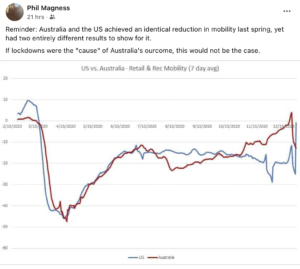
Here’s an important point from Phil Magness:

{ 0 comments }

Quotation of the Day…

… is from page 61 of Carlos Alberto Montaner’s 2000 essay “Culture and the Behavior of Elites in Latin America,” which is chapter 5 in Culture Matters, Lawrence E. Harrison and Samuel P. Huntington, eds. (2000):

But it is a quest for social justice that condemns the poor to permanent poverty – a true case of the road to hell being paved with good intentions.

DBx: This truth is especially important.

Intentions are not results. And, as Hayek argued, justice is an attribute of individual choices and relationships rather than something that society does or doesn’t collectively arrange and dispense.

As commonly used, the term “social justice,” with its lovely connotations and valence, is the name of the whole mix of social outcomes that those who use this term desire. And those who use this term invariably believe that their desired outcomes must be imposed with conscious direction by the state.

Are some workers paid less than social-justice advocates believe these workers deserve? Raise the minimum wage! Are some workers without paid leave? Have government arrange for such leave! Are some people poor? Redistribute income! Is income or wealth inequality too great? Redistribute income! Do some workers lose their jobs because fellow citizens choose to buy imports? Raise tariffs! Are some people unemployed? Have government guarantee employment! Are some people deeply in debt? Have government pay off these debts or simply declare the debts forgiven! Are some corporations currently quite large relative to other companies or relative to what someone’s imagination regards as ideal? Break them up or impose more proscriptions and prescriptions upon their activities! Do some people abuse drugs? Make such drugs illegal!

What could be simpler?!

Such thinking is appallingly simplistic, yet it is commonplace in elite circles no less – indeed, perhaps more so – than in non-elite circles. Such thinking is proudly endorsed by popes, politicians, pundits, and professors – all of whom believe that their good intentions carry the day, and none of whom bother to inquire with any depth into the actual consequences of the state actions that they endorse. These consequences typically are largely ill and outweigh whatever good outcomes are achieved by the state interventions.

{ 0 comments }

Bonus Quotation of the Day…

… is from page 57 of Robert Higgs’s brilliant 1971 book, The Transformation of the American Economy: 1865-1914 (footnote deleted; links added):

“Institutions,” Arthur Lewis has written, “promote or restrict growth according to the protection they accord to effort, according to the opportunities they provide for specialization, and according to the freedom of manoeuvere they permit.” In all these respects American institutions were basic to the initiation of economic growth and to its sustainment.

DBx: I add only – as I believe Bob Higgs would agree – that also at work in the U.S. was bourgeois dignity.

Lewis is correct. And note that his message is counsel against industrial policy. After all, industrial policy stymies some effort with special penalties in order to stimulate other effort with special privileges; it restricts opportunities for specialization only to those tasks that government officials and their think-tank muses somehow divine are acceptable; and it has as its essence restrictions on the freedom of economic actors to choose their own maneuvers.

…..

Pictured above is the late Nobel-laureate economist W. Arthur Lewis.

{ 0 comments }